Dive Brief:
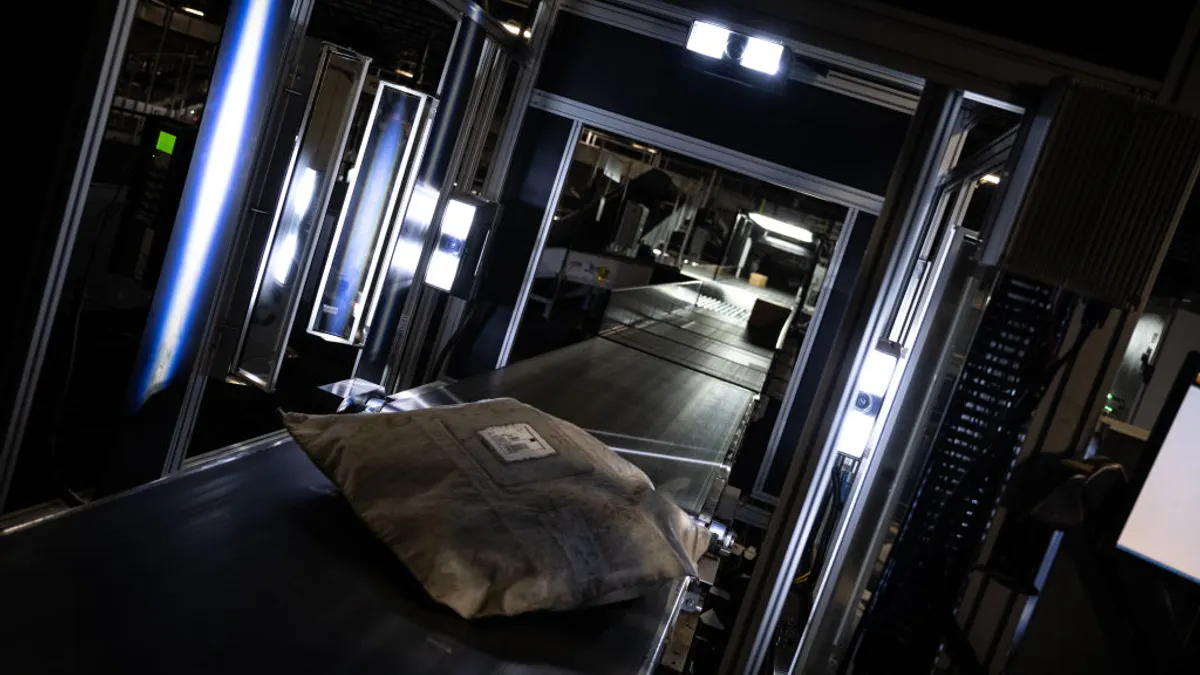
- UPS is expanding its use of RFID package sensing technology across its U.S. network, an undertaking aimed at increasing customer visibility and delivery reliability while reducing manual parcel scans, the carrier announced Tuesday.
- The expansion will include equipping the carrier's U.S. hubs with RFID sensors starting later this year, and rolling out RFID label printing capabilities for customers in 2026 and 2027, according to a UPS spokesperson.
- The RFID expansion will also allow UPS to eliminate nearly 20 million manual scans daily, the spokesperson said. The technology enables automatic sensing of shipments traveling past sensors embedded in its network. The company has been pushing to reduce manual processes within its operations as part of an ongoing network overhaul.
Dive Insight:
UPS has been using RFID to serve critical healthcare shipments for years, but lower costs for labels helped enable the expansion to serve a wider array of customers, said Michael Yoshida, UPS VP of product innovation and strategy, in an interview.
"We're starting with the U.S. segment, and as we expand this throughout this year and into next year, we will start to deploy internationally, with the goal of our entire network, almost every package being equipped with RFID," Yoshida said.
The expanded rollout adds to UPS' growing RFID capabilities – the carrier has already invested more than $100 million to develop and implement the technology in its network. UPS also places RFID labels on every package shipped in over 5,500 The UPS Store locations, and tag readers are embedded in all of UPS' U.S. package delivery vehicles.
As more customers are able to print RFID labels through the expansion, UPS vehicles will be able to provide an automated scan at pickup, offering improved visibility earlier on in the shipping process, according to Yoshida.
"In some instances, you're talking hours earlier, because [for] a larger shipper, we may be picking up several times a day," Yoshida said.
Ingram Micro, a technology products distributor, is one UPS customer leaning into the carrier's growing RFID capabilities. RFID offers information during a package's journey that can enable shippers to work more proactively with the carrier on potential issues, said Bill Ross, EVP of global operations and engineering at Ingram Micro.
Ingram Micro currently places RFID labels on all UPS-bound packages at its Texas warehouse, which handles over 28% of Ingram Micro's UPS volume, Ross said in an interview. Other Ingram Micro sites will go live with the technology later on.
"The focus is really getting the right data structures between Ingram Micro and UPS, so that we can layer AI over top of that to get shared learnings," Ross said, such as figuring out ways to mitigate delays or limit touches within UPS' processes.
Ingram Micro previously used FedEx for its parcel shipping needs before transitioning to UPS a few years ago, primarily due to UPS' "commitment on investing in RFID," Ross said. But FedEx has been making its own RFID-related strides. The UPS rival is testing sensors on select customers' packages and plans to scale deployment over time, helping improve information flows between shippers' supply chains and FedEx's operations, a FedEx executive told Supply Chain Dive earlier this year.