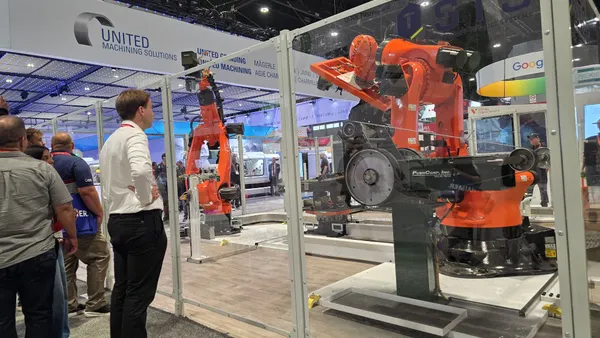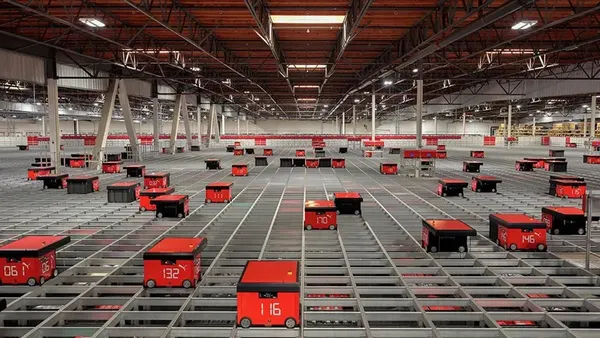
Warehouse robotics isn’t just about the physical hardware. Alongside the robots themselves, like Boston Dynamics’ Stretch or Knapp’s Pick-it-Easy, software is a critical piece of the puzzle for supply chain operators.
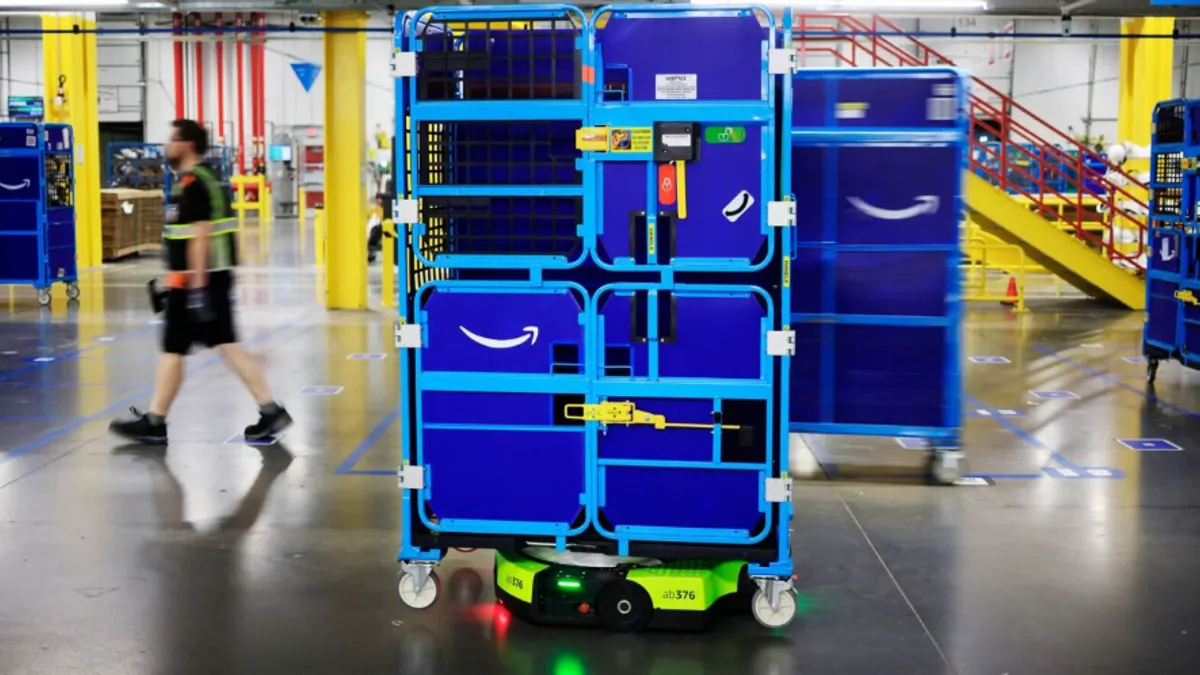
Take a pick-assist autonomous mobile robot, for example. At its base, it can work collaboratively with humans in a warehouse. By introducing software-directed labor capabilities to these systems, operators can direct the robots along the fastest routes for optimal efficiency.
This category of technology is referred to as “software robotics” or “software automation,” according to Brian Gaunt, VP of digitalization at DHL Supply Chain. The company, which is leaning heavily into robotics, knows that hardware is only one half of the investment equation.
“When we think of automation, we look at both sides,” Gaunt told Supply Chain Dive.
AI can make robots more adaptive
For companies utilizing warehouse robotics, the real competitive differentiator comes from how intelligently the systems are designed and orchestrated, according to Carla DeSantis, CPG and operations transformation leader at PwC US.
“The most successful strategies pair digital intelligence with physical automation to create more connected, adaptive systems,” Desantis said in an email.
Warehouse robotics include a wide spectrum of systems, some of which operate without AI and instead rely on structured, rule-based automation, according to supply chain technology company AutoStore. Automated guided vehicles, for example, use predetermined routes such as magnetic tape or lasers.
However, a report published by management consultant company PwC last year that surveyed more than 600 operations executive and supply chain officers showed 57% of respondents have integrated AI in some form, including as part of their warehouse robotics strategy. For example, Amazon is building a framework for its warehouse robots to communicate with humans using human language.
Others are taking a partnership approach to remove the need for in-house development.
Walmart, for instance, has teamed with Fox Robotics to deploy AI-powered autonomous forklifts, although the retail giant is developing its own AI tools as well. Meanwhile, some logistics providers are relying on technology vendors to enhance technology performance, such as GXO’s work with robotics developer Dexterity to use AI-powered tools to de-palletize, label and re-palletize packages.
The future of warehouse robotics is cognitive
The most tech-forward warehouse operators are designing environments in which physical robots act as “hands” while AI-powered software is “the brain,” according to DeSantis. Success lies in effectively connecting robotics, data and AI under uniform platforms to fuel these systems.
“The future of warehouse robotics isn’t purely physical; it’s cognitive. Machines will increasingly collaborate with AI systems that forecast demand, guide workflows, and manage exceptions autonomously,” DeSantis said.
However, it is a precarious time to strategize around technology investments, with many companies struggling to balance short-term needs with long-term strategic changes, according to the PwC survey. Meanwhile, many AI investments are meant to future-proof organizations, although some do address near-term pains, DeSantis said.
Ninety-two percent of respondents in the PwC survey reported that their technology investments haven’t fully met expectations, with 47% attributing the shortcomings to integration complexity. Going forward, the consultancy said companies should be aware that investing in AI tools may also require new architectures.