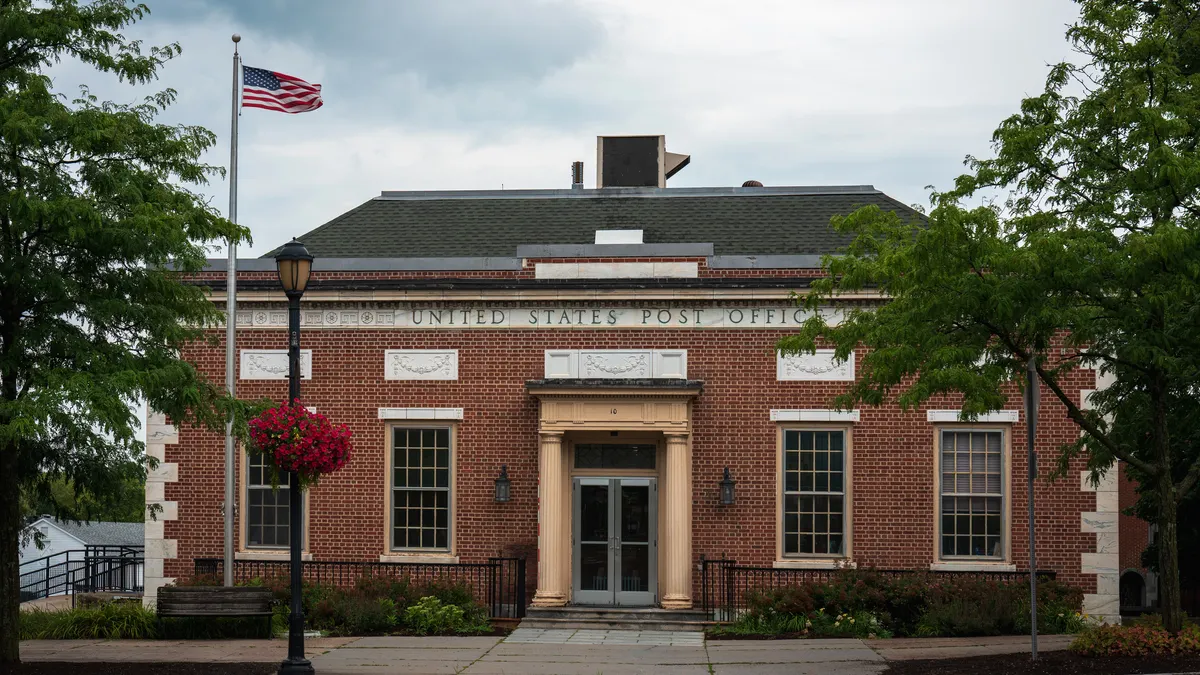
A transportation overhaul underway at the U.S. Postal Service has been a mixed bag for the agency's package delivery services in terms of on-time reliability, particularly for rural customers, according to a Sept. 8 report from the USPS Office of Inspector General.
The Regional Transportation Optimization initiative, or RTO, aims to consolidate volume dropoff and pickup activities at post offices more than 50 miles away from regional processing and distribution centers. The initiative adds an extra transit day for parcels originating from affected locations. By trimming the number of trips to and from more rural locations, the Postal Service has said it can save transportation costs and even speed up service for a portion of volume near major facilities.
The initiative is expected to eventually affect 72% of ZIP codes in the contiguous U.S., encompassing 48% of the population and 29% of outgoing package volume, per the report. As of May, the Postal Service has implemented RTO in about 64% of planned ZIP codes. Rural customers have been disproportionately impacted by the shift, while customers living near regional processing and distribution centers — generally around metropolitan areas — are seeing faster service, it added.
"Because of this disparity, the Postal Service risks losing customers who perceive the service as inequitable, which could harm its brand and reputation, and adversely affect revenue," the report said.
From October 2024 to April 2026, on-time delivery rates for services competing with FedEx and UPS — like Priority Mail and Ground Advantage — were lower on average for ZIP codes affected by the consolidation effort versus those that weren't, the report said. The exact percentages were redacted in the report.
However, following service standard changes in 2025 to align with the initiative, results differed by product, per the report. On-time delivery for Ground Advantage packages originating from RTO ZIP codes neared or slightly exceeded those from non-RTO ZIP codes, while Priority Mail packages from RTO ZIP codes fell further behind non-RTO ZIP codes.
Some states will feel the impact of RTO more than others. The report said all ZIP codes in Louisiana, South Dakota, Vermont, West Virginia and Wyoming will be subject to RTO, risking slower transit times.
"For example, First-Class Mail service standards in Vermont were extended from two to four days to send mail from one corner of the state to another, despite the state only being 157 miles long and 90 miles wide," the report said.
Postal Service management generally agreed with the OIG's findings in a response accompanying the report. Additionally, the agency is evaluating locations most impacted by its network overhaul for opportunities to improve delivery service.
RTO is part of larger USPS efforts to slash costs within its operations through its 10-year Delivering for America plan, which commenced in 2021 and has sparked on-time delivery challenges along the way. Since the plan's launch, the Postal Service has reduced overall transportation expenses by about $755 million, the report said.
Despite the large-scale shifts, "the financial position of the Postal Service has not improved, and the operational changes have coincided with service performance declines, with rural communities experiencing the most noticeable impacts," the report added. Postmaster General and CEO David Steiner has outlined improvements to on-time delivery and the agency's financial outlook among his priorities since he began leading the agency last year.
Editor’s note: This story was first published in our Logistics Weekly newsletter. Sign up here.