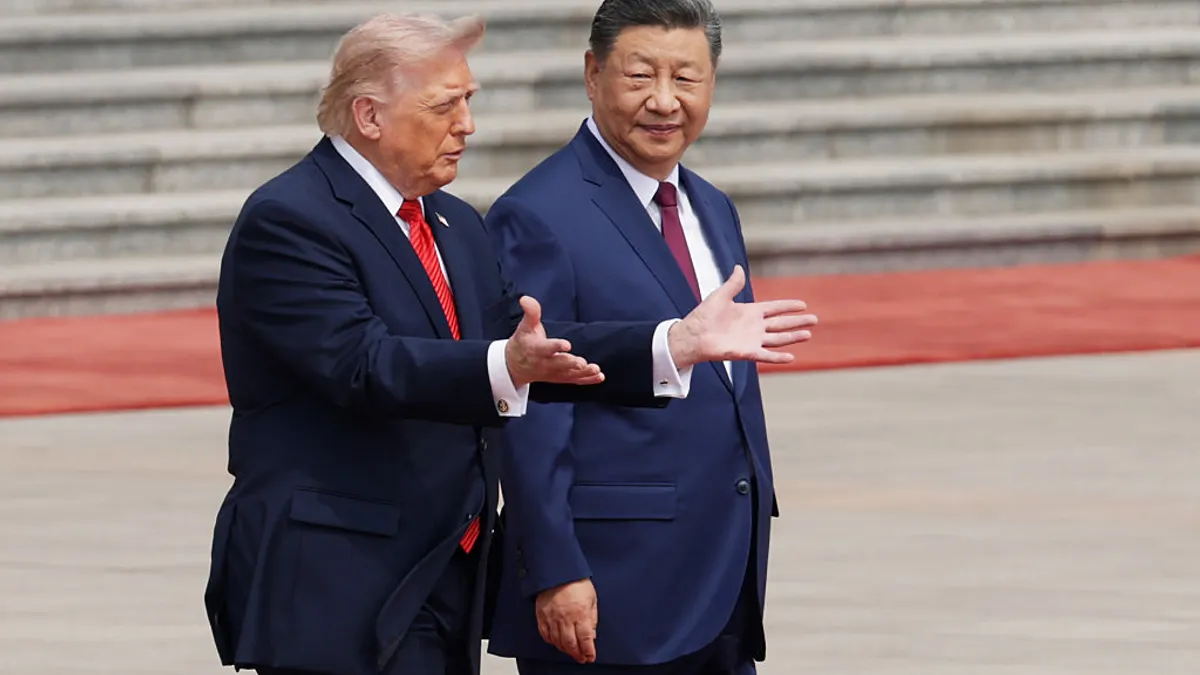
The United States and China reached a consensus on agricultural trade and other priorities during a meeting in Beijing between U.S. and China leaders and other officials.
As part of the arrangement, President Donald Trump and China President Xi Jinping will establish the U.S.-China Board of Trade and the U.S.-China Board of Investment, according to a White House fact sheet.
The Board of Trade will enable the U.S. government and China’s government to manage bilateral trade across certain goods. The Trade Council, China’s term for the board, will discuss topics such as tariff reductions on relevant products, agreeing “in principle” to reduce tariffs on certain goods, per a statement from a spokesperson for China’s Ministry of Commerce.
Both the U.S. and China also aim to resolve some non-tariff barriers and market access issues on agricultural goods.
The U.S. said it would work to address China’s concerns regarding dairy and aquatic products from China, alongside media-grown bonsai exports, according to a statement from China’s Ministry of Commerce.
Meanwhile, China agreed to purchase at least $17 billion of U.S. agricultural products throughout the rest of this year and into 2027 and 2028, according to the White House fact sheet. The deal is in addition to the soybean purchase commitments made in October 2025.
China also renewed more than 400 expired listings of U.S. beef facilities, and added new listings, restoring market access for U.S. beef, per the White House fact sheet. Further, China said it would work with U.S. regulators to lift the suspension of U.S. beef facilities.
Lastly, China also agreed to resume U.S. poultry imports that the U.S. Department of Agriculture believes are free of pathogenic avian influenza, according to the fact sheet.
Beyond agriculture, China will address U.S. concerns about rare earth and critical mineral supply chain shortages, including yttrium, scandium, neodymium and indium, per the White House fact sheet. Further, U.S. concerns over restrictions or prohibitions on the sale of rare earth production and processing equipment and technologies will also be addressed.
China also approved the purchase of 200 U.S.-made Boeing aircraft for China-based airlines, according to the fact sheet. Also in the aviation sector, the U.S. agreed to supply aircraft engines and related parts to China, per China’s Ministry of Commerce.
According to the White House fact sheet, both countries also called for the reopening of the Strait of Hormuz, which has been disrupted since the start of the Iran war in February — a major passage route for global oil supply. However, this part of the deal was not mentioned in China’s statement from the Ministry of Commerce, nor by its spokesperson.
The two countries aim to finalize the preliminary agreement outcomes “at an early date,” according to China’s Ministry of Commerce. Last week’s Trump-Xi meeting in China comes after months of trade negotiations and retaliations from both the U.S. and China.
In October 2025, the U.S. agreed to lower tariffs on imports from China as part of a broader trade truce, including a one-year pause in reciprocal tariffs. The pause is set to lift Nov. 10, 2026.
At the time, the U.S. said it would maintain certain Section 301 tariff exclusions until that same date. Earlier this month, the Office of the United States Trade Representative began a review of Section 301 tariffs on China imports established during the first Trump administration.