
Dive Brief:
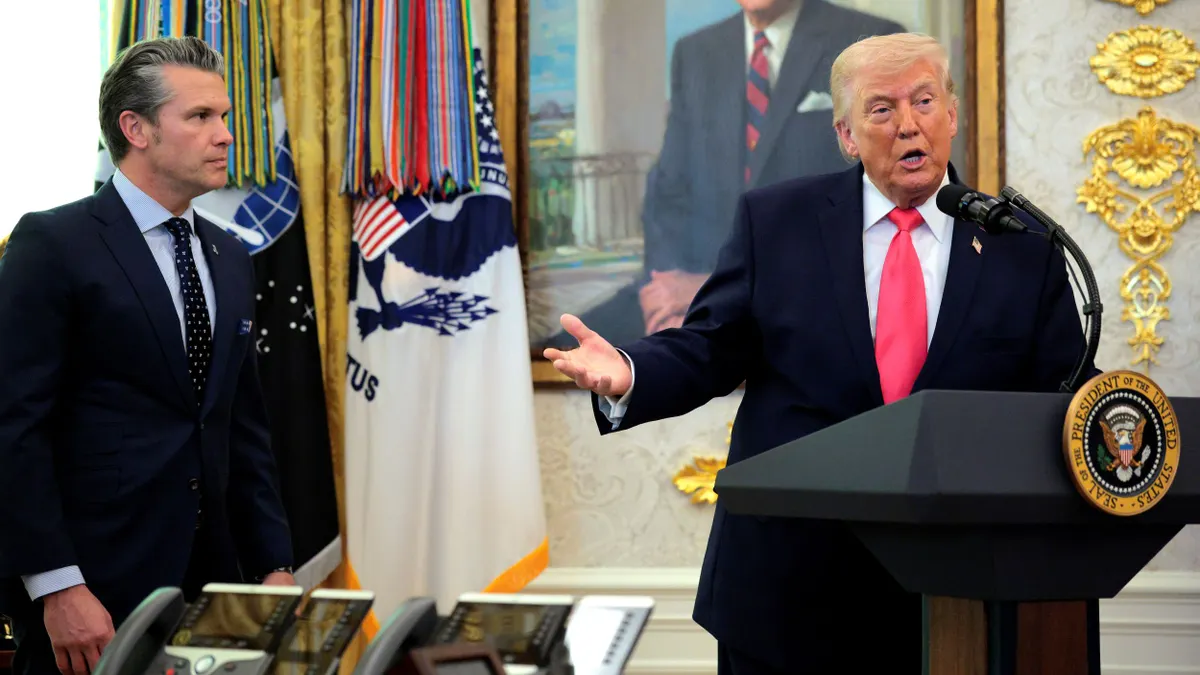
- President Donald Trump signed a proclamation Thursday imposing 100% tariffs on certain unmanned aircraft systems, or drones, and their components due to a perceived national security threat to the United States.
- The duties will take effect Sept. 3 and will apply to drones with a maximum takeoff weight of more than 55 pounds, as well as systems with thermal imaging capabilities. For other UAS types, a 25% tariff will be imposed on smaller drones and components without defense capabilities.
- Drones imported from U.S. allies, including European Union members, Japan, Liechtenstein, South Korea, Switzerland and Taiwan, will be charged a 15% rate. UK-made UAS models will be charged a 10% rate, so long as all of the drones' hardware, software and other technology originated from the countries listed or the U.S.
Dive Insight:
Trump’s proclamation also orders Commerce Secretary Howard Lutnick to establish an onshoring incentive program for entities investing in manufacturing drones and their components.
China’s drone market, projected to reach a $15.6 billion value in 2025, has the largest global presence and the “deepest component supply chain,” according to research firm Drone Intelligence.
China’s market presence led the U.S. to pivot away from that country’s drones and components amid national security concerns. In 2017, under Trump’s first administration, the U.S. Army banned its soldiers from using China-based DJI drones, according to a blog post from UAS component maker Vision Aerial.
The latest tariff charges align with Trump’s executive order to expedite domestic drone production, strengthen the supply chain and reduce the United States’ reliance on foreign countries.
Trump also made purchasing critical parts outside of the U.S. more difficult for defense companies such as drone manufacturers. He signed an executive order restricting the Department of Defense's authority to issue waivers to procure critical minerals and components from foreign entities of concern such as China, in a bid to safeguard domestic end-to-end supply chains.
For its part, China has made it harder for U.S.-based companies to procure components. Last month, China’s government added 10 military-linked companies to its export control list and 46 defense and aerospace firms to its procurement list, including subsidiaries of Lockheed Martin and General Dynamics.
The levies mirror a provision under the National Defense Authorization Act for fiscal year 2026 to strengthen domestic manufacturing and advance technologies across the U.S. defense industrial base. Under the NDAA, the DOD would be prohibited from purchasing batteries for weapons and support systems made with materials from foreign entities of concern, such as China or Russia, beginning Jan. 1, 2028.
The latest tariffs come as the president’s sons, Donald Trump Jr. and Eric Trump, have been expanding their portfolios by investing in various drone companies. Most recently, Eric Trump invested in a $638 million merger between defense geospatial technology firm Space-Eyes and special purpose acquisition company McKinley Acquisition Corp.
Donald Jr. is an investor in drone maker Unusual Machines, and serves on the company’s advisory board. Unusual Machines also contributed to the Trump brothers’ recent merger deals.
Donald Jr. also has been making investments through his venture capital firm, 1789 Capital, in other defense technology companies. Most recently, 1789 Capital was involved in defense startup Hadrian’s series D funding round of $1.37 billion in equity financing, which is aiming to garner government contracts.
Donald Jr. also has a stake in another defense-adjacent company, rare earth magnet manufacturer Vulcan Elements, through 1789 Capital, ProPublica reported in May. DOD awarded Vulcan a $620 million loan in 2025, and Donald Trump Jr. denied any involvement in the deal. However, Peter Navarro, a White House adviser to the president and a friend of Donald Trump Jr.’s, worked on Vulcan’s deal.
Democrat lawmakers are demanding answers from the White House regarding the deal, alleging corruption.
While Trump tightens defense-designed drone systems imports, the Commerce Department is loosening its export controls on certain unmanned aerial vehicles.
The agency finalized a rule that went into effect Thursday removing required licenses for civilian drones and their related components, accessories, technologies and software that pertain to their wind gust tolerance under the Export Administration Regulations.
The regulation also removes national security controls on particular drone parts, components, accessories and attachments that do not have military or intelligence capabilities.