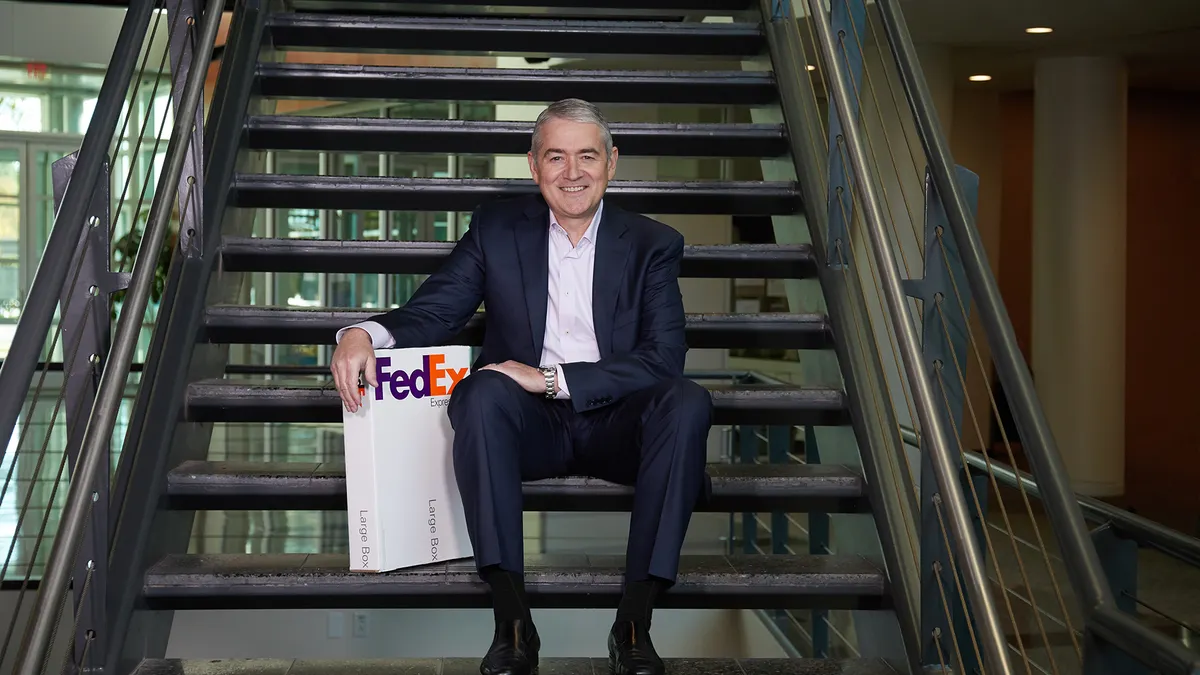
FedEx's ongoing push to attract more healthcare shippers has entered its next chapter, with company veteran Nick Gennari leading the charge against stiff competition from UPS and other providers.
Gennari joined FedEx in 1992 as an account executive and now heads FedEx Life Sciences, a dedicated organization focused on healthcare customers which launched in June. In an interview with Supply Chain Dive, the president of healthcare and life sciences said having a team with a dedicated healthcare focus — rather than one juggling customers in a mix of verticals — is an advantage as FedEx looks to grow its market share in the lucrative segment.
"We think it's very, very difficult to do what we're doing in healthcare if you have three or four other focuses," Gennari said. "And so the team is carved out specifically to allow us to move with pace to design solutions that matter and are meaningful."
The opening of FedEx Life Sciences, which Gennari said employs a little under 150 people, is a sign of the times for parcel logistics giants. FedEx and rival UPS have been bolstering their healthcare capabilities in recent years to attract more profitable shipments, distancing themselves from lower-value e-commerce packages in the process. Healthcare already makes up a sizable portion of FedEx's business, with the company making nearly $10 billion in revenue from the segment in fiscal year 2026.
Gennari said one appealing aspect of the healthcare industry — which covers shipments ranging from medical devices and lab tests to GLP-1s and biologics — is that it's not as exposed to economic ebbs and flows as other verticals are.
"Patients are going to continue to seek treatment when they need it, regardless of what's going on from a GDP perspective," Gennari said.
But healthcare shippers are also a highly demanding customer base, given the impact their products can have on patients' lives and the often temperature-sensitive nature of their shipments. Healthcare shipping clients consistently prioritize reliability above all else and have greater service expectations than other sectors, according to Thomas Duke of Green Mountain Technology, a parcel logistics management and advisory firm. These priorities call for on-time delivery rates that are consistently above 99% and end-to-end shipping support.
"Our customers want to feel like these carriers are their true partner," Duke, the company's director of strategic intelligence and analytics, said in an interview.
Gennari: FedEx is built for healthcare success
FedEx can handle the high expectations of healthcare shippers, according to Gennari, particularly due to its cold chain capabilities, visibility technology and network footprint.
The carrier works with customers on customized logistics arrangements and interventions for their shipments, including by ensuring products don’t deviate from a certain temperature range. For example, if bad weather introduces transportation delays, a customer may request the shipment be placed in a cold chain facility to maintain product efficacy until the weather improves.
"There's a lot of value associated with that from a customer point of view," Gennari said.
Intervention capabilities are especially important for healthcare customers, which tend to have lower shipping volumes compared to other industries, Pankit Bhalodia, a partner at the consultancy West Monroe focusing primarily on the life sciences space, said in an interview. That means even a few late deliveries can have a large impact on their business.
"As long as we are delivering the best solutions in this space, we're helping customers root out waste in their supply chain, and we're providing them with the oversight that they're looking for and the solutions that they require, the growth is going to be there."

Nick Gennari
FedEx President of Healthcare and Life Sciences
FedEx uses technology so it and its customers can keep an eye on shipments throughout the transportation process, and step in if an issue occurs. The company's FedEx Surround monitoring and intervention suite offers shippers near real-time shipping data, weather alerts and predictive insights. Gennari said 40% of healthcare customers are utilizing FedEx Surround.
Beyond technology, FedEx also has a growing facility footprint focused on healthcare, with multiple Life Science Centers globally offering cold chain capabilities for customers moving temperature-sensitive goods. A FedEx spokesperson said in an email to Supply Chain Dive that the company has six Life Science Centers located in Memphis, Tennessee; Mumbai, India; Seoul, South Korea; Tokyo, Japan; Veldhoven, the Netherlands; and Singapore.
Over time, FedEx is looking to expand its cold chain facility presence beyond primary healthcare hubs and into secondary markets, Gennari said. Customers oftentimes are using truck transportation to bring their shipments to cold chain facilities, and FedEx wants to place more locations closer to the point of manufacturing, according to Gennari.
"I think bringing the market to the customers versus having the customers come to the market is key in creating differentiation, and that is why you'll see us over time continue to expand our cold chain solutions," he said.
FedEx targets growth among pharma shippers
A larger set of cold chain facilities is one way FedEx is looking to attract more healthcare customers over the long term, particularly in the pharmaceuticals space.
The sector, which makes up nearly half of the $80 billion addressable healthcare market, is FedEx's next major focus in the healthcare space, EVP and Chief Customer Officer Brie Carere said during a February Investor Day. The company's year-to-date pharmaceutical revenue at the time was $1.6 billion, she added.
"To compete in pharma, it requires a comprehensive parcel, airfreight and digital solution set, and we now have these three capabilities globally at scale," Carere said. "Pharmaceutical companies also need extreme accuracy and reliability to deliver the life-saving outcomes they need for their patients."
But FedEx isn't the only logistics provider eyeing growth in the pharmaceuticals space. UPS — which generated $11.2 billion in healthcare revenue in 2025 — recently expanded an air hub in Incheon, South Korea, in part to support pharmaceutical trade flows. The company also has made a $48 million investment in 27 temperature-controlled cross-dock facilities.
Despite stiff competition, Gennari said his team has spent "a lot of our time, effort, energy and focus" on the pharmaceuticals industry and expects to capitalize on the space's growth in the years ahead.
"As long as we are delivering the best solutions in this space, we're helping customers root out waste in their supply chain, and we're providing them with the oversight that they're looking for and the solutions that they require, the growth is going to be there," he said.