Dive Brief:
- FedEx is expanding its China-U.S. air cargo connectivity with new weekly flights to better service businesses including artificial intelligence infrastructure, advanced industrial manufacturing, semiconductor production and premium e-commerce, according to a Nov. 9 press release.
- Three of the weekly flights connect Shanghai (PVG) to major U.S. hubs in Anchorage (ANC), Alaska, and Memphis (MEM), Tennessee, via Osaka (KIX), Japan, per the release. A fourth weekly flight connects Guangzhou (CAN), China, to ANC and MEM.
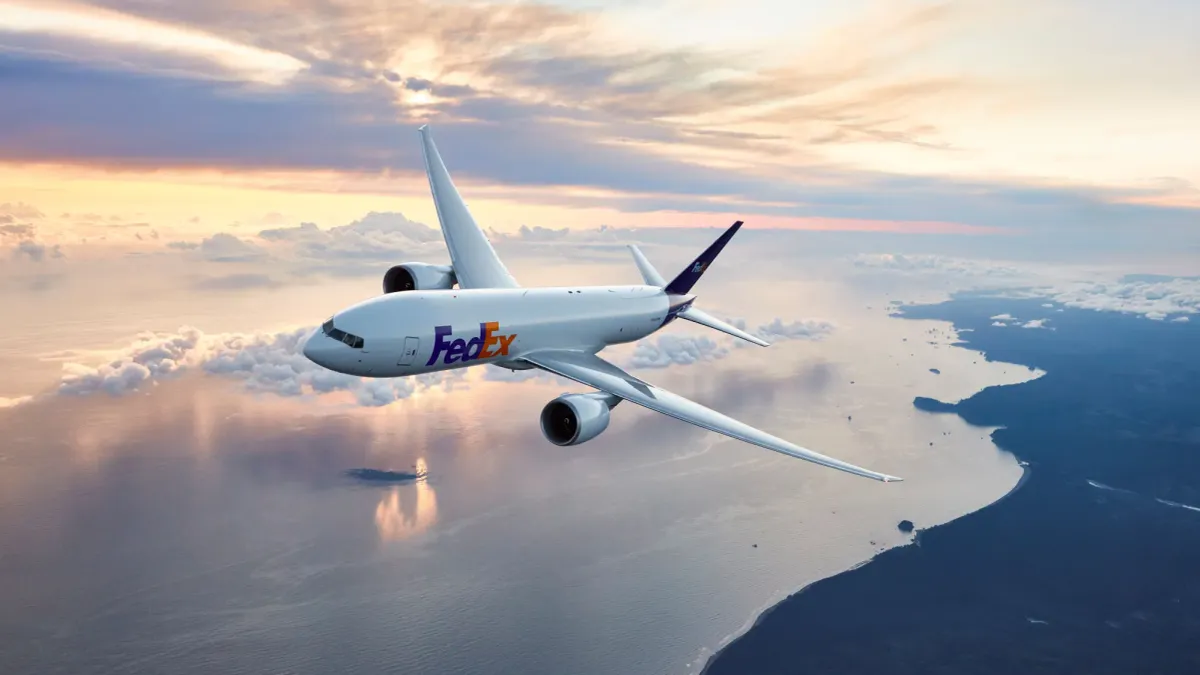
- The new flights enable a five-times-weekly service connection from China to Dallas-Fort Worth via ANC, per the release. All flights are operated using a Boeing 777F.
Dive Insight:
FedEx’s recently launched capacity aims to bolster shipper access between manufacturing hubs in the Asia Pacific region and technology and data center markets, including the Dallas-Fort Worth region, according to the release.
The services also intend to help China-based customers better respond to evolving market demands, per the release. This includes moving critical inventory and tapping into growth opportunities within the manufacturing, AI-driven digital economy and premium e-commerce. Memphis, Tennessee, is the home of FedEx's World Hub.
Demand for AI-related components is currently the biggest driver on the Transpacific corridor, with chargeable weight between Asia Pacific and North America up 15% year over year in October, Xeneta reported.
Other companies have also been making efforts to accommodate demand for AI-related cargo on the Transpacific trade lane. DHL Global Forwarding, for example, launched a flight connecting Bangkok (BKK) and Cincinnati (CVG) earlier this year. Forwarder Nippon Express also recently teamed up with Japan Airlines to start a weekly circuit connecting Los Angeles to Japan, Taiwan and Singapore to meet growing demand for AI- and semiconductor-related volumes.
The additional capacity builds on FedEx’s other efforts to bolster its Asia Pacific connectivity as it optimizes its air network. During a recent earnings call, President and CEO Raj Subramaniam said that the carrier aims to capture more air freight business from customers focused on parcel shipping. This includes high-value and fast-growing segments such as data centers.
Further, in June, the company inked a deal to share network resources with China Southern Air Logistics to strengthen route connectivity and the global supply chain. Part of the deal was making efforts to bolster Guangzhou as an international cargo hub.