Dive Brief:
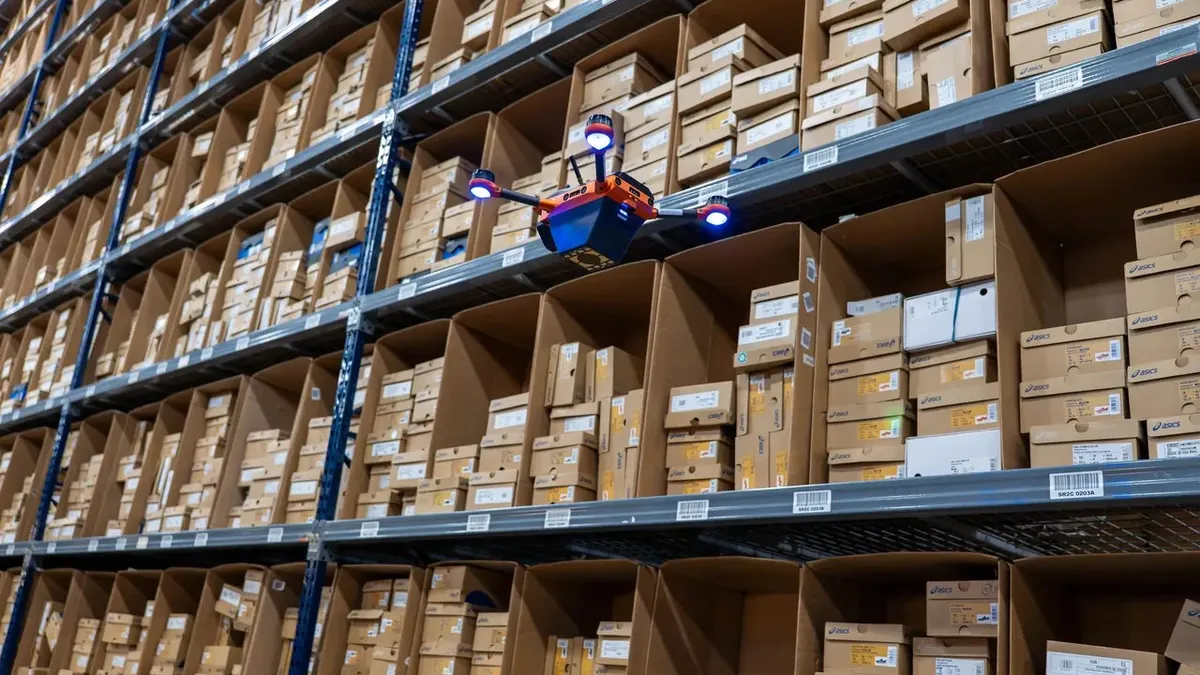
- Asics has deployed autonomous warehouse drones at its omnichannel distribution center in Byhalia, Mississippi, to sharpen inventory management, according to a Nov. 10 press release.
- The drones, developed by Corvus Robotics, have helped the footwear and apparel retailer recover misplaced inventory 60% faster than it did before implementation while increasing counting frequency and shaving off labor hours. In one three-month period, the drones identified 26 misplaced cases containing more than 200 pairs of shoes.
- “If a unit went missing, we might not find it for six months. That could be the last pair in the building for an order we’ve already taken, and then the customer gets a cancellation,” Kyle Koestler, senior director of distribution and transportation at Asics America, said in the release. “With Corvus One, we’re cycle counting on a monthly basis so we can surface any errors sooner and ensure customer orders are delivered on time.”
Dive Insight:
A wide range of companies are leveraging warehouse drones to sharpen inventory management. Corvus Robotics itself counts alcohol distributor Southern Glazer's Wine & Spirits and skincare brand Dermalogica among its client roster. Meanwhile, sportswear brand On partnered with robotics manufacturer Verity in 2024 to deploy drones within a fulfillment center to improve inventory visibility. On planned to scale rollout across its facility network.
Before implementing the Corvus One drones at its Byhalia site, Asics performed manual counts within the site twice a year. The footwear brand now conducts monthly counts in two of the site’s most critical sections: the singles area, which houses single pair and returned products, and the case reserve space, which holds full cases containing multiple pairs of shoes.
Overall, the 855,000-square-foot Byhalia facility stores nearly 3 million units across roughly 44,000 SKUs. The site fills e-commerce, wholesale and retail store orders and is managed via Manhattan Associates’ warehouse management system.
Asics deploys the drones to run seven flights at night, starting roughly around 7 p.m., per the release. The drones scan the singles and case reserve sections to read universal product codes, or UPCs, and count boxes. The drones do both of these tasks because certain products may fall under the same SKU, especially in areas where new and returned goods are stored together.
“If there's 10 boxes, you should have 10 UPCs. And so, there's some unique logic with that,” Koestler said in a case study report published on Corvus’ website.
To guard against misreads, inventory associates review each flight path the morning after a deployment to identify any discrepancies using video and images the drone captured the night before. Even with this manual process, the drones cut 200 labor hours from the Byhalia site’s operations, including by being able to more efficiently navigate the very narrow aisles within the site. Most are less than 6 feet wide.
“Now we can just look at the footage and we can tell exactly what's going on with it in the locations before we have to send someone out,” Angela Williford, inventory control operations manager at Asics America, said in the report. “If it's something that we can correct from the desk, we'll correct it then.”
With improved visibility over its inventory, Asics does not need to hedge on product availability within online marketplaces, allowing it to list all SKUs and avoid the need to sell non-listed items at a discount. The company previously held back up to 15 of every 100 products due to fulfillment risk at the tail of the inventory chain, per the release.
“So the fewer situations and fewer instances where we have that fire drill where it's like, oh my gosh, we have to go find this, then the better off we're going to be,” Koestler said in the report.