Over the past two years, Lenovo has expanded its global manufacturing network, strengthening a regional strategy that reduces tariff and geopolitical risks while strengthening supply chain resilience, Benjamin Massie, VP of global supply chain, servers and storage, told Supply Chain Dive.
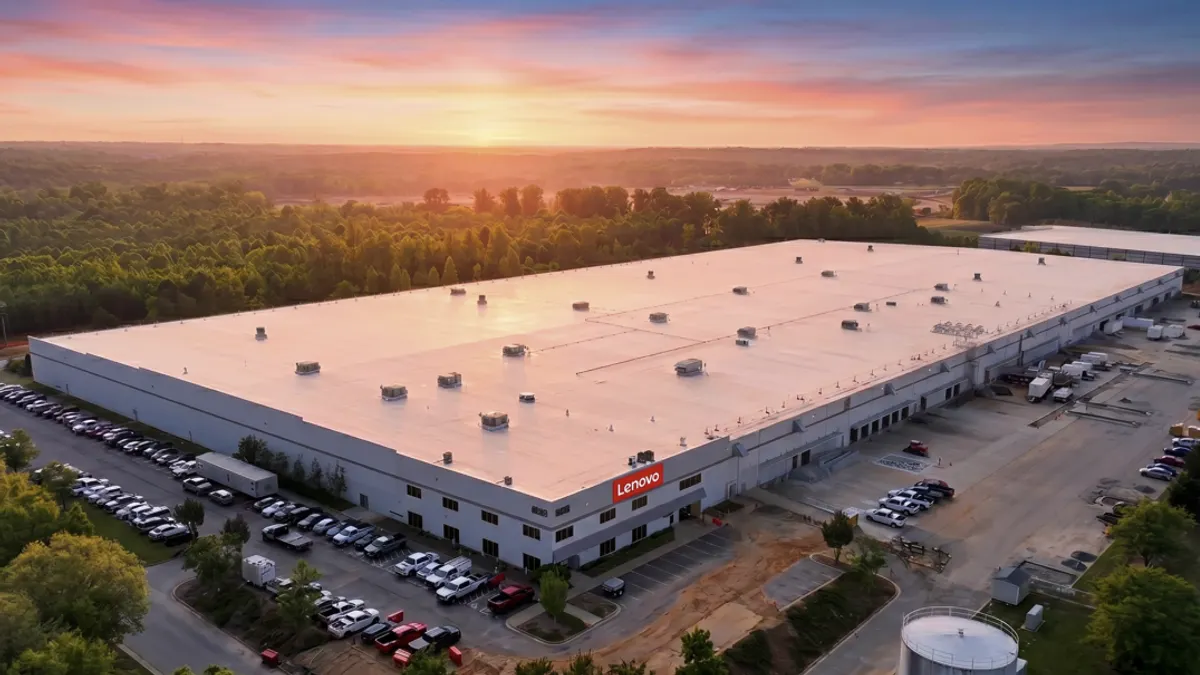
The latest moves in Lenovo’s "global local" strategy included opening a manufacturing facility in Riyadh, Saudi Arabia, to serve the Middle East and Africa market, and doubling capacity at its Whitsett, North Carolina, plant, to support rising server demand, Massie said. The Riyadh plant began making PCs last December as part of a pilot launch, but the factory, which will also produce servers, will not fully open until the winter after the Iran war delayed its launch from the summer.
Together, the 890,000-square-foot North Carolina expansion and the Riyadh plant underscore Lenovo's geographic manufacturing approach, Massie said. The Riyadh facility is part of an 11-building, 2.15 million-square-foot campus built with ALAT, a Saudi public investment fund.
Regional facilities, in general, help build supply chain resilience by giving Lenovo room to adjust as trade rules shift, Massie said.
"We've been able to pivot between the different nodes we have around the world to be able to adjust for the different geopolitical rules and tariffs," he said. Lenovo also partners with original design manufacturers for additional production flexibility.
Supply chain regionalization has been an industry trend for five to seven years, Massie said, but the shift has accelerated over the last couple of years to bolster local production amid tariffs. While other companies "have put a toe" into localization, Massie said Lenovo has "gone all into this global local model."
Lenovo’s dedication to the strategy dates back decades to the early 2000s, according to a Lenovo spokesperson, pointing to the company’s opening of its first European factory in Hungary in 2022 as well as its manufacturing of goods for the North America market in Mexico.
“That's been kind of a part of our DNA for many you know many years, and we've been purposely bringing manufacturing closer to our customers,” the spokesperson told Supply Chain Dive.
AI demand raises product lead times
Still, high demand for memory and other semiconductors powering the AI data center boom has lengthened product delivery times, Massie said. Rivals Dell Technologies and Hewlett-Packard Enterprise have reported similar delays. A recent TrendForce report estimates lead times for some server components stretching to nearly a year.
"We're not getting enough supply to meet the overall market demand, so we differentiated our own lead times again based on where we want to have our strategic plays," Massie said. "So customers that are long-term customers and plan with us — our lead times are a little shorter."
To help manage component scarcity, Lenovo has increased inventory and uses its AI-powered supply chain platform, iChain, to monitor product availability at first-, second- and third-tier suppliers, Massie said.
Even with those measures, the component shortage has contributed to a "very large" backlog of orders in Lenovo's server business, Massie said. Lenovo's artificial intelligence server pipeline grew to $54 billion last quarter, up 157% quarter to quarter.
"This demand cycle that's out there right now just seems to be growing rather than shrinking or even stabilizing," Massie said. "There seems to be an arms race a little bit, and we're seeing that in our backlog, in our pipeline."
Editor’s note: This story has been updated with additional details from a Lenovo spokesperson.