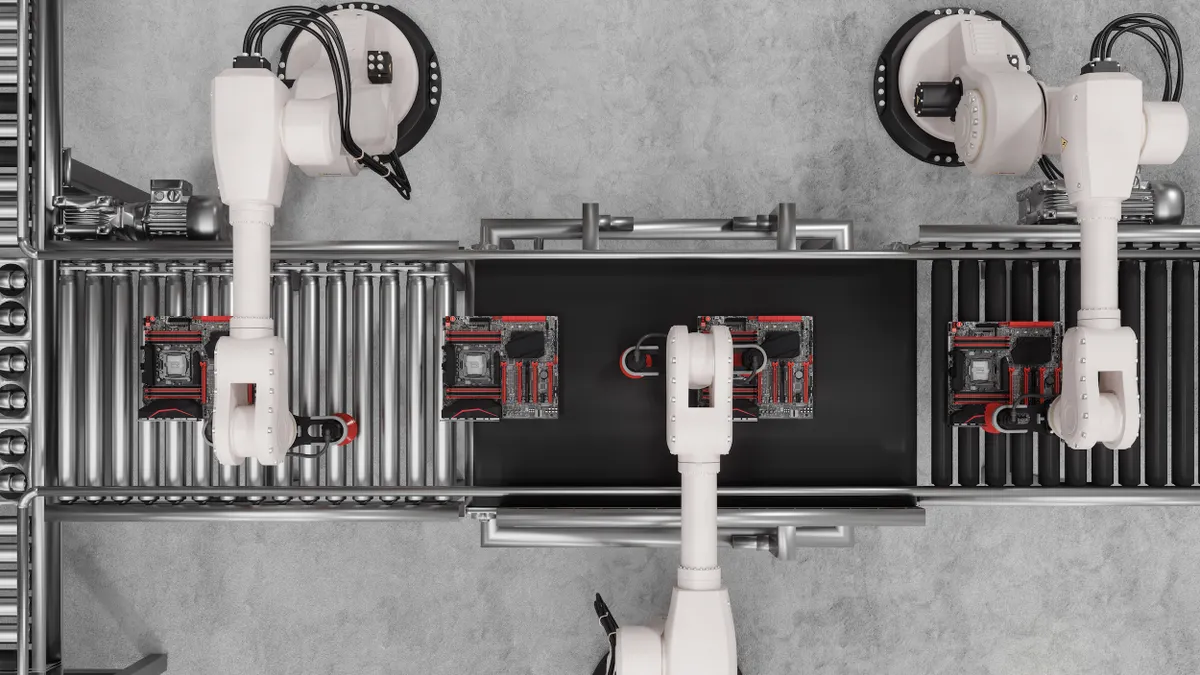
Robotics and artificial intelligence, usually tools reserved for billion-dollar enterprises with sprawling supply chains, are increasingly becoming accessible to a wider swath of companies. So, while giants such as Walmart and Amazon continue to pursue the cutting edge of supply chain technology, smaller operators are taking advantage of the economics that naturally come with technological development and scale.
Record-breaking attendance at MHI’s ProMat event last March and the robotics that flooded the show floor provide proof of the trend, according to Sonya Snellenberger, VP of partnerships at Conexus Indiana, an economic development nonprofit focused on advancing the state’s manufacturing and logistics sectors.
“That's a huge indicator for there's an appetite for this,” Snellenberger said. “It's not just all the big companies.”
As-a-service fuels adoption
One major reason robotics, specifically, have become more accessible for warehouse operators is the development of as-a-service platforms, according to Jayesh Mehta, managing executive of industry groups at MHI. These subscription-based setups, both robotics-as-a-service and software-as-a-service models, are particularly helpful for midsized companies and have been gaining more traction in recent years.
A 2025 study conducted by MHI, Peerless Research Group and The Robotics Group found that 48% of participating organizations were using robots in their plants and/or warehouses in 2025, up from 23% three years earlier. The study surveyed 216 respondents between January and February 2025, with more than half companies with less than $50 million of annual revenue.
Running parallel with the rise of warehouse robotics use, in the 2024 version of the survey, 64% of responding companies said they were using a RaaS or SaaS system, up from 46% two years prior.
Mobile accessories distributor Superior Communications is working with Brightpick to integrate 37 autopicker muliti-purpose robots into its Tennessee distribution center. Superior CEO Solomon Chen highlighted the ability to purchase the equipment through a RaaS scheme as a decision-making factor when choosing a robotics partner, further noting that the autopickers will optimize throughput and reduce fulfillment costs.
Meanwhile, parcel carrier UniUni, which operates over 100 warehouses in North America, started its robotics journey in 2023 through a partnership with Global Robotics Services. The UK-based technology firm offers a RaaS model, which it says requires a lower upfront investment and reducing fixed costs, alongside flexible lease terms.
According to Peter Lu, CEO of UniUni, the first processes the company automated were parcel sorting and sequencing, which he described as “two of the most labor-intensive and time-sensitive stages of warehouse operations.”
The company then made its GRS partnership public in April 2025, announcing it would use two AI-powered sorting tools that integrate with an existing warehouse execution system.
“This trend is exciting,” Lu said in an email. “It’s driving innovation throughout the industry, encouraging both large and small companies to rethink how technology can enhance efficiency and service quality.”
Peer success spurs domino effect
When companies consider technology upgrades, identifying and achieving a path to return on investment is the top barrier to spending, according to a whitepaper from Pennsylvania State University, commissioned by MHI, analyzing the trade association’s 2024 study.
For UniUni, growing parcel volumes and the staying power of e-commerce gave it such a business case. Meanwhile, lessons from its story can help others push past the investment barrier, according to Snellenberger, even if vendor sales teams from vendors and service providers provide ROI data.
“I can hear all day from a tech integrator what they believe the ROI is,” Snellenberger said. “But I want to hear from my peers.”
As increased interest in warehouse robotics pressures more companies to invest, the end results will benefit the greater logistics ecosystem, Lu said. In that way, growing adoption of warehouse robotics, alongside more accessible financing, begets more adoption, even if every robotics solution won’t make sense for every warehouse.
“[Small- to medium-sized enterprises], or anyone for that matter, need to thoroughly investigate if they need to implement robotics and if this is helping them become more efficient, or is this just automating a task with little to no difference,” Mehta said, warning firms to avoid a “keeping up with the Joneses” mentality.