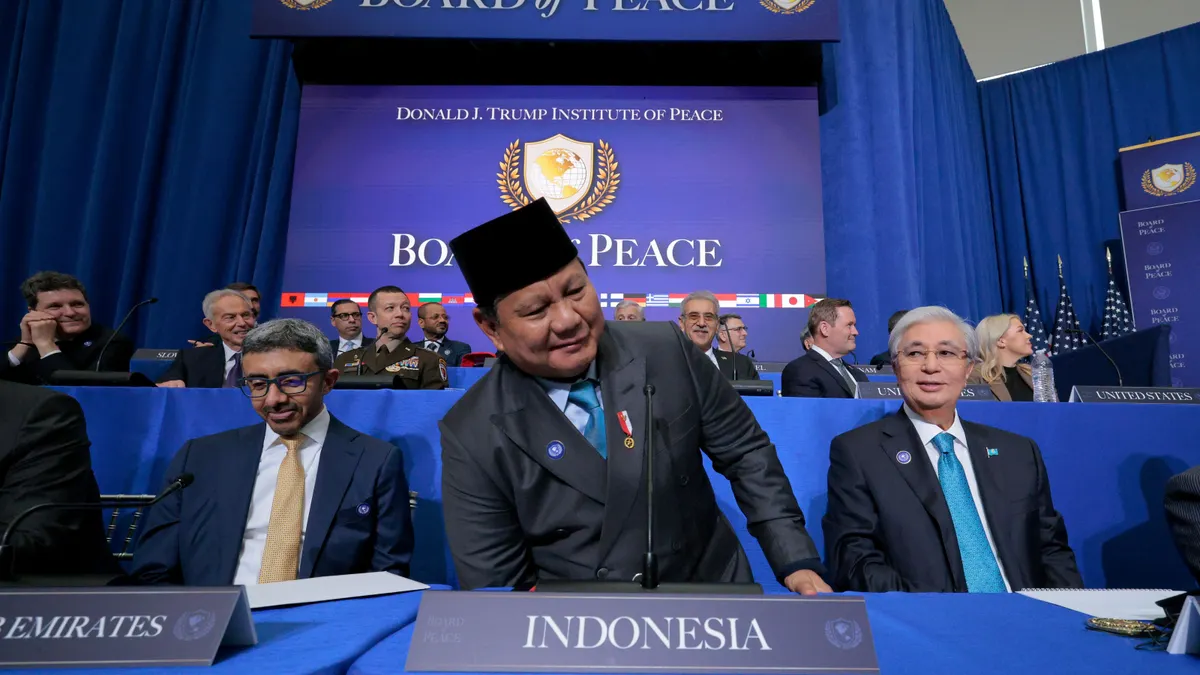
The United States and Indonesia on Thursday finalized the terms of a framework trade agreement that would limit reciprocal tariffs on imports from Indonesia at 19%.
As part of the agreement, first reached last July and signed by leaders of both countries Thursday, the U.S. also said it would remove levies for certain products from Indonesia in accordance with a November executive order that exempted over 200 agricultural goods. The U.S. further agreed to eliminate tariffs for other products, including some live animals, plants and chemical compounds. These tariff rates will be enforced in addition to the Most Favored Nation rate, per the agreement.
Additionally, the U.S. plans to establish a process to remove reciprocal tariffs for a “to-be-specified” volume of apparel and textile imports from Indonesia. The amount will be determined in relation to U.S. exports of similar goods to Indonesia. This provision matches similar language in a reciprocal trade agreement the U.S. reached with Bangladesh earlier this month.
The U.S. can terminate the agreement if Indonesia enters into a trade pact with another country that may jeopardize U.S. interests. If so, the U.S. would resume applying the 32% reciprocal tariff rate announced last April on goods from Indonesia.
Even with the agreement formalized, it and other similar pacts are now on uncertain ground following a Friday decision by the Supreme Court. Per the decision, the high court struck down tariffs enacted under the International Emergency Economic Powers Act, the statute President Donald Trump has used to install country-specific reciprocal tariffs.
Beyond reciprocal tariffs, the U.S. may consider terms of the Indonesia agreement with respect to potential Section 232 levies, per a White House fact sheet. The U.S. has previously installed tariffs on goods such as steel and automobiles under the statute.
For its part, Indonesia said it would remove duties on a large swath of U.S. goods while setting tariff rate quotas for pork, distilled spirits and wine. Indonesia also agreed to align with the U.S. on customs duties and quotas put in place to protect economic and national security interests.
Indonesia further plans to establish processes to address unfair trade practices, such as exporting below-market goods to the U.S. by companies in Indonesia controlled by third countries. Indonesia will also enter into a duty evasion cooperation agreement with the U.S. to protect against transshipments.
The Southeast Asia country further agreed to provide preferential market access to U.S. agricultural products and accept U.S. standards for goods such as food, pharmaceuticals, medical devices and auto parts. It also said it would not apply import licensing to U.S. goods in a way which restricts the importation of such products.
The two countries will also collaborate on investments related to the mining, extraction and distribution of critical minerals and energy sources. In turn, Indonesia said it would remove export restrictions on critical minerals and other industrial commodities to the U.S.
Meanwhile, Indonesia plans to invest $10 billion in U.S. engineering, procurement and construction projects. Indonesia also said it would support and facilitate agreements for $15 billion of U.S. energy resources — including coal, crude oil and gasoline — along with $13.5 billion of U.S.-made aircraft and $4.5 billion of agricultural goods.
Indonesia further agreed to strengthen intellectual property, labor and environmental protections, including adopting regulations prohibiting the importation of goods produced by forced labor. It also said it would not apply value-added or digital services taxes that discriminate against U.S. companies.
With terms formalized, the two countries must now conduct internal legal procedures to finalize the deal. The agreement would go into force 90 days after each country notifies the other that those processes are complete.