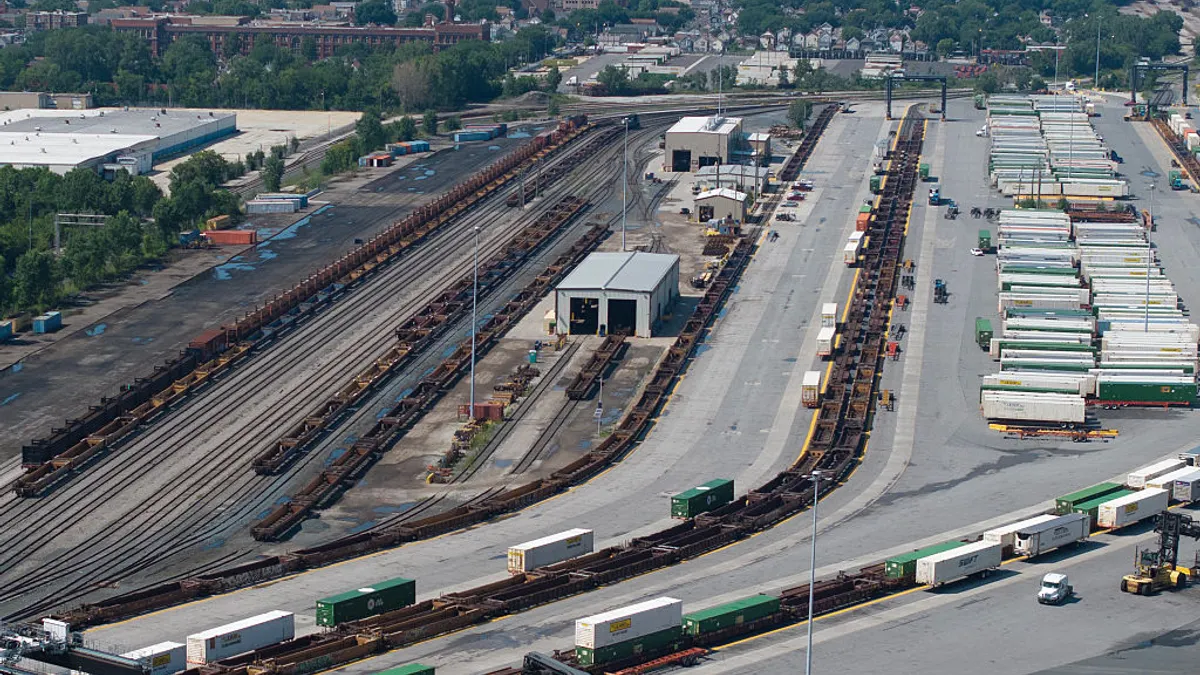
Union Pacific’s proposed acquisition of Norfolk Southern will create a colossus of railroads if approved, potentially eating up the lion’s share of freight that moves by rail in North America.
The debate rages on over the competitive implications of the merger — which would create a 52,215-mile transcontinental network dwarfing the other four Class I systems — for the rest of the rail sector. While competitors fear a coast-to-coast network would be able to use its outsized market power to raise rates and stifle rail competition, UP and NS say a merger will increase competition between railroads as well as with trucks.
The Surface Transportation Board on Jan. 16 rejected as incomplete the nearly over 6,000-page merger application the railroads filed in December. UP said it would provide regulators with additional information on post-merger market share forecasts, submit the full UP-NS merger agreement and address other shortcomings the board identified in the initial application.
While the railroads fine-tune their merger application in anticipation of resubmitting it by late June, here’s a look at just how large the tie-up would be and how different stakeholders view the potential impact.
How big is big?
This much is certain: Based on 2024 financial results, a transcontinental UP would have 56% more revenue than the No. 2 railroad, BNSF.
A combined UP-NS network would be a “railroad of unprecedented size, with over 40% market share in the majority of commodity categories,” Jason Miller, the Eli Broad endowed professor of supply chain management at Michigan State University, said during an Oct. 28 webinar. It would also be No. 1 or No. 2 in every rail-hauled commodity with the exception of iron ore, according to Miller’s analysis of freight data.
UP would be able to use such scale and reach to squelch competition, Peter Swan, associate professor emeritus of logistics and operations management at Penn State Harrisburg, said in an email.
“Keeping gateways open is not the same as keeping joint and local rates at current levels."

Peter Swan
Associate professor emeritus of logistics and operations management, Penn State Harrisburg
Thanks to the current regional duopoly — with BNSF and UP in the West and CSX and NS in the East — many rail shippers have competitive options.
For example, in Houston, the Port Terminal Railroad Association provides UP, BNSF and Canadian Pacific Kansas City with access to a cluster of major petrochemical plants and port facilities. Similarly, CSX and NS have access to Conrail, a neutral local service provider in the Detroit, northern New Jersey and Philadelphia areas, allowing shippers to use either railroad.
A combined UP-NS would upset regional competitive balance in these areas and elsewhere, Swan said.
Eastbound shipments that currently originate on UP can be interchanged with either NS or CSX. Conversely, westbound shipments that originate on NS can be interchanged with UP or BNSF. In a post-merger world, he explained, traffic that originates on UP or NS would likely flow only to the combined UP system.
Higher rates ahead?
While shippers could still control routings — and use BNSF-NS or CSX-UP options — UP could set high local rates that would leave BNSF and CSX unable to compete effectively, Swan said.
“UP and NS could provide a lower contract rate than BNSF that might still be higher than if UP and BNSF competed on a level playing field,” Swan said. “The same would be true if UP had the monopoly and NS and CSX were in competition.”
BNSF and CSX would likely be forced to take similar actions for carload and bulk shipments for which they control the origin or destination, Swan said. “So any negative effects on competition are likely to spread throughout the industry and not be limited to UP and NS alone,” he said.
He added that keeping current interchanges open — in places like Chicago, St. Louis and New Orleans — wouldn’t necessarily ensure competition. “Keeping gateways open is not the same as keeping joint and local rates at current levels,” he said.
None of this is lost on rail-dependent industries. “The merger likely will result in higher rates, which will translate into higher inflation as shippers of energy, chemical and agricultural products pass on increased transportation costs to their customers,” Chris Jahn, CEO of the American Chemistry Council, said in an interview.
Jahn said the evidence is clear that reduced competition leads to higher rates. In the past 15 years, rates on non-competitive routes are up 240% compared with a 24% increase on competitive rail routes, he said.
There could also be downstream effects on other transportation rates, particularly in the trucking market.
Railroads have pricing power for carload and bulk shipments but lack such an edge for intermodal shipments because rates for container and trailer shipments are largely determined by the trucking sector, according to Michigan State’s Miller.
Still, if railroads raise rates, truckers will too — and transportation prices will increase across the supply chain, igniting inflation and making American companies less competitive in global markets, two members of the National Industrial Transportation League said in an interview. They spoke on the condition that their names and companies not be disclosed because they fear retribution from the railroads.
UP: Competition is alive
UP CEO Jim Vena has dismissed shipper and railroad concerns about competition. The UP-NS combination is an end-to-end merger, he said, with very little overlap between networks. The railroads jointly serve only a handful of customer locations in the Midwest, and UP will take steps to ensure those facilities still have access to two railroads, he said, adding that no other customers would see their competitive options diminish.
“We’re going to keep every interchange open. We’re not shutting any interchange,” Vena said in an October interview. “Somebody would say, ‘Well, you have too much market power and you’re going to try to force us to come with you.’ Absolutely not.”
Shippers will still have options to route their freight via CSX and BNSF based on service and price, Vena said.
“If you’re a shipper in the Gulf somewhere and you’re going to go to the Eastern U.S. … you’re going to pick the shortest route. The shortest route to go to Florida is going to be with the CSX through New Orleans,” he said. “And we’re going to keep that gateway open, because if you try to move things 300 miles further by going the NS route that’s more circuitous, you lose.”
In other instances, where UP and BNSF or CSX routes are an equal match, shippers will retain their competitive options, Vena said. In their merger application, UP and NS said they would offer shippers “Committed Gateway Pricing.”
“Somebody would say, ‘Well, you have too much market power and you’re going to try to force us to come with you.’ Absolutely not.”
Jim Vena
CEO, Union Pacific
Committed Gateway Pricing, the railroads said, will streamline pricing for interline moves that otherwise may not directly benefit from the merger.
“Committed gateway pricing is purely additive, providing an extra rate and service option without removing any existing choice,” Kenny Rocker, UP’s EVP of marketing and sales, said on a Dec. 19 webcast after the merger application was filed with federal regulators.
The chief executives of UP rivals BNSF and CPKC, however, said that few shippers would be able to take advantage of Committed Gateway Pricing. CPKC CEO Keith Creel said only 20% of customers would benefit from the program, while BNSF CEO Katie Farmer put the number at just 1%, while delivering remarks at the Midwest Association of Railroad Shippers winter meeting in January.
Vena also said that over the long term, alliances between railroads are doomed to failure and that a transcontinental merger is the most effective way to improve service and compete with trucks.
Yet the recently launched BNSF-CSX intermodal partnership, which links the Southwest and Southeast, immediately put a dent in Norfolk Southern’s domestic truckload intermodal volumes. In the six weeks after the service was launched in August, CSX intermodal volume rose 8%, while Norfolk Southern’s declined 6.8%, according to weekly traffic reports.
BNSF and CSX executives have said that their alliance was in the works before the merger was announced, but UP and NS see it as evidence that competition is heating up.
“We started to see some of the revenue erosion from competitor reactions to the merger announcement,” NS CEO Mark George said on the railroad’s Q3 earnings call. “We expect the impact to grow in the fourth quarter and continue to be a challenge over the near and medium term.”