Dive Brief:
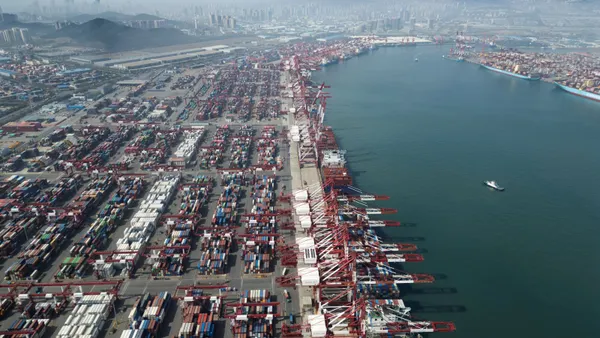
- Transpacific ocean rates have eased slightly with slowing freight demand a potential factor, according to Freightos’ weekly update from Nov. 10.
- When compared week over week, Asia-to-U.S. West Coast spot rates fell 1% to $8,245 per forty-foot equivalent unit, according to the Freightos Baltic Index. Asia-to-U.S. East Coast spot rates are at $9,708 per FEU, down 2% week over week.
- Still, rates are over more than double what they were last year at this time. Asia-to-West-Coast prices were at $2,958 per FEU and Asia-to-East-Coast prices were at $3,513, per November 2025 data from Freightos.
Source: Freightos
Dive Insight:
Freightos said slowing demand could be one factor helping ease rates. Peak season is winding down, although volumes are still strong, according to the Global Port Tracker from the National Retail Federation and Hackett Associates.
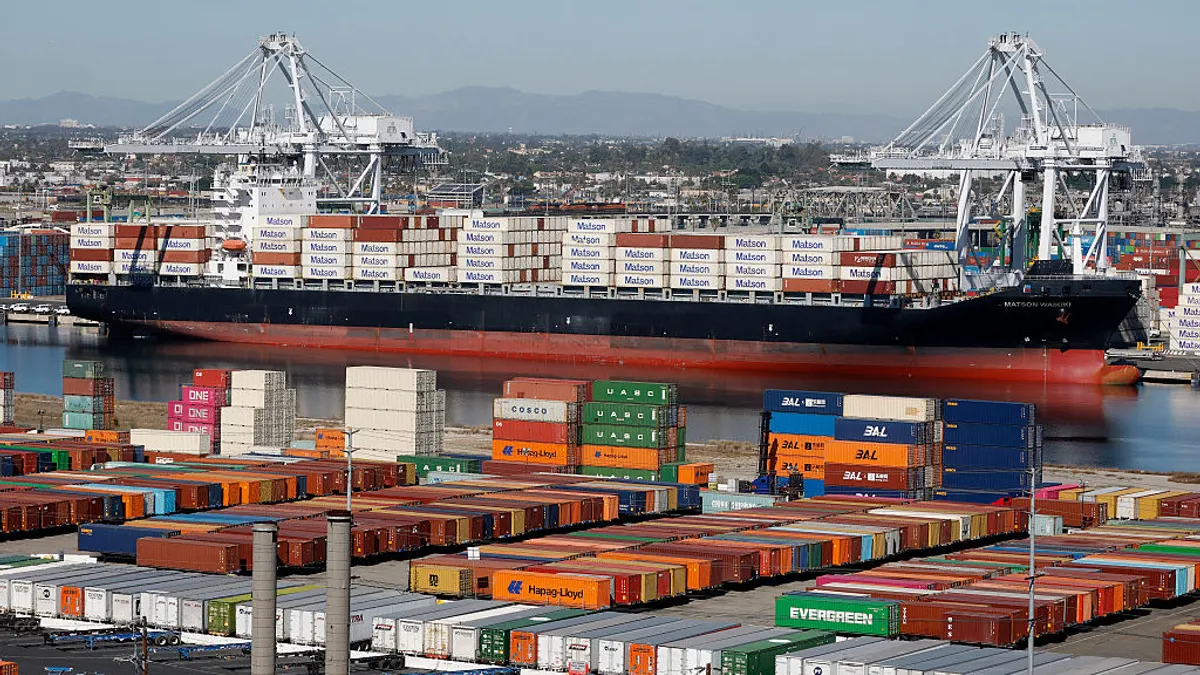
A combination of higher diesel costs and the looming November expiration date for a since extended U.S. and China trade war truce led to some frontloading at certain ports such as the Port of Los Angeles. Demand is expected to ease as retailers have shipped most of their holiday merchandise, according to NRF VP for Supply Chain and Customs Policy Jonathan Gold.
[R]etailers are working closely with their supply chain partners to ensure that the supply of holiday gifts continues to flow smoothly,” Gold said in a press release.
U.S. ports have yet to report October import numbers, but the Global Port Tracker projects that the month will be at 2.26 million TEUs, slightly down from 2.37 million TEUs the month prior. November is forecast to be at 2.05 million TEUs and December at 2.03 million TEUs.
Elevated volumes stemming from an extended peak season have led to backups at some ports, “particularly on the West Coast where cargo has sat for extended periods waiting to be transferred to rail cars,” Gold said.
In September, the Ports of Long Beach and Los Angeles experienced elevated container dwell times due to a glut of peak season cargo, according to the Pacific Merchant Shipping Association. Local truck dwell times were 3.18 days in September, up from 2.95 days in August, and rail dwell times were at 7.19 days, up from 6.75 days the month prior, per a PMSA press release.
The Southern California ports could face fresh disruption in November based on the outcome of labor negotiations between the International Longshoremen and Warehouse Union Local 26 and Pacific Maritime Association. The union, which represents 250 watchmen who provide security at six container terminals at the San Pedro Bay port complex, has twice delayed strike actions as the two sides continue contract discussions that have been ongoing since July 2025. The most recent deadline was pushed to Nov. 20, per a PMA statement emailed to Supply Chain Dive.