Regular air cargo operations at the Miami International Airport (MIA) have largely resumed after an Amazon Prime Air freighter crashed earlier this week.
A Boeing 767-300 Prime Air aircraft operated by 21 Air overran the runway when touching down in Miami on Sunday, MIA posted on X. Five people died as a result of the crash, according to the Miami-Dade Sheriff's Office. The jet had departed from San Juan, Puerto Rico.
As of Tuesday, two of MIA’s four runways remain closed, according to MIA’s website, which didn't specify when the runway would reopen. The National Transportation Safety Board needs to document the scene first, and "it is not a completely safe scene" for the agency just yet, Chairwoman Jennifer Homendy said in a press conference Monday.
"We hope that we can move through it swiftly because we know it is impacting flight operations here, but we have to make sure that we're able to get access to the aircraft first," Homendy said.
While the disruption "is a significant short-term capacity and reliability event for MIA," it hasn't become a shutdown for the Latin America cargo gateway, Derek Lossing, founder of Cirrus Global Advisors, told Supply Chain Dive in an email.
“However, shippers with perishable cargo should maintain very close contact with their forwarders and airlines, as the disruptions are very real."
On Monday, the airport recorded 181 flight cancellations and 408 delays, FlightAware reported. Some disruption is ongoing, according to FlightRadar24 data as of Tuesday, but cargo flights are operating again, including widebody service to and from Latin America, Lossing said.
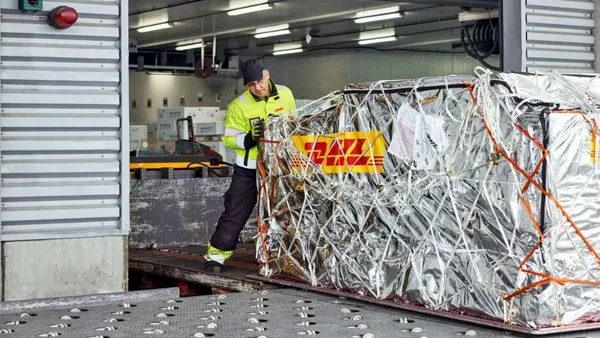
FedEx flights are currently operating as normal at the airport, the carrier told Supply Chain Dive. DHL Express operations have also resumed at MIA, despite the temporary closure on Sunday spurring three MIA-bound DHL Express aircraft to be rerouted to alternative airports, DHL said in an email. The carrier’s network has “since returned to normal operations.”
However, reduced runway capacity is spurring longer arrival holds and missed connections, per Lossing.
“This will also create backlogs and full warehouses, which rapidly can reduce processing times for sensitive cargo,” Lossing said. “Flights arriving late- even a couple of hours, has major impact where ground handlers can only shift labor slightly, so it will be all hands on deck to process the delayed cargo.”
The scale of MIA as an international gateway is what makes the short disruption impactful, Lossing said.
“That means one delayed arrival can affect several downstream flights and distribution commitments. Perishables, pharmaceuticals and other temperature- or time-sensitive shipments face the greatest immediate exposure,” Lossing said.
The length of the closures will determine the impact of MIA’s closures, per Lossing. Further, considering the number of diversions in place, crews, aircraft rotations and general maintenance, operations at the airport will need at least several days to normalize.
“If the runways reopen relatively quickly, I would expect most of the disruption to manifest as 24-to-72-hour delays and backlog recovery rather than a lasting capacity problem,” Lossing said. “If the closures continue for several more days, the impact will compound through missed connections, spoilage risk, additional trucking and repositioning costs, and potentially higher prices for recovery or charter capacity.”
MIA ranked at No. 5 for the world’s busiest airports in 2025, based on handled cargo volumes, according to data compiled by Airports Council International. Last year, MIA handled 3.4 million tons of air cargo, with top commodities including perishables, pharmaceuticals, e-commerce and high-tech goods, according to the airport’s website. About 85% of MIA’s cargo is classified as international, with 87% of the airport’s tonnage transported via freighter.
As a major cargo gateway, MIA is a hub for several top air freight carriers. FedEx Express, for instance, in 2021 completed an expansion of its MIA air cargo hub in a bid to increase capacity between the U.S., Canada, Latin America and the Caribbean, per a press release. A.P. Moller-Maersk also opened an air cargo hub in Miami in 2024 as the carrier looked to improve connectivity to Latin American markets.
Editor’s note: Max Garland contributed to this story.