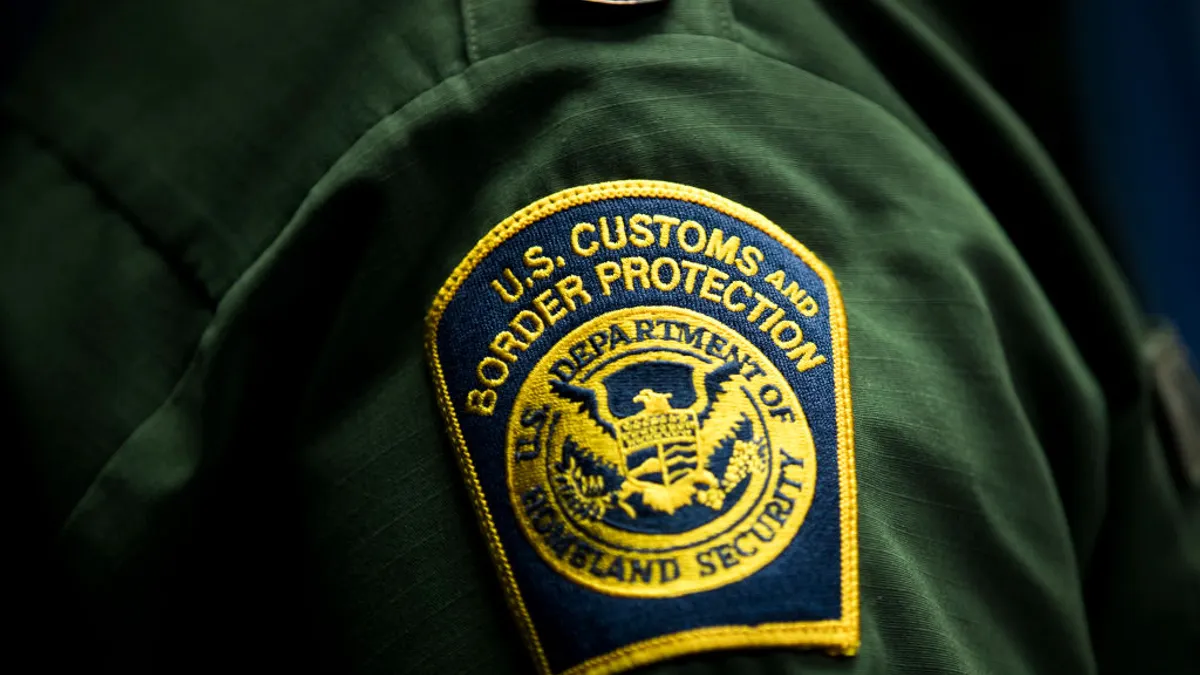
The U.S. is preparing to install new restrictions for foreign importers while establishing higher penalty floors for those noncompliant with customs regulations, according to an executive order signed on June 3 by President Donald Trump.
The order could introduce complications for overseas brands and shippers without an adequate level of supply chain visibility, experts told Supply Chain Dive. For example, importers must provide ownership disclosures, anticipated volumes and production methods, and customs brokers must "conduct greater due diligence of their importers," U.S. Customs and Border Protection said in a news release.
“This Executive Order helps CBP better detect when bad trade actors try to break the rules,” Susan Thomas, executive assistant commissioner for the CBP's Office of Trade, said in the release. “These are major advances in protecting our revenue and increasing supply chain transparency—both critical to ensuring fairness for everyone and safeguarding our nation’s economic and national security.”
The changes, which are set to take effect within 180 days of the order, add to the risks importers face for non-compliance, according to Rathna Sharad, CEO and founder of FlavorCloud, a cross-border shipping platform.
Here's how the order is poised to shake up importing rules and penalties — and what shippers should do to prepare for the looming overhaul.
Crackdown on foreign importers of record
All importers of record will need to maintain "a minimum level of tangible domestic assets, bonding, or both" to ensure they abide by trade laws, according to the order. This will allow the U.S. to more effectively penalize foreign entities in instances of noncompliance, experts said.
U.S. brands typically act as the importer of record or have an entity such as a customs broker act as the IOR on their behalf, Sharad said. While these businesses are easy to levy penalties against due to their U.S. ties, foreign IORs can be a different matter, with some leveraging shell companies that are difficult to take action against, she added.
The order said future guidance from the Secretary of Homeland Security will prioritize preventing entries that use "shell companies, sham transactions, or artificial corporate or organizational structuring in an attempt to qualify as a U.S. IOR."
To meet the minimum requirements to qualify as located within the U.S., an entity must have its principal place of business in the country, a physical presence where significant business is conducted and sufficient tangible U.S. assets, per the order. The Secretary of Homeland Security will provide further guidance pertaining to the definition of “located in the United States,” according to the order, although no timeline for such guidance was shared.
In the lead-up to the new rules, cross-border shippers should evaluate any foreign IOR arrangements currently in place, stress-test their bonding and domestic asset positions against higher minimums, and verify the accuracy of their ownership and supply chain disclosures and documentation, law firm Holland & Knight said in a June 9 alert.
The order also eliminates informal entry capabilities for foreign IORs. Type 11 informal entry generally allows imports below $2,500 to pass through customs in a streamlined manner versus the more rigorous compliance measures attached to formal entries. Type 11 has often been leveraged by low-value importers since the elimination of the de minimis exemption last year, according to Izzy Rosenzweig, CEO of Portless, which offers direct e-commerce fulfillment from Asia.
"If you do a shipment of a package to an individual person, almost always now it's under Type 11," Rosenzweig said.

Trump's order is eliminating the ability for foreign IORs to use informal entry partially because such importers bring in "substantially higher volumes of low-value articles" and face lower financial consequences for noncompliance since penalty amounts are correlated to value. Blocking informal entries for foreign IORs puts all importers on equal footing, the order said, noting that the U.S. faces hurdles when attempting to enforce its trade laws against overseas actors.
Sellers outside the U.S. or domestic companies using China-based carriers may have a tougher time maintaining their current import activity under the order's changes, Rosenzweig said.
"I think some of the big carriers in the cross-border space are going to have a very hard time being compliant," Rosenzweig said. "I would say anyone that's using this type of [informal entry] method or these carriers ask some hard questions."
Businesses should ask their carriers about their plans once the order's mandates take effect, including if the listed importer of record will still be able to maintain that status, he added.
Higher penalty floors elevates compliance pressures
For importers — be they foreign or domestic — that CBP deems noncompliant with new regulations, harsher enforcement penalties could be in play following the implementation of Trump's order.
All IORs will be required to maintain "good standing" with CBP within 180 days of the order's publication, a status based on the importer's compliance history, payment of required customs liabilities and other considerations. Those deemed to not be in good standing, such as IORs found to have illegally imported illicit substances like fentanyl, will not be allowed to import into the U.S. or conduct related activities.
The order also says CBP must establish a minimum floor of at least 50% for assessed penalty amounts on noncompliant importers — absent circumstances materially impacting national security — and eliminate mitigation options for repeat offenders, challenging businesses appealing for reduced charges. The Secretary of Homeland Security will revise standards to support that mandate within 90 days of the order's publication date.
"The ROI on compliance just doubled."

André Cruz
Senior manager of trade and customs at KPMG US
Under current regulations, CBP has broad discretion to cancel or reduce liquidated damage claims, which "often produces mitigation well below 50% of the assessed amount," according to Diaz Trade Law. Establishing a 50% floor would raise the stakes for petitions seeking relief from penalties, meaning timely and thoroughly documented petitions "will matter more than ever," it added.
For years, the CBP's mitigation guidelines have led to penalties being negotiated down to 10% or 25%, André Cruz, senior manager of trade and customs at KPMG US, said in a LinkedIn post. With the higher floor, compliance failures are now much more expensive, he said.
"If your compliance budget was denied last quarter, take this [executive order] to your CFO," Cruz said. "The ROI on compliance just doubled."
The order also calls for the Secretary of Homeland Security to establish heightened import disclosure requirements, including providing information about the supply chain and production methods of imports. The secretary will "enforce all applicable criminal fines and civil penalties in the event of noncompliance with these heightened requirements," the order noted.
Some overseas sellers may shift their focus to non-U.S. markets to avoid the increased regulatory burden, according to Scott Friedman, head of policy at Altana, which provides an artificial intelligence-powered trade platform. However, other countries are also ramping up their supply chain regulations, meaning shippers need to understand their supplier mix and be prepared to provide auditable information for a variety of markets, he said.
"This is just another drop in the bucket towards this idea that full traceability is now table stakes," Friedman said. "It is something you're going to have to do.”