Dive Brief:
- DHL Global Forwarding expanded its healthcare cold chain network to include six bi-directional corridors linking North America and Europe to healthcare and pharmaceutical hubs in Asia, according to an Oct. 12 press release.
- The newly established U.S.-based corridors include DHL’s hub in Cincinnati (CVG) to Singapore (SIN), CVG to Tokyo Narita (NRT), and CVG to Seoul Incheon (ICN), per the release.
- The corridors aim to provide pharmaceutical shippers with flexible routing, access to temperature-controlled capacity and more consistent transit across markets to reduce supply chain risk, according to the release.
Dive Insight:
The healthcare corridors, which are part of DHL’s Health Logistics Cold Chain Network, respond to customer demand for reliable pharmaceutical shipment connectivity between healthcare markets, DHL Freight spokesperson Laura Lehnen told Supply Chain Dive.
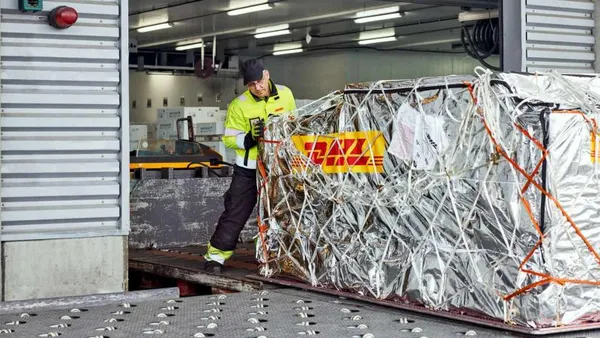
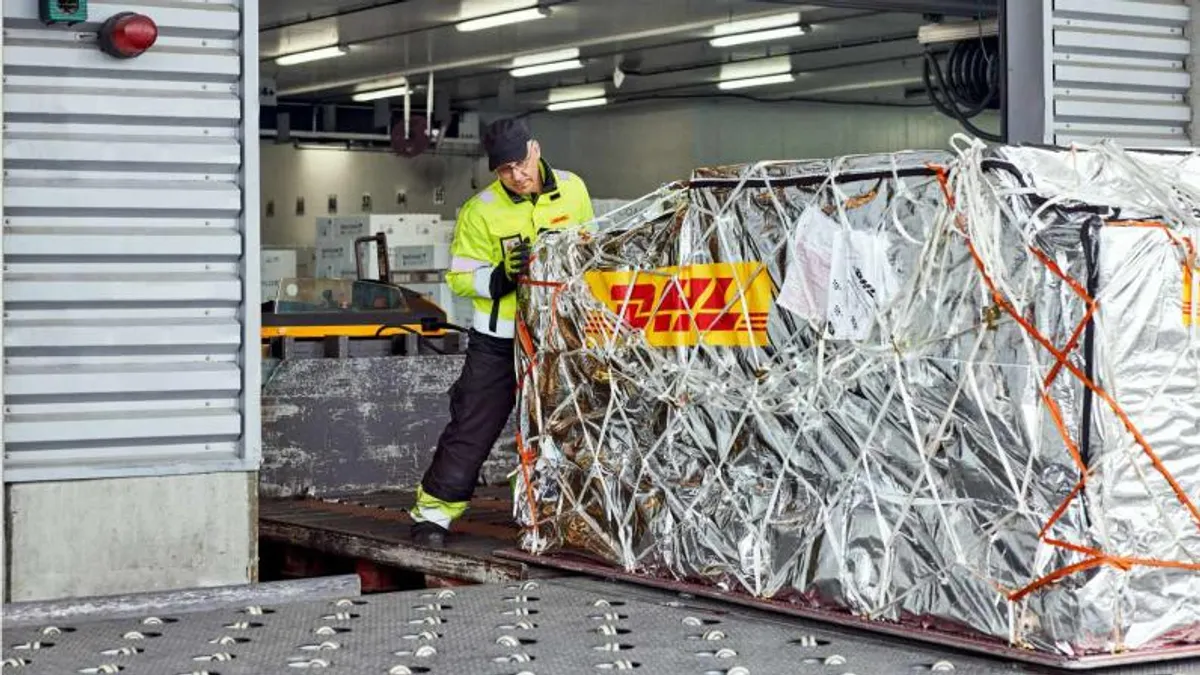
DHL’s Health Logistics Cold Chain Network is a global network of dedicated healthcare corridors that handle temperature-controlled goods, per the release. Through specialized handling processes and infrastructure, the network aims to provide safe and compliant transport of pharmaceuticals, biologics, vaccines, clinical trial materials and other healthcare products. Earlier this year, DHL Group also launched a Brussels (BRU)-CVG route as part of its cold chain network.
Currently, DHL is seeing stronger demand from pharmaceutical manufacturing hubs in North America and Europe to Asia, Lehnen said. In turn, current volume expectations are weighted toward inbound Asia shipments, with most of the corridor’s available air freight capacity dedicated to those Asia Pacific trade flows.
“DHL can therefore support both directions of trade as customer demand evolves and manufacturing and distribution patterns continue to develop,” Lehnen said.
A majority of the routes are operated using DHL’s Boeing 777 fleet, which are equipped with three different compartments with dedicated temperature settings, according to the release.
Cincinnati is one of DHL’s established healthcare gateways offering temperature-controlled storage and handling, GDP-compliant healthcare logistics facilities and specialized equipment, Lehnen said. Besides DHL’s temperature-controlled handling and storage footprint at CVG, it also operates a dedicated life sciences and healthcare facility in Indianapolis, per the release.
DHL is further building its healthcare logistics capabilities with several investments at CVG.
In the “near future,” for instance, DHL plans to deploy five temperature-controlled dollies to support the transport of healthcare shipments between aircraft and facilities during extreme weather, Lehnen said.
In 2027, the company will begin operating a new airside facility to provide temperature-controlled storage for both inbound and outbound Unit Load Devices, or ULDs, near the aircraft to maintain temperature integrity throughout the handling process, Lehnen added. DHL is also investing in a new off-airport facility that will provide temperature-controlled storage and handling, including ULD build-up and break-down capabilities, as well as pallet storage.
Other logistics providers have also been bolstering their healthcare supply chain capabilities. FedEx, for instance, in June launched a dedicated organization to support healthcare and pharmaceutical logistics. Last year, FedEx began offering a flight between Dublin, Ireland (DUB), and Indianapolis (IND) primarily targeting healthcare goods.