
As manufacturers move into the second half of 2026, they continue to navigate a complex mix of interest rates, inventory decisions, energy volatility and geopolitical uncertainty.
While inflation accelerated to 4.2% year over year in May, according to the latest Consumer Price Index report, executives and advisors say companies are still planning investments to help them compete beyond 2026.
One piece of good news for manufacturers is that the Federal Reserve kept interest rates unchanged at the last Wednesday’s Federal Open Market Committee meeting.
Experts say this steadiness in an otherwise uncertain environment can be especially helpful, given the difficulty large manufacturers may have shifting course after their factories are built and their machinery is purchased.
Preparing for 2027 through targeted investments
Alex Krutz, managing director at Patriot Industrial Partners, said issues such as oil price volatility stemming from the war in Iran may prove to be minor disruptions compared to the economic shocks triggered by COVID-19 in 2020.
"I don't think that companies in manufacturing, which is usually years in investment and planning, will make drastic decisions based upon a short-term shock," he said.
Krutz, who served as deputy assistant secretary for manufacturing at the Commerce Department in 2025, believes companies will take a more measured, strategic approach to navigating uncertainty.
“I think that company leaders need to be cognizant of laying out a plan that shows the roadmap for their investors, where they're going to go for their investors, and what it's going to take to get there,” he said.
Krutz sees five trends that manufacturers are investing in as they prepare for the second half of the year:
- A shift from global sourcing toward more localized supply chains, ensuring suppliers are located closer to production facilities and end customers.
- Efforts to develop an energy strategy by evaluating energy costs, grid reliability and emerging technologies.
- Increasing localized production of high-value and strategically important components, such as semiconductors, pharmaceuticals and other specialized products, to reduce supply chain vulnerabilities.
- A growing connection between industrial strategy, economic security and national security. Manufacturers are paying closer attention to how sourcing decisions, production capabilities and supply chain resilience align with broader economic priorities.
- Plans to pursue targeted, shorter-term artificial intelligence projects that can generate measurable operational improvements and productivity gains.
Initiatives like these support competitive positioning and may not always be out of reach financially, according to experts.
Scott Spyker, a supply chain technology expert who works closely with manufacturers, said uncertainty, not necessarily costs themselves, is often what causes companies to hesitate.
“Companies really don't care what the game is. As long as they know what it is, they can play it,” said Spyker, a partner at Neos by Argon & Co.
The challenge, he said, is that ongoing geopolitical events and economic volatility make it difficult for organizations to confidently plan investments months or years into the future. When companies are unsure what conditions will look like six months from now, they often become more cautious with spending and capital deployment.
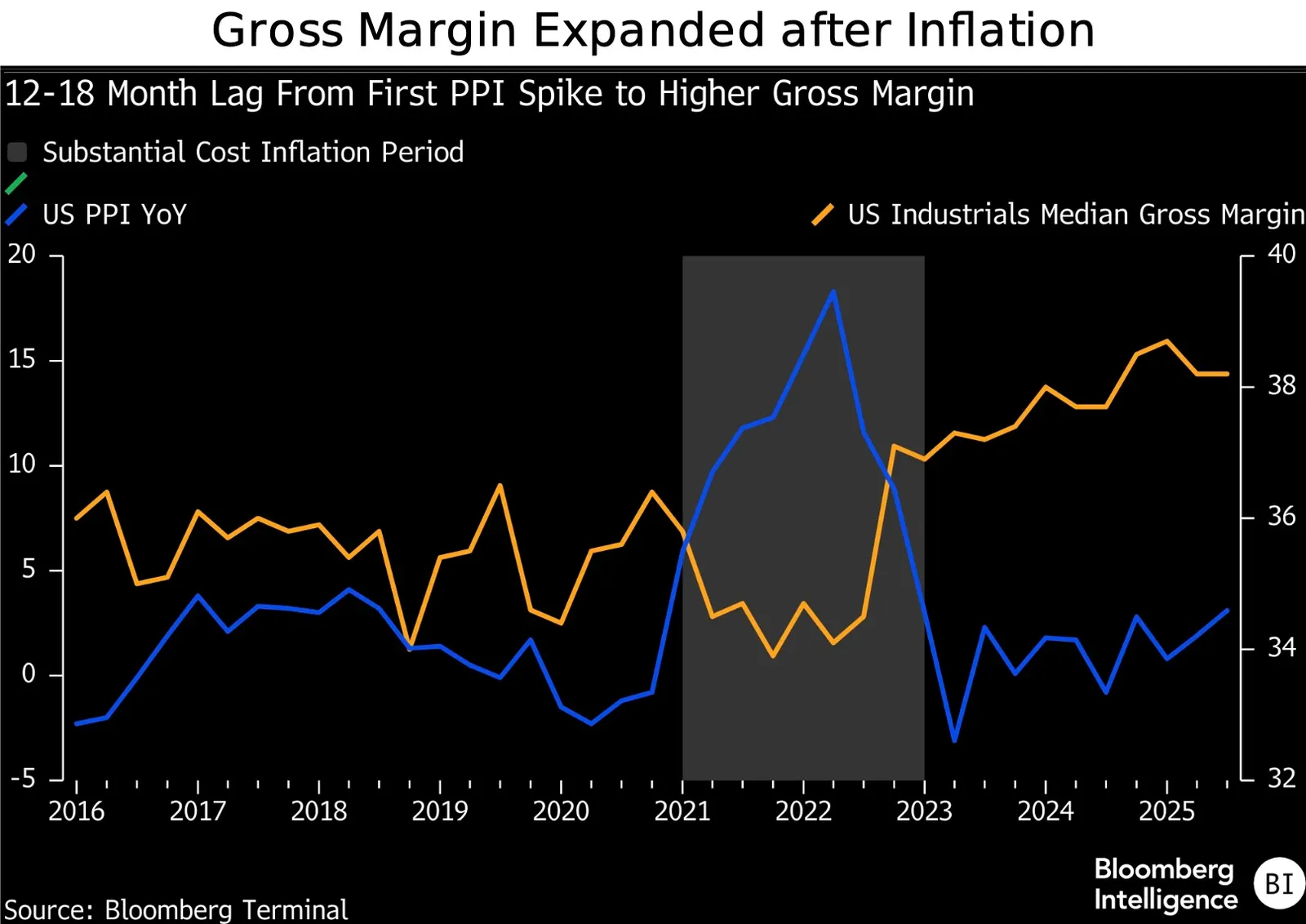
“Cost inflation is likely the biggest earnings risk for U.S. industrials beyond the next two quarters as input costs rise,” said Mustafa Okur, a senior research analyst for Bloomberg Intelligence, in a May 29 report.
The report noted that while many manufacturers benefit from short-term protection through hedging contracts, recovering margins through pricing actions can take considerably longer. It also noted that many industrial companies report being better prepared for inflationary pressures today than they were during the last major inflation cycle.
Prioritizing inventory and supply chain flexibility
One area where manufacturers may have a higher degree of control is inventory management.
During the pandemic and its aftermath, many companies learned costly lessons about supply chain disruptions and shortages. Today, manufacturers are taking a more nuanced approach, balancing the need for product availability against the financial burden of carrying excess inventory.
“There’s been a lot more talk about optimizing not only inventory quantities, but optimizing inventory placement,” Spyker said.
Companies are increasingly looking at the total cost of inventory throughout the supply chain rather than focusing solely on reducing stock levels.
Inventory remains one of the most important ways manufacturers can manage costs and margins. According to Spyker, organizations must carefully balance inventory levels with customer service expectations and demand forecasts.
“There are a couple of big levers from a manufacturing perspective that you can pull,” he said. “One is how much inventory are you carrying.”
Success increasingly depends on manufacturers having accurate forecasts and supply chains that can respond quickly to changing economic conditions, transportation disruptions or geopolitical developments.
Even when geopolitical tensions ease, the financial consequences often linger. For example, ships that cross the Strait of Hormuz can face significantly higher insurance premiums and operating costs, creating ripple effects across supply chains months after the original disruption.
Valencia Davis, a senior supply chain consultant at Neos by Argon & Co, says many manufacturers are focused on understanding exactly where inventory sits across their networks and how those decisions affect cash flow.
“A lot of focus is where should our inventory be to ensure that our service levels are on target,” she said.
That focus reflects a broader reality for manufacturers: Protecting customer relationships remains critical, even when economic conditions become challenging, and losing product availability can mean losing customers.
Not all manufacturers are approaching inventory the same way in this mid-year economic environment.
Spyker noted that healthcare manufacturers continue to maintain larger inventory positions than many other sectors because product availability provides a significant competitive advantage. Companies producing pharmaceuticals and medical devices are often willing to absorb additional inventory costs rather than risk shortages that could push customers toward competitors.
Manufacturers may face a new layer of uncertainty in the months ahead.
Federal Reserve Chair Kevin Warsh's recent statement omitted any forward guidance, a communication tool the bank has long used to signal its future interest rate intentions, even as the White House has pushed for rate cuts. Warsh himself did not participate in the latest forecasting exercise, and FOMC members were split on the question of rate cuts or increases. As a result, while today's rate environment is relatively well understood, the outlook for the remainder of the year is far less predictable.
Still, Davis said uncertainty has become a familiar operating condition for many manufacturing organizations.
“Most of our customers live in this chaotic space,” she said. “They're just finding new creative ways to solve the problem.”