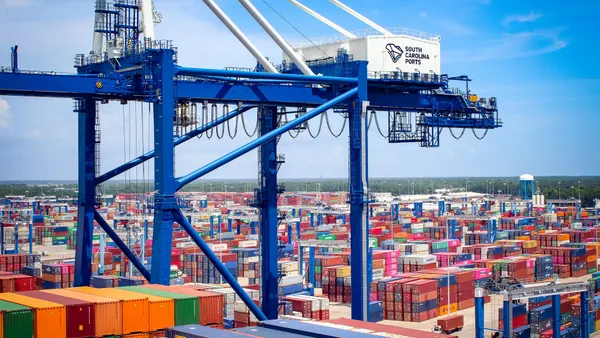
Shippers are changing how they route their cargo to capitalize on pricing advantages in intermodal transport.
The trucking market has been tightening for five months now. Shippers are dealing with higher truckload spot rates, which are up 27% for van and 30% for reefer year over year, according to Uber Freight’s economic and market update for April.
Truckload contract rates are also up by about 5% and 6% year over year across all categories, per the report. Along with increasing tender rejections, these are all indicators of a tightening market, Uber Freight Principal Economist Mazen Danaf told Supply Chain Dive in an interview.
During soft markets, volume tends to move from intermodal and less-than-truckload to truckload services, but in tight markets, the opposite happens, Danaf said.
“The tight market capacity becomes too constrained, and volume starts overflowing to the intermodal market and the LTL market,” he said.
Intermodal rates lag behind truck rates by about three to six months, and now they're climbing due to rising diesel costs and a strengthening truckload sector, according to Uber Freight’s economic report. Still, intermodal remains a cheaper freight alternative.
Fuel costs and tight capacity weigh on freight strategies
The Iran war has increased fuel costs and impacted global shipping flows, stymieing traffic through the Strait of Hormuz. The major waterway is known for transporting oil, and fuel prices have gone up since the war started.
On-highway diesel prices were at $5.351 per gallon, up $1.837 from a year ago, per April 27 data from the U.S. Energy Information Administration.
“This year we are seeing that spot rates remained high in March, actually, they increased because of fuel, and remained high into April as well,” Danaf said. “We didn't see the typical seasonal dip, and because of that, what we're telling our shippers is to be prepared for more tightness to come, because this is what we're seeing in April.”
The month of April tends to be the “calm before the storm,” and shippers should be prepared for increased market tightness in May and June, Danaf said.
Market tightness from typical seasonality tends to increase as the Commercial Vehicle Safety Alliance’s International Roadcheck takes place from May 12 to May 14. Further pressure normally emerges heading into June until the end of the Fourth of July as summer produce volumes surge, Danaf said.
Union Pacific, Norfolk Southern and CSX have reported how their rail and intermodal services stand to benefit in terms of volumes due to existing higher trucking rates and fuel costs, according to several earnings calls.
Shippers grapple with higher tender rejections
Contract rates are climbing and tender rejections are up about 10% from last year, Danaf said. These are all signs of a tightening market driven mostly by supply, he said.
“[O]n the supply side, we’ve seen the sharpest capacity reduction since the great financial crisis over the last three years, and that’s looking at truckload employment,” Danaf added.
The reduction stems from regulatory enforcement efforts, such as stricter English-language proficiency policies that have been put into place for commercial drivers.
With a tighter market, carriers may look for opportunities to make more money by rejecting loads in favor of more lucrative volume on the spot market.
Carrier rejections are coming at higher costs than before. A few months ago, it was a 1% incremental cost when a shippers' preferred carrier rejected a load. Right now, that expected cost increase has climbed somewhere between 7% and 9%, Danaf said.
This is why having a diversified carrier base is important, Danaf said. When a shipper gets their load rejected, they either have to go to the spot market or other carriers they aren't optimized for, spurring additional costs for the shipper.
In the report, Danaf said that shippers should “proactively diversify carrier partnerships on essential lanes to avoid the need for reactive sourcing.”