Dive Brief:
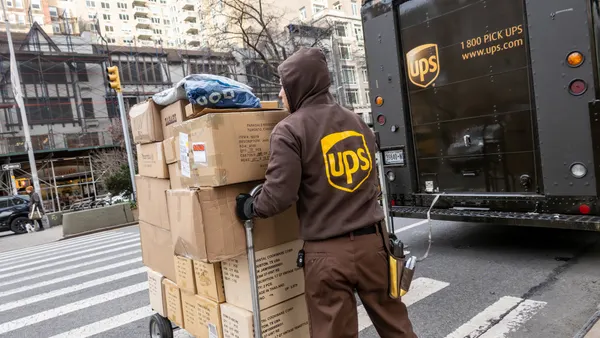
- UPS reduced the average daily volume it delivered for Amazon by 500,000 pieces in Q1, advancing the carrier's plan to cut its Amazon volume in half by June, CEO Carol Tomé said on a Q1 earnings call Tuesday.
- Amazon made up 8.8% of UPS' total revenue at the end of the quarter, Tomé said, down from 10.6% in 2025. Despite the large-scale volume reduction, she said UPS wants to continue its work with Amazon, particularly in the product returns space.
- "Returns are the nemesis of anybody who's in the e-commerce space," Tomé said. "In fact, 19% of all e-commerce sales are returned. And so with our great reverse network, the capabilities that we have for box-less, label-less returns, that relationship with Amazon is just going to continue to grow."
Dive Insight:
With fewer Amazon packages to deliver, UPS made further progress in slimming down its network in Q1. The company closed 23 buildings and reduced nearly 25,000 operational positions year over year, EVP and CFO Brian Dykes said. UPS is also buying out roughly 7,500 drivers through its "Driver Choice Program," with 77% of departures leaving in April, Tomé said.
"Interest in the program was extremely strong and ultimately exceeded our expectations," she said, adding that more drivers applied than UPS could accept.
UPS will have a "more agile and more automated network" in the second half of the year following the completion of its Amazon volume reduction and related network adjustments, according to Dykes. The company has automated nearly 68% of its buildings in a push to handle packages more cost effectively, Tomé added.
Going forward, UPS also plans to focus on winning more profitable volume among smaller companies, business-to-business shippers and complex healthcare customers, Tomé said.
UPS has already made progress on that front, with small and medium-sized businesses making up 34.5% of UPS' U.S. volume in Q1, up from 31.2% in Q1 2025. Additionally, UPS achieved its first-ever $3 billion quarter for healthcare revenue, Tomé said. She highlighted direct-to-consumer shipments of GLP-1 drugs as an area where the company leads the market.
"We won't forget healthcare ever, because healthcare is such an important part of our growth engine," Tomé said. "It is in every segment of our business with double-digit operating margins, and we're going to continue to lean into that space in a meaningful way."
Rival FedEx is pursuing a similar strategy, distancing itself from general e-commerce volume while emphasizing higher-value shipments in segments like healthcare.