Dive Brief:
- Amazon Web Services today launched “Amazon Connect Decisions,” an agentic supply chain planning and intelligence tool that aims to help businesses improve planning, data analysis and decision making.
- The product combines more than 25 specialized supply chain tools into a set of artificial intelligence agents, called “teammates,” to make calculations on behalf of the user, VP of AWS Supply Chain Ozgur Dogan told Supply Chain Dive.
- “Every variance, invisible patterns — the system learns and gets better,” Dogan said. “And a supply planner can make an action, take an action, the system learns from it and spreads [it] to everyone.”
Dive Insight:
At its core, Amazon Connect Decisions aims to help companies make more informed decisions in hours instead of days, Dogan said, noting that the new platform is based on Amazon’s decades of experience managing over 400 million SKUs.
More than 10 beta customers have been using Connect Decision since late last year, Dogan said. Some of these clients include Wells Vehicle Electronics and TVS Motors, per an Amazon blog post published Tuesday.
The platform connects data from multiple systems and centralizes those decisions into a hub that compounds information over time. Through the system, which can connect with existing tools such as enterprise resource planning tools, the AI teammates can trace an issue’s root cause and present potential resolutions, Dogan said.
Beyond translating demand forecasts, Connect Decisions also can assess thousands of alerts within the system to help prioritize tasks. Dogan added that in some cases, the AI agents can help detect “invisible patterns” so companies can identify unnecessary stocks they don’t need to be carrying.
“At all times, they provide complete visibility and transparency into AI recommendations and decision-making, so you stay in control,” per the Amazon blog post. “AI teammates continuously learn from your team's actions, translating those learnings into better planning, analysis, and recommendations.”
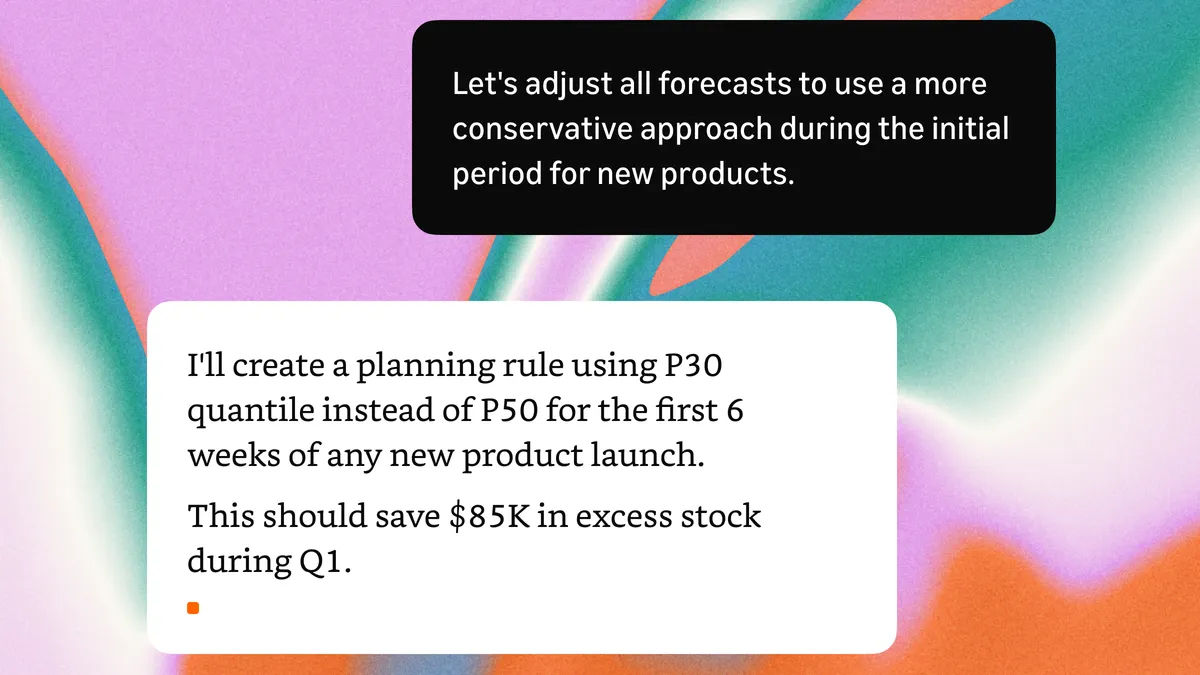
Connect Decisions leverages both a visual and chat user interface, Dogan said. With the chat feature, users can directly ask the model specific questions about the data being presented. Meanwhile, system-created visual charts can help a supply chain planner with forecasting decisions.
“But it's not a static dashboard that sticks and doesn't change,” Dogan said. “It's completely depending on how the company wants to use it.”
Once supply chain teams begin using the product, it can also institutionalize decisions and business goals, which can then be scaled across the entire organization.
“So it doesn't ask to change how the companies operate,” Dogan said. “It adapts to them and just makes the decisions faster.”
Amazon Supply Chain Optimization Technology, called “SCOT,” is one of Connect Decisions’ foundation models, Abhishek Gupta, director of forecasting and labs at Amazon SCOT, told Supply Chain Dive. Gupta described SCOT as a distribution of AI machine learning and optimization systems that make predictions, recommendations and other daily decisions.
“So, SCOT is deciding what items to buy, where inventory should be placed, and how it is stored throughout our global fulfillment network, and after, how do we ship it to our customers,” Gupta said.
SCOT’s AI models examine historical data, including events such as holidays and planned product promotions to help improve forecasts, he added.
Connect Decisions is a “new evolution” of AWS Supply Chain, which launched in 2022, Dogan said. The cloud tool, which enabled users to pool information into a central data lake, was later expanded to include four new capabilities in 2024.