Dive Brief:
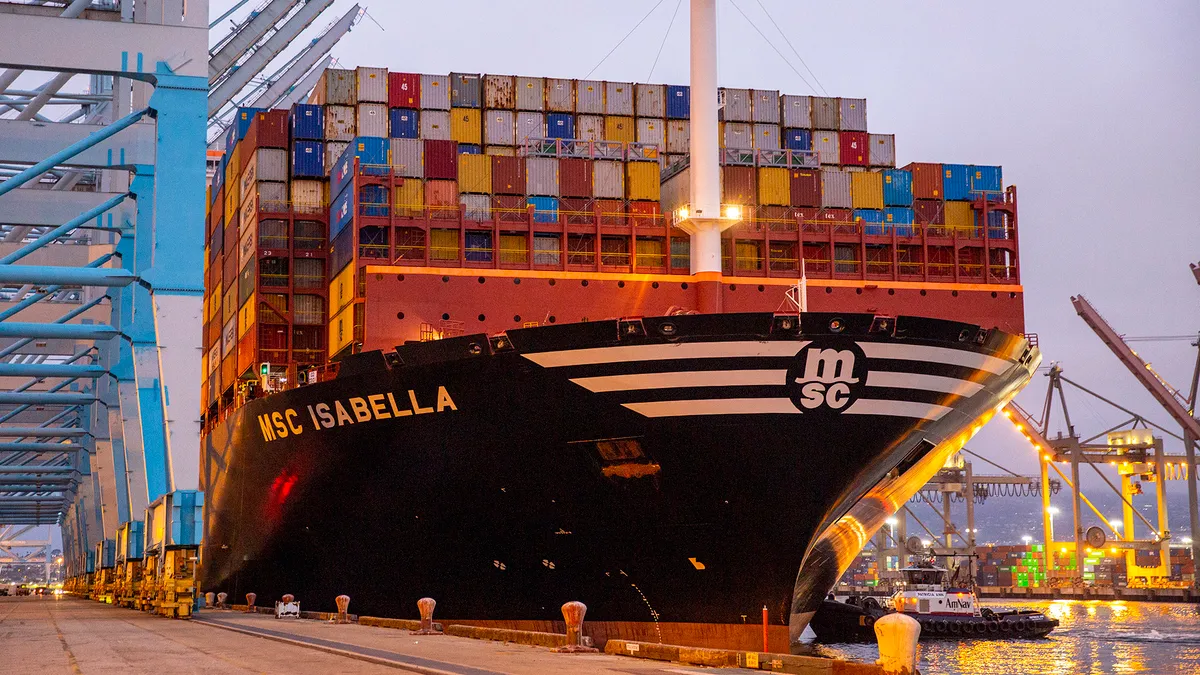
- Ocean shippers are moving quickly to take advantage of the current “window of stability,” pushing to speed cargo through the supply chain as conditions allow, Port of Los Angeles Executive Director Gene Seroka said during a June 16 media briefing.
- In May, the port processed 840,165 TEUs, up 17% year over year, driven by a burst in volumes as shippers navigate trade policy uncertainty, according to a June 16 press release.
- “Our strong May performance reflects the resilience of the American consumer and the ability of businesses to adapt in a continuously changing environment,” Seroka said in the release.
Dive Insight:
Companies are factoring in energy costs, tariffs, inventory needs and geopolitical risks when making strategic sourcing and shipping decisions, according to Seroka. Amid this turbulence, “companies are operating with shorter planning horizons and taking advantage of opportunities when they emerge,” he said in the press release.
Looking ahead, the Port of Los Angeles is forecasting a strong summer. Seroka noted that the port optimizer signal, which tracks Los Angeles-bound imports, is projecting the port to surpass 900,000 container units in June.
The Port of Los Angeles is also projected to handle more than 900,000 container units in July — a “strong number historically for us,” Seroka said. Last year, cargo frontloading peaked in July as importers hustled to move cargo ahead of possible tariff hikes. That month, the port handled more than 1 million TEUs.
Aligning with Seroka’s expectations, the Global Port Tracker, published by the National Retail Federation and Hackett Associates, also forecasts a bump in import volumes in June and July, indicating an early peak season.
Despite the projected dip in July TEUs, “coming in at 900,000 crossing that mark is really good, but it'll look just a little bit different than last year,” Seroka said, noting that it shows that consumers continue to spend despite higher inflation.
The port director further said that retail products, including toys, electronics, apparel and furniture, will continue to roll in. On the business side, parts and components from American factories are still on the move.
According to Seroka, “the supply chain works best when there's a semblance of certainty around it.”
Seroka also said some importers haven’t yet felt the total impact of higher energy prices relative to bunker and disel fuel on the land side.
Seroka also noted that the port might even get a “pop of cargo” imports closer to the end-of-year holiday season, specifically fashion and children-themed products that are in demand during that time.
“So, I don't think it's all over with an early peak season, but it does show that people are being very mindful of the geopolitics and what impacts it's having on their business,” the port director said.
Despite Seroka in April characterizing the Iran war as a “concern” but not a worry for ocean shippers, the conflict still casts a shadow over the market. While the U.S. and Iran agreed to a memorandum of understanding that would reopen the Strait of Hormuz, per the Associated Press, Seroka said it will take shipping lines months to normalize schedules, clear backlogs and return the supply chain “back to some semblance of normalcy.”