A wave of U.S. Postal Service pricing changes is set to take effect next month, introducing fresh cost pressures for parcel shippers.
On July 12, the agency will change how it calculates the size and rates for large-but-lightweight packages, expand its dimensional reporting requirements, and eliminate ounce-based rates for certain USPS Ground Advantage shipments. Some of the changes could catch unprepared shippers off guard and increase their transportation costs, experts told Supply Chain Dive.
The changes align the Postal Service’s pricing practices more closely with those of FedEx and UPS. The adjustments could also draw in additional revenue for the financially ailing agency. However, the moves come with some risk attached, as customers could explore other delivery options, said Mark Waverek, managing partner at PlaidMark Management Consulting Services.
"The biggest challenge probably for the Post Office is maintaining or retaining existing customers through these changes," Waverek said.
USPS tweaks dimensional measurements
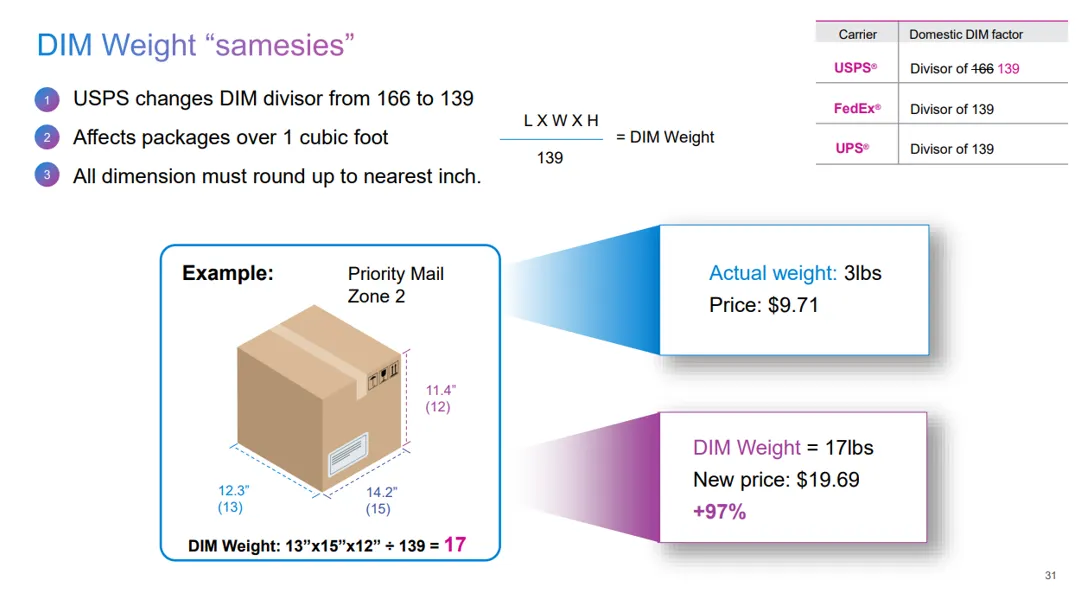
Packages exceeding one cubic foot are subject to USPS rates based on dimensional weight, which is calculated by multiplying length, width and height, then dividing that total by a specific number called the divisor. USPS will lower its divisor from 166 to 139 — matching FedEx and UPS’ typical approach — and round up all fractional measurements to the next inch starting July 12.
These pricing adjustments will fuel higher rates for shipments measured by dimensional weight, Waverek told Supply Chain Dive. For example, a Priority Mail package that weighs three pounds could have a dimensional weight of 17 pounds under the new rules, resulting in higher charges, according to a Pitney Bowes presentation earlier this month.
Shippers with a limited amount of SKUs and packaging sizes should be able to adjust to the USPS changes quickly, but businesses frequently customizing their box sizes will need to weigh the pricing impacts at a deeper level, Waverek said.
Lightweight but bulky packages are especially vulnerable to the Postal Service’s changes, because the parcels’ dimensional weights will likely be much higher than their actual weights, logistics data platform Loop said on LinkedIn.
To mitigate cost challenges, shippers should find opportunities to shrink their package sizes, said Jack McCrum, director of optimization and analytics at Reveel, which offers a parcel shipping intelligence platform.
"If you have a lot of empty space in your packages, you're going to be more susceptible to these fractional changes," McCrum said. “It's going to be more painful for you.”
Shippers will also need to ensure they report their package dimensions to USPS accurately when using services like Ground Advantage or Priority Mail, or face a $3 noncompliance fee. The requirement currently applies only to parcels exceeding 1 cubic foot or 22 inches in length, but it will expand to all shipments within the affected services regardless of size starting July 12. However, the noncompliance charge on newly eligible shipments won’t start being assessed until early next year.
"If you have a lot of empty space in your packages, you're going to be more susceptible to these fractional changes. It's going to be more painful for you.”

Jack McCrum
Director of optimization and analytics at Reveel
McCrum advised shippers to “have very accurate measurements ahead of this implementation change” in their warehouse and transportation management systems, as a $3 charge can snowball into a bigger cost challenge for high-volume shippers. For example, when UPS began rounding up fractions of an inch last year, many noncompliant packages were hit with additional fees. This led to some shippers facing shipping charge corrections up to three times what they would normally pay, McCrum said.
Price increases for sub-pound shipments
On the same day the Postal Service is adjusting its dimensional pricing, the agency will also eliminate ounce-based rate differences for sub-pound USPS Ground Advantage Commercial shipments. Some shipments’ prices will jump as much as $2.04 with the change.
USPS Ground Advantage Commercial price increases by weight and shipping distance, effective July 12
| Maximum weight | Zone 1 | Zone 2 | Zone 3 | Zone 4 | Zone 5 | Zone 6 | Zone 7 | Zone 8 | Zone 9 |
|---|---|---|---|---|---|---|---|---|---|
| 4 ounces | +$1.43 | +$1.36 | +$1.66 | +$1.74 | +$1.86 | +$1.86 | +$1.94 | +$2.04 | +$2.04 |
| 8 ounces | +$0.90 | +$0.79 | +$1.12 | +$1.16 | +$1.33 | +$1.42 | +$1.51 | +$1.66 | +$1.66 |
| 12 ounces | +$0.77 | +$0.69 | +$0.97 | +$1.07 | +$1.17 | +$1.12 | +$1.17 | +$1.27 | +$1.27 |
Source: USPS published rates, Postal Regulatory Commission filing
Ground Advantage Commercial rates will still be lower than retail rates for sub-pound shipments, David Bilodeau, senior director of product marketing at Pitney Bowes, said during the presentation. He added that Ground Advantage shipments made through Pitney Bowes' software will still retain ounce-based pricing.
As such, smaller businesses and shippers sending only a sliver of their volume to the Postal Service will be particularly susceptible to the ounce-based rate elimination, as they likely don't have enough volume to justify a USPS contract, said Waverek of PlaidMark Management Consulting Services.
Vulnerable shippers may consider diverting volume to cost-effective alternative carrier options. However, other providers are more limited in their coverage scope compared to the USPS, and adding new delivery providers can introduce other hurdles, Waverek added.
"There's operational costs every time you add a carrier, you add another distribution point in your operation, or you add another truck and trailer on the dock," he said.
Additionally, the change does not impact customers with negotiated commercial rates. That said, it does open the door for the Postal Service to be more strict on ounce-based pricing options in future shipping contracts, according to Reveel’s McCrum.
"I don't necessarily believe that you're going to get the same deals that you would have gotten before this change is going into place," he said.