
Dive Brief:
- The Federal Reserve held the main interest rate steady Wednesday while deleting wording in a policy statement suggesting that it leaned toward trimming borrowing costs in the future.
- In a policy statement at the end of a two-day meeting, the Federal Open Market Committee decided in a 12-0 vote to remove a reference from its April 29 statement referring to “additional adjustments” to the main rate beyond the several cuts between September 2024 and December 2025. Fed officials forecast in a median projection that the main rate, now at a range between 3.5% and 3.75%, will end the year at 3.8%.
- The FOMC noted that inflation persists above the central bank’s 2% goal, “in part reflecting supply shocks that have driven price increases in certain sectors, including energy.” Concluding an unusually brief statement and hinting that the next change to the main rate may be an increase, the FOMC said that it “will deliver price stability.”
Dive Insight:
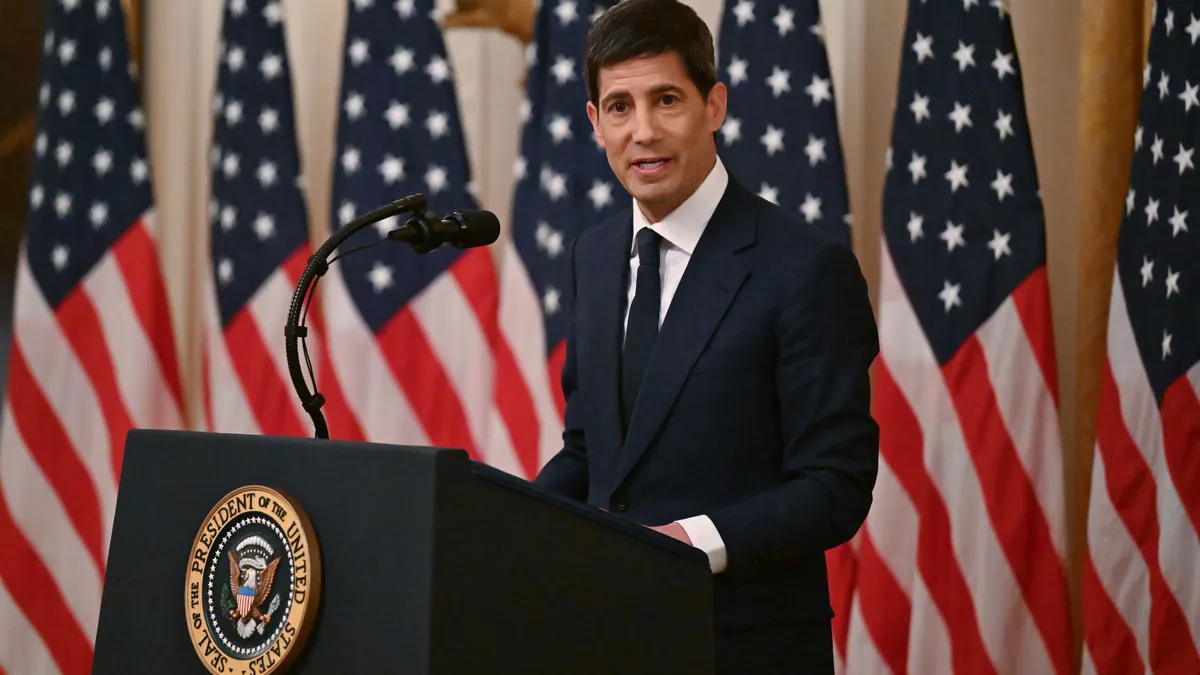
The FOMC met for the first time under newly appointed Fed Chair Kevin Warsh, who won nomination from President Donald Trump and rose to the top spot last month after echoing the president’s call for cuts to the federal funds rate.
With war-induced inflation rising since February, Warsh in a press conference on Wednesday flipped his message, repeatedly saying that the Fed’s monetary policy committee will push down price pressures.
“I’ve said for years that inflation is a choice,” Warsh said. “And today I'm announcing that this committee unambiguously and unanimously has decided we are going to deliver” on its mandate for price stability.
Fed officials forecast that their preferred measure of inflation, the personal consumption expenditures index excluding volatile food and energy prices, will end this year at 3.3% and fall to 2.5% by the end of 2027.
In congressional testimony and other public comments late last year before his nomination, Warsh also called for sweeping change at the central bank.
Warsh advocated for reducing the Fed’s balance sheet and scaling back its communications including “forward guidance,” or the comments and quarterly economic projections aimed at influencing public perceptions of the future direction of central bank decisions.
On Wednesday Warsh announced the creation of five task forces that will review the Fed’s approach to those two areas and three others: new data sources and data gathering approaches; productivity and jobs, along with artificial intelligence and other new technologies; and the forces that fuel inflation and ways to ensure price stability.
“For each of these independent task forces I'm enlisting some of the very best minds, both inside and outside the economics profession,” Warsh said.
“They'll have a straightforward charge: start with first principles, ask hard questions, examine current practice, consider alternatives and ultimately propose next steps for policymaker consideration,” he said, adding that he expects the task forces to submit reports before 2027.
Warsh expressed a favorable view toward U.S. economic growth. “Economic activity is expanding at a solid pace, despite elevated uncertainty that owes in part to the conflict in the Middle East,” he said.
Fed officials, in their median forecast, see the economy growing 2.2% this year and 2.3% in 2027.
Warsh also said the labor market is showing signs of firming.
“I'd say the jobs data has been moving in a good direction,” he said.
“The committee thought that the labor markets were stable,” Warsh said, adding “there were some people around the committee who thought that it was trending better.”
Fed officials in their median projections forecast that unemployment will end this year and 2027 at 4.3% before falling to 4.2% in 2028.