
For years, supply chain strategy has centered on optimization—driving down cost, reducing inventory and streamlining operations. But today’s environment is exposing the limits of that approach.
Retailers and ecommerce brands are navigating a new layer of disruption. The recent end of the de minimis exemption and wide-ranging tariffs have increased the cost of cross-border ecommerce. In addition, the upcoming review of the United States-Mexico-Canada Agreement (USMCA) is introducing uncertainty into sourcing decisions across North America. Combined with ongoing demand volatility and rising customer expectations, these shifts are forcing companies to rethink how their supply chains are designed—not just how they operate.
The takeaway is clear: supply chains can no longer be built solely for efficiency. They must be designed for adaptability.
This doesn’t mean sacrificing cost discipline. In fact, the most effective strategies are those that enable flexibility without adding structural cost. And increasingly, that starts with fulfillment.
Why fulfillment strategy is under pressure
Trade policy changes are reshaping the economics of how goods move. For ecommerce brands that relied on low-cost, cross-border shipping, the loss of de minimis advantages and high tariffs have quickly eroded margins. For retailers sourcing across North America, uncertainty around USMCA provisions may shift where products are manufactured or assembled.
These changes don’t just impact sourcing—they directly affect where inventory should be positioned and how orders are fulfilled.
At the same time, customer expectations continue to evolve. Speed still matters, but not at any cost. Consumers are increasingly balancing delivery time with price and reliability, putting pressure on retailers to find more efficient ways to meet service expectations.
In this environment, fulfillment is no longer a downstream function. It has become a central lever for managing cost, service and risk.
What an adaptable fulfillment network looks like
An adaptable fulfillment network is not built on excess capacity or redundant inventory. It is built on smart design.
- Flexibility in warehouse capacity is critical. Relying solely on fixed, dedicated space can limit a company’s ability to respond to shifts in demand or sourcing. More flexible models allow retailers to scale operations up or down without being locked into long-term constraints.
- Distributed inventory strategies are becoming more important. Positioning inventory across multiple nodes reduces reliance on any single flow of goods—whether that’s a specific port, supplier, or import channel. It also enables retailers to place products closer to customers, improving delivery speed while controlling transportation costs.
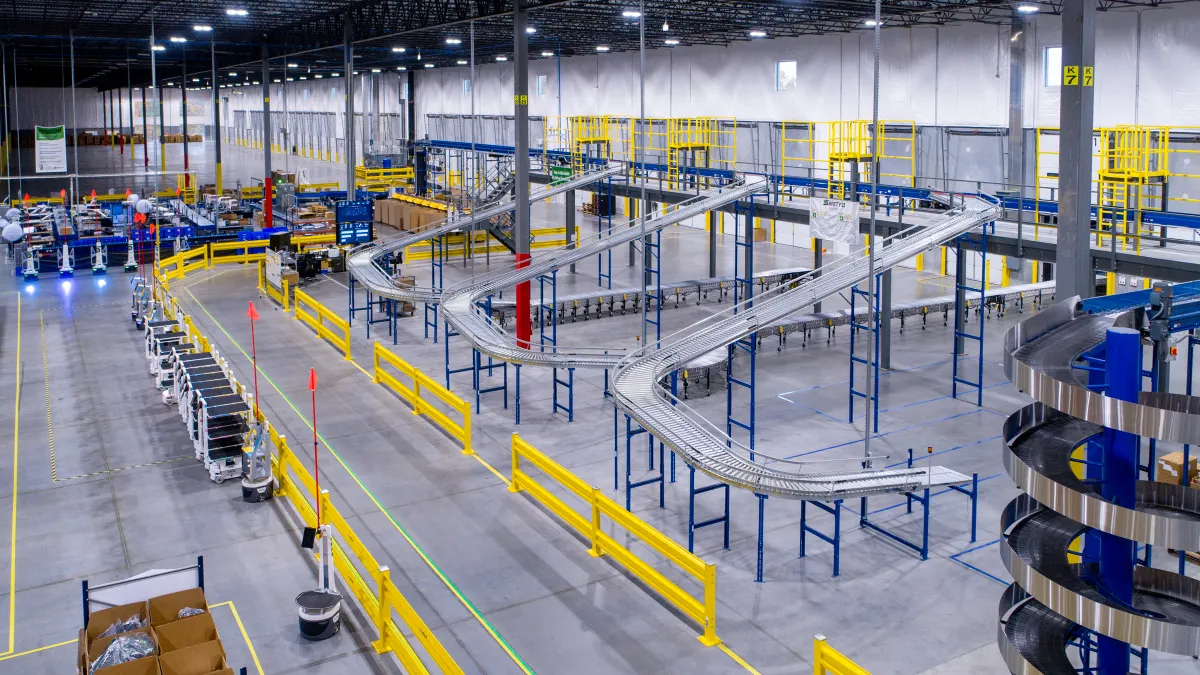
- Scalable operations—supported by a combination of labor strategies and automation—allow fulfillment centers to adjust throughput as volumes fluctuate. Rather than building for peak and carrying excess cost year-round, adaptable operations can expand and contract more efficiently.
- Connected systems provide the visibility needed to make these decisions in real time. When inventory, orders and transportation data are integrated, companies can dynamically adjust fulfillment strategies as conditions change.
Rethinking the cost of flexibility
There’s a common assumption that building flexibility into a supply chain inevitably increases cost. In practice, the opposite is often true.
A well-designed fulfillment network can reduce total landed cost by minimizing reliance on expedited shipping, improving inventory placement and increasing operational efficiency. Distributed networks, for example, can shorten delivery distances and reduce parcel spend. Scalable automation can improve throughput without a proportional increase in labor.
Perhaps most importantly, adaptability reduces the cost of disruption. When supply chains are rigid, even small changes—whether from policy shifts, demand spikes, or supplier issues—can trigger expensive workarounds. Flexible networks are better equipped to absorb these changes without significant financial impact.
How retailers can build optionality now
Building a more adaptable fulfillment network doesn’t require a complete overhaul. Many retailers are taking incremental steps to introduce greater optionality into their operations.
That often starts with evaluating current network design to identify single points of failure or overreliance on specific sourcing or fulfillment models. From there, companies can introduce additional fulfillment nodes in key regions, diversify inventory strategies across channels and invest in technologies that enable better visibility and decision-making.
Equally important is aligning fulfillment strategy with customer expectations. Not every order needs to be delivered as quickly as possible—but every order needs to meet the promise made to the customer, at a cost that makes sense for the business.
Designing for what comes next
Recent trade policy shifts are unlikely to be the last disruptions retailers face. If anything, they reinforce a broader trend: supply chain conditions will continue to evolve, often unpredictably.
The companies that perform best won’t be those that try to optimize for a single, stable scenario. They will be the ones that build networks capable of adapting to whatever comes next.
In today’s environment, the most efficient supply chain isn’t the most optimized. It’s the one that can adjust—quickly, intelligently and without unnecessary cost.