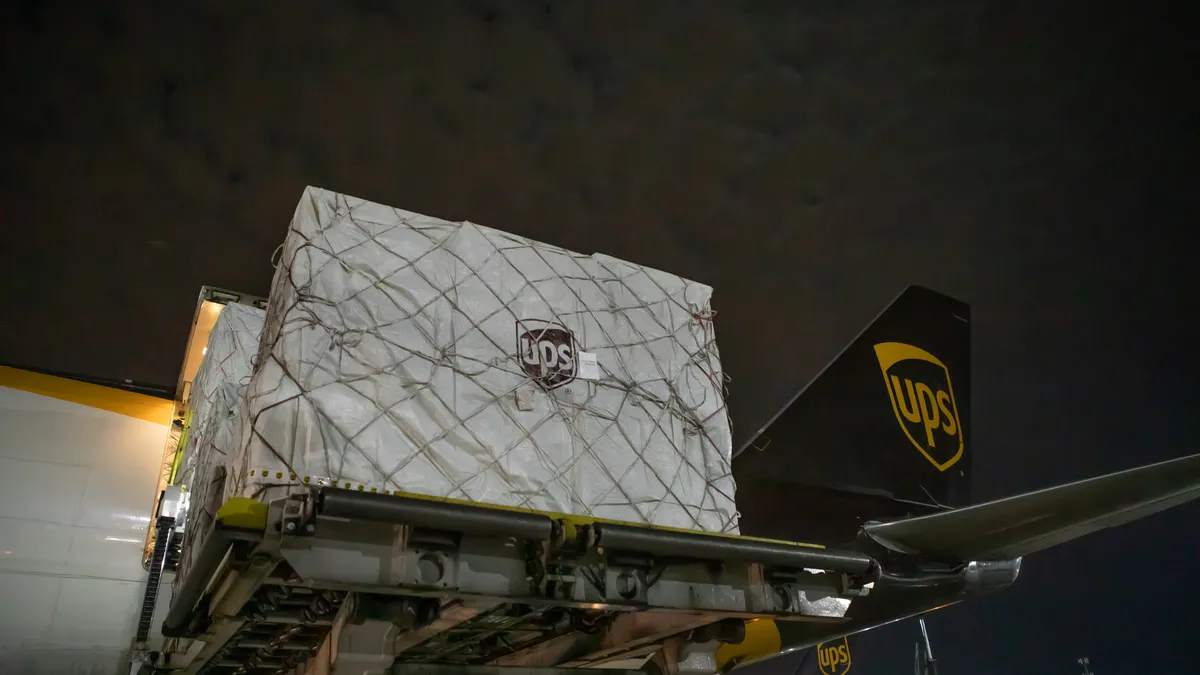
The U.S. Postal Service is transporting more First-Class Mail and Marketing Mail via air to satisfy its air cargo contract with UPS and avoid higher rates, according to a July 1 report from the agency's Office of Inspector General.
As part of its contract with UPS, which became the agency’s primary air transportation provider in 2024, the USPS guarantees a minimum daily average volume, with increased rates applying if volumes are a certain percentage above or below the negotiated amount.
The exact percentage was redacted in the report, which did not name UPS directly. However, it focused on the Postal Service's primary air cargo contract that began on Sept. 30, 2024, which aligns with the characteristics of the UPS agreement. The deal is valued at more than $10 billion and is effective through March 2030, according to the OIG.
The USPS didn't adequately consider declining volume for its Priority Mail service when solidifying the minimum volume thresholds, the report said. In the agency's 2025 fiscal year, volume for Priority Mail services plummeted 24.1% year over year as shippers shifted packages to slower but more affordable services.
The contract's volume requirement means the Postal Service has "little choice but to fly First-Class Mail" to make up for the shortfall and avoid higher expenses, per the report.
The agency's First-Class Mail and Marketing Mail product categories have historically relied heavily on surface transportation, the report said. However, those services have begun leaning on air cargo more often over the course of the UPS deal. For example, the percentage of First-Class Mail in the three-to-five-day shipping range traveling via air jumped from 2% in fiscal year 2025 to 50% by the middle of fiscal 2026, according to the report.
If the agency had only transported packages via air, rather than supplementing volumes with First-Class Mail and Marketing Mail, the agency's total transportation costs would have increased by more than $127 million, the report said.
"If package volumes continue to trend downward, the Postal Service will likely shift even more First-Class Mail and Marketing Mail into the air network to avoid higher costs even though that is inconsistent with the longer-term goal of reducing reliance on high-cost air transportation," the report said.
In a response included in the report, USPS management defended its approach of using more air transport for First-Class Mail, adding that the contract allows the agency to make adjustments in instances of market demand shifts.
"Flying First-Class Mail has helped manage costs in our air network by maintaining a favorable pricing tier and improved service performance for First-Class Mail," the agency said.
Despite the volume minimums, the OIG report said the new agreement has enabled the USPS to lower costs and increase flexibility in capacity planning while featuring a more stringent on-time transportation requirement. The agency has realized annual savings of about $1.7 billion due to the new air contract and other initiatives, per the report.
Still, the OIG recommended the USPS conduct an updated cost-benefit analysis to determine if terminating the current contract and pursuing a new deal would better align with ongoing volume and network changes.
"With the contract’s long duration and the continued difficulty of meeting minimum volumes without relying on First-Class Mail, the Postal Service may want to assess its options moving forward, including whether the current agreement remains the most effective approach," the report said.