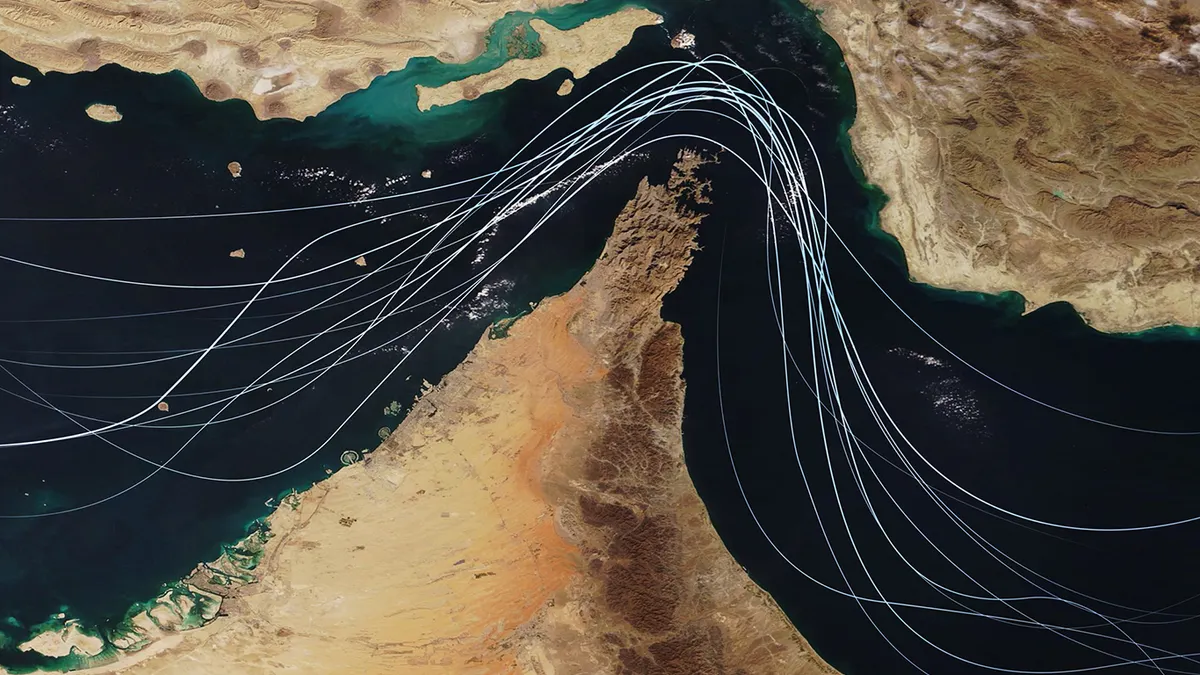
The U.S. and Iran reached an agreement to reopen the Strait of Hormuz, but ocean supply chain networks are not expected to recover until mid-September 2026, according to a June 19 Xeneta report.
Beyond its regionalized impact, the Iran war’s broader effect on the ocean shipping market has led to oil volatility and upward pressure on fuel prices and ocean spot rates. In turn, the rising cost of fuel has prompted some ocean carriers to implement surcharges.
While full details and the timeline of the agreement are still unclear, the memorandum of understanding signed last week by the U.S. and Iran, per the Associated Press, sets a 60-day window to negotiate a final deal, which would include the reopening of the strait. The agreement also calls for minesweeping operations, which may require an extended timeline, according to Xeneta.
In a June 20 Truth Social Post, President Donald Trump confirmed that there would be no tolls in the Strait of Hormuz for 60 days during the ceasefire period. After the 60-period expires, the U.S. would only impose tolls if the deal isn’t completed.
“Even if the ceasefire holds, around 10% of global container shipping capacity is impacted by the blockade and freight rates are spiralling across major trades,” Peter Sand, Xeneta chief analyst, said in the report. “This scale of disruption and market volatility cannot be reversed overnight.”
Spot rate hikes to continue
Looking ahead, Xeneta reported that spot rates are expected to continue to rise for at least another four weeks before the market peaks. Sand said spot rates will climb as long as the waterway isn’t fully open, which depends on how complex the de-mining operations are.
“Shippers should plan for a peak around the point the strait formally reopens, followed by a gradual easing,” per the analyst.
Since the start of the Iran war in February to June 19, ocean spot rates from the Far East to the U.S. West Coast and East Coast have spiked 192% and 158%, respectively, per Xeneta data.
Shippers frontloaded imports ahead of expected bunker fuel surcharge increases in July and fears over available capacity, Sand said, noting many have been told ships are full on trades out of Asia for weeks in advance.
“Shippers who manage to get their boxes on board are paying a premium to do so,” Sand said.
However, there may be some upcoming relief for the industry. Xeneta reported fuel pressure surcharges are expected to ease as marine bunker fuel and oil prices dropped around 20% in mid-June.
Even with the decline in fuel costs, container rates are still climbing due to early peak season demand driven by tariff changes, manufacturing price hikes and fuel-related surcharges, according to a June 23 Freightos market update. Currently, the early busy season has vessels full until at least July. Spot rates may start easing as demand wanes, regardless of what happens with the Strait of Hormuz.
Freightos further reported that expected bookings may peak in June, meaning that carriers could “find more resistance to July rate increases than they have to June price hikes so far.”
What’s next?
Since the MoU was announced, Hormuz transits have already gone up. For example, CMA CGM is increasing its Red Sea transits, per the Freightos update. The move may signal other carriers to follow if negotiations continue.
Xeneta expects a three-stage recovery, starting with extracting ships and crew stranded inside the Persian Gulf. The return of feeder and regional services into Persian Gulf ports would mark the next stage, followed by major long-haul services on Asia to North America and Europe trade lanes
“Shippers should plan for a peak around the point the strait formally reopens, followed by a gradual easing."

Peter Sand
Xeneta chief analyst
“The geo-political situation will remain fragile for the foreseeable future and both carriers and shippers will want to protect against the disruption caused by the closure of the Strait of Hormuz first time round,” Sand said. “Increasing use of transshipment services into the Gulf creates additional transit time, but it insulates the long-haul network from future disruption.”
Editor's note: This story was first published in our Logistics Weekly newsletter. Sign up here.