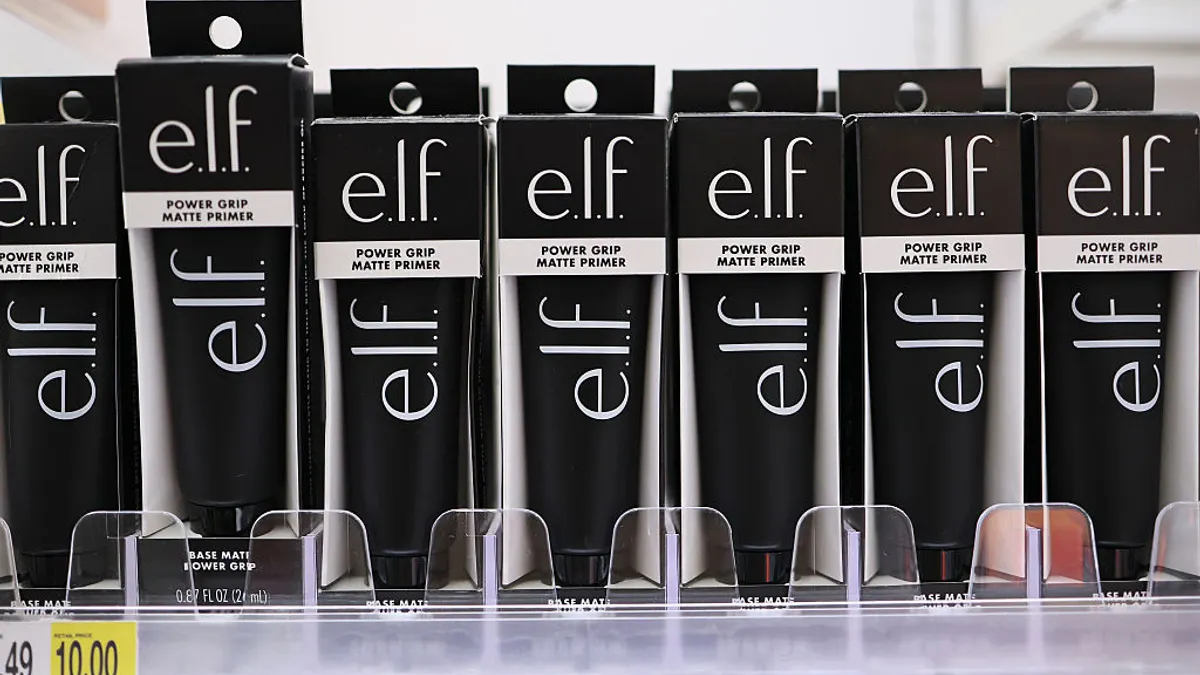
E.l.f Beauty expects $58.5 million in tariff refunds and plans to use the money to cut prices and lift sales volumes, executives told investors during a May 21 earnings call.
Despite “absolutely” expecting tariff refunds, the returned funds are not included in E.l.f’s current fiscal year outlook, President and CEO Tarang Amin said.
"Our plan on those one-time tariff refunds is really to go back and invest in value and accelerating unit growth," Amin said. "Those are the two areas we're particularly focused on."
E.l.f. and fellow beauty brand Tarte are among the long list of companies seeking refunds for tariffs invalidated by the Supreme Court earlier this year. U.S. Customs and Border Protection has since launched a dedicated portal to return funds and is on track to process around $85 billion in potential and certified tariff refunds. As of May 26, more than 15 million entries submitted to CBP’s portal have been accepted for duty removal.
In fiscal 2026, E.l.f. navigated an average tariff rate of about 55% — more than double the rate of the prior year, SVP and CFO Mandy Fields said. For the current fiscal year, the company's outlook assumes rates will remain at 35%.
The higher tariffs contributed to E.l.f.'s decision to raise prices in the year, which led to a decline in unit volume of about 5 points in the fourth quarter, Amin said. As a result, the makeup and skincare products company is reversing some of the price increases.
“As we look at the state of the consumer today, we have recently seen a more pronounced decline in units,” Amin said. “As a result, we are keenly focused on how to deliver a better value and improve unit velocity.”
E.l.f.'s tariff mitigation strategy has included diversifying its supply chain away from China. Over the last three years, E.l.f has upped its manufacturing capacity outside of China from 1% to 45%, Amin said.
While tariff costs are easing, E.l.f. is seeing some inflationary pressure from the war in Iran on commodity and transportation costs, Fields said. If oil prices average about $100 per barrel, the company would face "$15 million to $20 million of incremental cost headwinds" in the current fiscal year.
This story was first published in our Procurement Weekly newsletter. Sign up here.