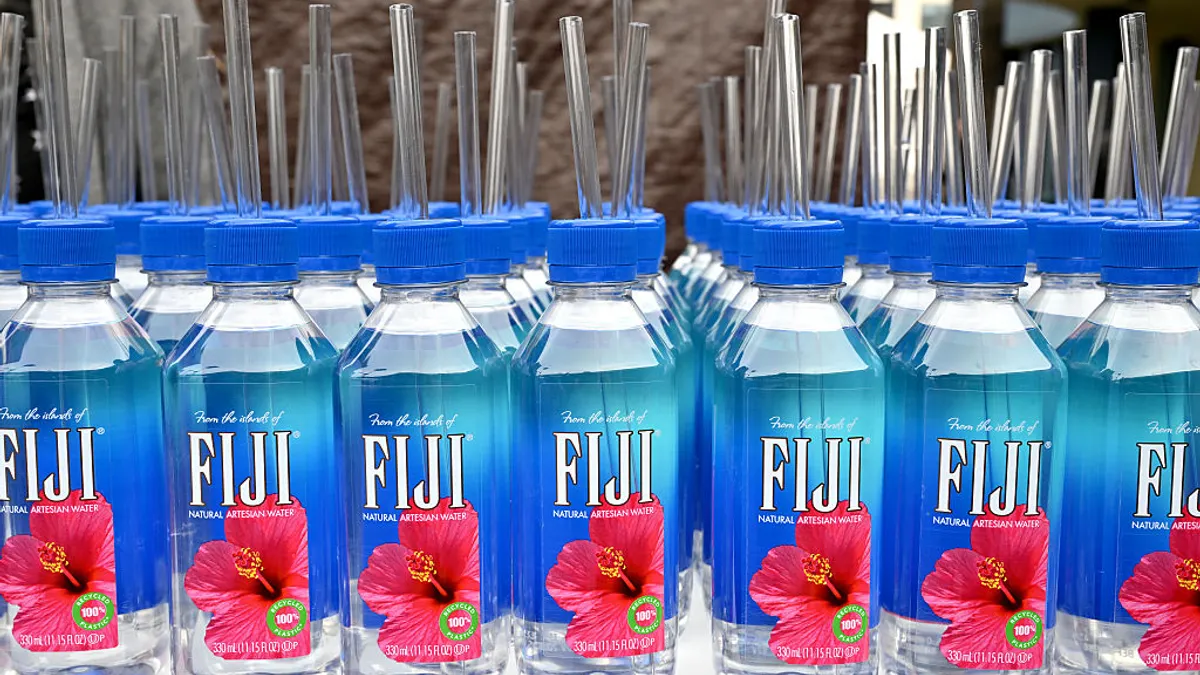
When Fiji Water’s existing ocean shipping models weren’t working for regions that required specific connectivity and precision during the COVID-19 pandemic, it created its own.
More specifically, amid the pandemic, the water company’s parent brand The Wonderful Co. launched a Fiji-U.S. service through Neptune Pacific — a shipping and logistics business acquired by the consumer goods company in 2007. The service allowed the company to gain control over its logistics chain when available vessel space and reliable capacity was hard to schedule, according to Neptune Pacific President Kim Kristensen.
At the time, Fiji Water’s dedicated U.S. East Coast sevice connected Fiji to Philadelphia, Houston and Savannah, Georgia, Kristensen said. The service, using a purchased vessel, ran multiple voyages until global capacity improved, and is now no longer active, a Neptune Pacific spokesperson told Supply Chain Dive.
Although the endeavor is no more, during the 2026 Agriculture Transportation Coalition’s Annual Meeting last month, Kristensen outlined why the CPG brand temporarily operated its own vessels for Fiji Water products and considerations for other shippers who might follow suit.
How to navigate the South Pacific
At a high level, logistics decisions sometimes need to address specific realities of the given trade environment. Details, such as port options, service connections and room to recover when shipments “move off window” are critical, the ocean line president said, especially when it comes to South Pacific connectivity.
“The point wasn't about owning more of the chain, it was to reduce exposure at a point where reliability mattered,” Kristensen said of the dedicated Fiji Water service. “So, this wasn’t about finding a different carrier; if the structure of the trade is the underlying issue, changing providers would only go so far.”
Fiji Water’s products are sourced, bottled and shipped from the island nation of Fiji in the South Pacific. The region operates in a very different shipping environment than other parts of the globe, Kristensen said. Typically, global shipping networks are built on consistent conditions, scale and volumes between major ports, which often balance cost, schedules and performance.
Conversely, South Pacific ports are smaller with infrastructure built to match, including smaller vessels, Kristensen said. Because of this, even the smallest changes can have a huge impact on utilization, service viability and route economics.
Ports in the region also have greater environmental exposure. For instance, Kiritimati — an isolated port south of Hawaiʻi— has no sea wall to protect it from the elements. As a result, vessels can only work during the day and need to return to anchor by night.
Storms also have a greater influence on shipping operations in the South Pacific, as they impact the reefs around atolls, which affects vessel access and timing, Kristensen said. Resulting port congestion and infrastructure breakdowns can make maintaining a consistent schedule difficult.
Having a local presence in the region is also critical for South Pacific shipping operations to navigate language, culture and established local networks, Kristensen said.
Given these hurdles, attempting to apply a more global model in the region can make gaps appear very quickly, Kristensen said. The shipping conditions aren’t uniform, and in turn, behave in an unpredictable way, he added.
Connections smooth the way
Overall, connections matter, especially for specialized supply chains, Kristensen said. In the case of moving products from a remote region like Fiji to international markets, there is less buffer for change, making those connections even more vital.
“A service that is built around the region can help reduce the uncertainty, not by pretending the complexity is gone, but by managing it more directly through local knowledge, established relationships, practical routing decisions, and a clear understanding of how capital action moves through guidance,” Kristensen said.