Editor's note: This story is the first in a three-part series about how reverse logistics providers have upgraded their capabilities for the post-holiday returns rush and beyond.
UPS' Happy Returns is using artificial intelligence to stymie a particular strain of returns fraud in the thick of the post-holiday sprint for reverse logistics providers.
The company announced in November that it is piloting two new capabilities with select shippers, including apparel seller Everlane, to tackle the issue.
The first capability provides a risk assessment and score for specific returns based on shopper behavior and patterns. Returns deemed to be high risk — based on timing, frequency or other factors — are flagged for review before the shopper can receive a refund. The second, called Return Vision, audits the high-risk returns by using AI to compare the returned products with images from the retailer's online catalog to see if they match.
The process aims to provide an extra layer of protection against "decoy return" attempts, in which a shopper aims to get a refund by returning a similar-looking but cheaper product instead of the original item, Happy Returns co-founder and CEO David Sobie said in an interview with Supply Chain Dive.
"Maybe I bought a very expensive little black dress, and I'm returning a very cheap little black dress," Sobie said in November. "And it's hard for a human, especially a busy human, in taking in a return to necessarily say, 'Oh, this one has a different stitching on it.'"
An estimated 9% of all returns are fraudulent, and decoy returns are among the tactics retailers are seeing grow in prevalence, per a 2025 report from Happy Returns and the National Retail Federation.
Happy Returns' Return Vision software, used at company hubs, looks for discrepancies in returns that are difficult for humans to catch. This could include a strap being too wide, a missing logo or a mislabeled tag. The audit helps determine whether a product refund should be given or withheld.
"We do this because we also have busy humans in our warehouses, and so you need to make sure that you take the images, you validate the human decision with AI, and then these images will help the retailer down the line if they need to explain to a shopper why a refund wasn't approved," COO Juan Hernandez-Campos said in an interview.
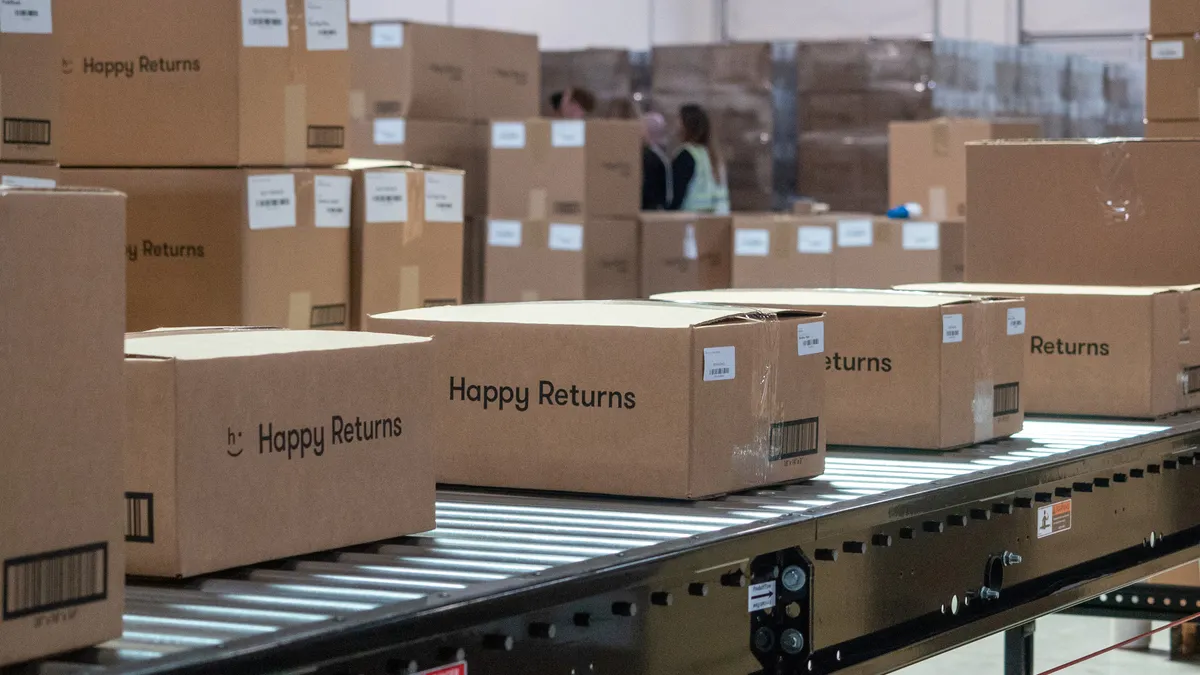
Happy Returns is making sure the process happens quickly to avoid clogging its warehouses with items waiting to be audited. When an item is flagged at a Return Bar location, the company will complete the audit within a day of it arriving at a hub, Hernandez-Campos said.
Nearly all returns from Return Bar locations are verified as legitimate, with less than 1% being flagged for review, according to Happy Returns’ announcement. Retailers see a per-return average of $218 in prevented loss on flagged items.
Happy Returns is planning to roll out Return Vision more broadly in 2026 after the post-holiday returns peak, with a goal to expand the service to more retailers, Sobie said.
"The wonderful thing about AI and machine learning is that the bigger your dataset gets, the more accurate it is," he said.