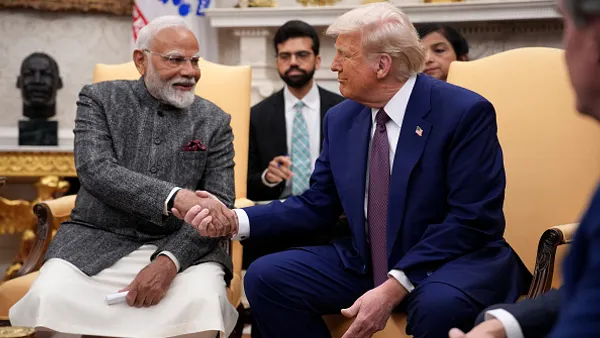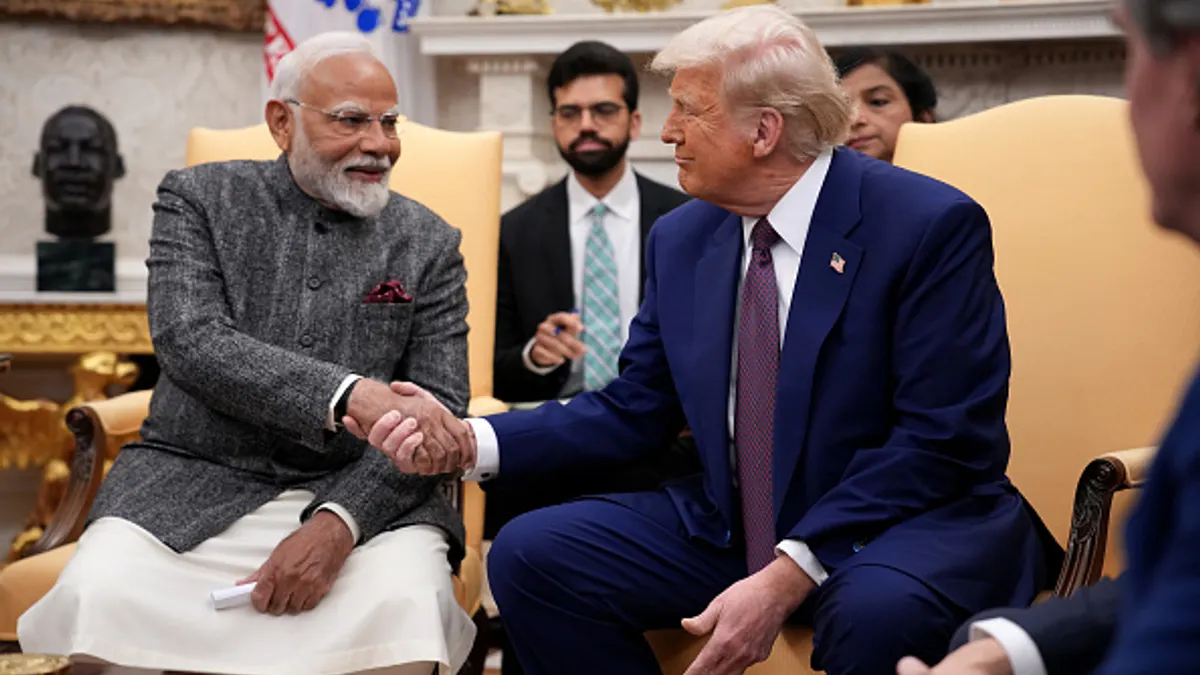
President Donald Trump said on Monday the U.S. will lower reciprocal tariffs on goods from India after reaching a trade deal with the country.
In a Truth Social post, Trump said he would reduce the country-specific tariff from 25% to 18% as part of the agreement. The U.S. will also remove an additional 25% tariff Trump installed last year for India’s purchasing of oil from Russia, a White House spokesperson confirmed to Supply Chain Dive. However, the White House has not released official documentation of any agreement between the two countries as of publication time.
Trump said that as part of the pact, India Prime Minister Narendra Modi agreed to lower India's tariffs and non-tariff barriers for U.S. imports to zero. Trump also said India agreed to stop buying oil from Russia while committing to purchasing more than $500 billion in U.S. products in the energy, technology, agriculture and coal sectors.
Should a deal to lower tariffs between the U.S. and India be made official, it would be strategically significant, according to Pete Mento, director of global trade advisory services at Baker Tilly.
"Many people watching tariffs have expected and waited for a shift downward for Indian imports," Mento said in a LinkedIn post.
However, Mento cautioned that announcements are only the first step and "implementation is where it becomes real."
"So, I'm cautiously optimistic — and professionally curious," he said. "When the paperwork hits, the Federal Register moves, and both governments publish the mechanics, then we’ll know exactly what changed."
An agreement with India would be the latest in a string of tariff-related pacts between the U.S. and its trading partners in the last year. Spurred by the Trump administration’s reciprocal tariff policy, which placed new levies on numerous countries, the U.S. has negotiated framework trade deals with the European Union, Japan and South Korea, among many others.
However, uncertainty has begun to swirl around some of those pacts. For example, after Trump threatened in January to impose new tariffs on eight European countries that opposed his campaign to take over Greenland, the European Union suspended its tariff pact with the U.S. Trump has since walked back the threat.
Meanwhile, the U.S.’ framework agreement with South Korea is in hot water after Trump said he would hike duties on imports from the country due to its alleged failure to meet the terms of the deal.