Monthly import volumes at U.S. ports are projected to remain muted year over year until May, according to a Global Port Tracker report published Jan. 9 by the National Retail Federation and Hackett Associates.
Despite decreased activity, the NRF expects January to see its first month-over-month increase since July 2025, with a volume forecast of 2.11 million twenty-foot equivalent units. While Lunar New Year volumes are driving the increase in activity, overall volumes would still be down 5.3% year over year, per the report.
February through April are expected to continue year-over-year declines, with May forecast to see the first year-over-year gain in ocean cargo volumes, the NRF said.
Following months of cargo frontloading and a busy holiday season, retailers are currently assessing what lies ahead and how to ensure optimal supply chain operations to meet consumer needs, per the NRF.
“There should be a brief bump in imports this month ahead of Lunar New Year factory shutdowns in Asia, but we’re otherwise headed into the post-holiday shipping lull that comes each year,” Jonathan Gold, NRF VP for supply chain and customs policy, said in a statement.
Regardless, fluctuating trade policies are likely to continue to impact 2026 ocean cargo volumes, according to the tracker.
U.S. ports covered by the port tracker handled 2.02 million TEUs in November, down 2.3% month over month and 6.5% year over year, per the tracker. December data had not yet been released by the time of the report’s publication, however, the NRF forecasts ports to handle about 1.99 million TEUs in December, down 6.6% year over year.
The NRF expects volumes of 25.4 million TEUs for 2025, down 0.4% from the year prior.
“November and December are traditionally slow, but the year-over-year declines are partly because imports in late 2024 were elevated by concerns over port strikes,” the NRF reported. “In addition, many retailers imported cargo earlier than usual in 2025 to avoid tariffs.”
Despite the overall year-over-year dip in volumes, ports still saw record years.
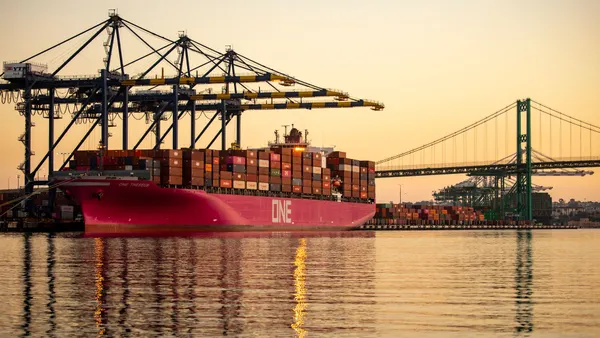
The Port of Los Angeles moved 10.2 million container units in 2025 — it’s third best year, Executive Director Gene Seroka said during the 2026 State of the Port of Los Angeles meeting. He further outlined port infrastructure investment plans, including the Pier 500 Marine Container Terminal Project and a maritime support facility serving as a dedicated hub for chassis parking and container pickup and dropoff.
The neighboring Port of Long Beach handled 9.9 million, twenty-foot equivalent container units in 2025, setting an all-time record for container volumes, the port’s CEO Noel Hacegaba said during the Jan. 15 State of the Port event. He further noted that the Port of Long Beach imported a record 4.8 million TEUs due to shipper frontloading efforts driven by tariffs.