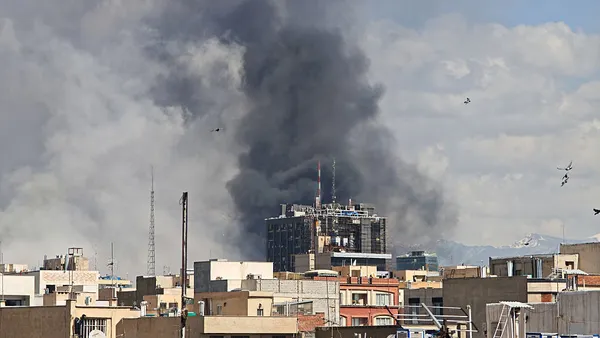
Ocean and air cargo carriers have deployed temporary suspensions for various Middle East-connected services in response to an ongoing military conflict between Iran and the U.S. and Israel that has sparked widespread turmoil in the region.
"In the near term, businesses should prepare for longer lead times, tight capacity, elevated rates, and continued volatility across both ocean and air networks," Flexport said in a Feb. 28 blog post about the conflict.
CMA CGM has suspended Suez Canal passage until further notice and is rerouting vessels via Africa's Cape of Good Hope. The carrier has also halted bookings of hazardous and reefer cargo to several Middle East countries and levied an emergency conflict surcharge for affected cargo. The surcharge, which took effect Monday, is $2,000 per twenty-foot equivalent container unit and $3,000 per forty-foot equivalent container unit.
"We understand these measures may impact your logistics and supply chain operations; however, they are necessary steps that also lead to additional operational costs," CMA CGM said in its surcharge notice.
Other ocean carriers are deploying similar measures. MSC has suspended all bookings for worldwide cargo to the Middle East until the security situation improves. Hapag-Lloyd is levying a war risk surcharge for cargo from the Upper Gulf, Persian and Arabian Gulf, set at $1,500 per TEU for standard containers and $3,500 per container for reefer and special equipment. And Maersk has paused future sailings through the Bab el-Mandeb strait for the time being, rerouting its fleet around the Cape of Good Hope instead.
The conflict will halt any plans for a return of Red Sea container shipping operations until the security situation becomes clearer, Xeneta Chief Analyst Peter Sand said Feb. 28.
Major shipping lines have been avoiding Suez Canal transit since late 2023 due to Houthi-led attacks on cargo ships, with a common mitigation tactic being to sail around the Cape of Good Hope instead. The longer sailing distances absorb around 2.5 million TEUs of global container shipping capacity, according to Sand.
"With a largescale return of container ships to Red Sea in 2026 now unlikely, freight rates on major global trades will continue to soften, but will not fall as hard as previously expected in the second half of the year as more services returned to Suez Canal transits," Sand said.
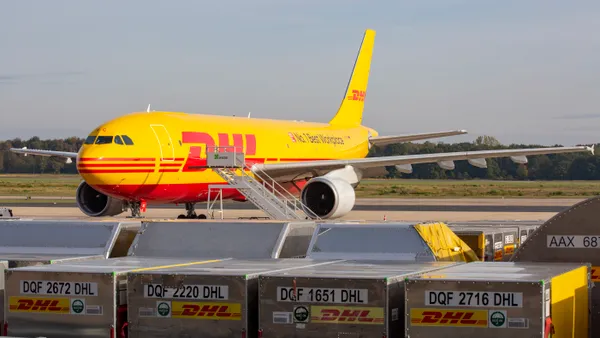
Meanwhile, multiple air cargo carriers are halting operations due to airspace closures throughout the Middle East.
FedEx said in a service alert Sunday that flights to and from Bahrain, Iran, Iraq, Israel, Jordan, Kuwait, Lebanon, Oman, Qatar, United Arab Emirates and Saudi Arabia have been suspended. The carrier warned that shipments to and from other markets throughout the region may experience longer transit times.
Additionally, Emirates SkyCargo has suspended flights until Tuesday afternoon and placed "temporary restrictions on the booking and acceptance of all new shipments on our flights for the next 24 hours," per its website. Qatar Airways Cargo has also suspended flight operations due to the closure of Qatari airspace.
The air cargo suspensions are creating extended transit times and irregular schedules, and customers should expect "potential delays or even cancellations, space constraints, and short-notice rate adjustments in the coming days and weeks," according to a DSV advisory.
For shippers affected by the logistics disruptions in the Middle East, DSV recommended several measures. The freight forwarder said customers should share updated shipment forecasts to support capacity planning, confirm bookings early to secure space, consider congestion impacts in safety stock assessments and consider alternatives where feasible.