Dive Brief:
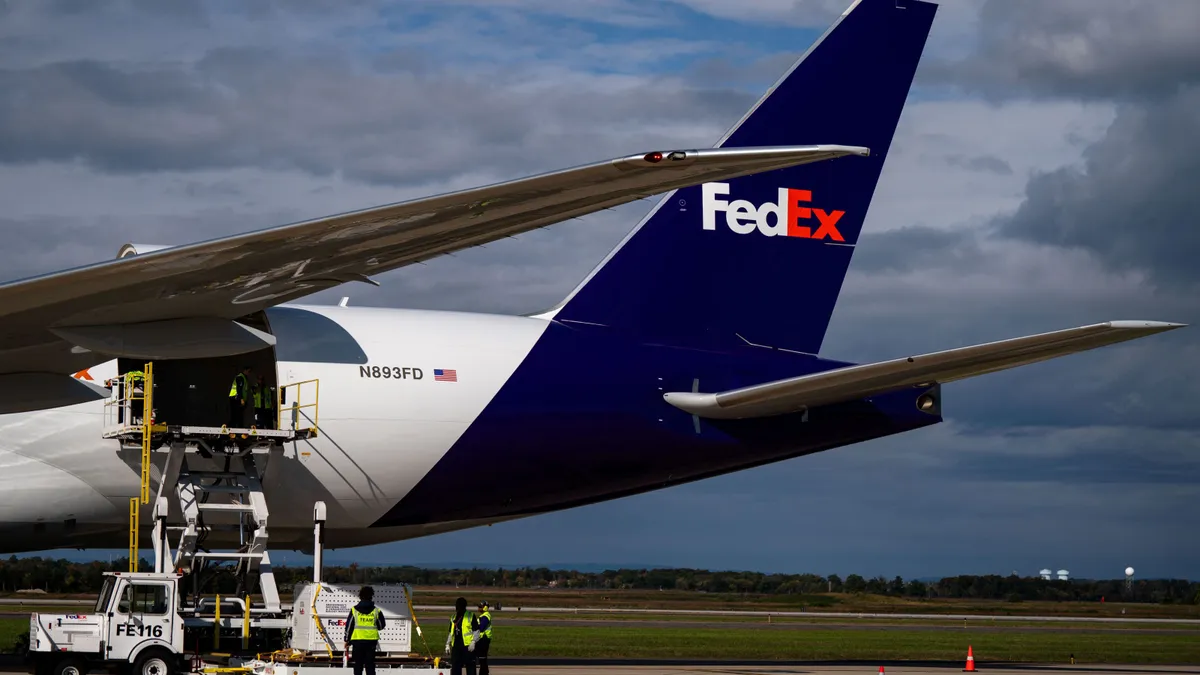
- FedEx is seeking a full refund from the U.S. on all paid duties that were installed under the International Emergency Economic Powers Act, per a lawsuit filed by the carrier in the Court of International Trade on Monday.
- A Supreme Court ruling Friday marked the end of tariffs enacted by President Donald Trump through IEEPA. In its lawsuit, FedEx said it has "paid IEEPA duties on numerous entries" and wants a refund on all IEEPA-subjected import entries with U.S. Customs and Border Protection, plus interest.
- FedEx requested the court to order CBP to reliquidate any import entries that have incurred IEEPA duties and ensure all unliquidated entries won't have IEEPA tariffs apply. Liquidation occurs once CBP determines an import's final duty amount, after which the agency notifies the importer of record if money is owed or a refund is available.
Dive Insight:
FedEx is now among several companies that have filed lawsuits seeking tariff refunds through the courts, including Costco, Revlon Consumer Products, Bumble Bee Foods, but one of the first to do so in the wake of the Supreme Court’s ruling. Even with the court's decision, uncertainty still looms over how the U.S. will ultimately approach the IEEPA tariff refund process.
"The Court says nothing today about whether, and if so how, the Government should go about returning the billions of dollars that it has collected from importers," Justice Brett Kavanaugh said in a dissenting opinion Friday. "But that process is likely to be a 'mess,' as was acknowledged at oral argument."
FedEx acknowledged the uncertainty over refunds on its website and said it "will communicate any relevant information and updates in a timely manner" to customers. The carrier collects duties and taxes from shippers in its capacity as a transportation provider and customs broker.
"We understand that this news has prompted questions about previously assessed duties and taxes," FedEx said on its website. "We are committed to helping our customers navigate the regulatory environment and providing updates when we have them."
The case raises questions about what obligation an importer of record like FedEx has to pass on any refunds to customers that may have shared in tariff costs, Geoffrey Gertz, a senior fellow at the Center for a New American Security think tank, said on LinkedIn.
"Who will actually get paid back, and through what process, is going to have to be worked out contract by contract, and will likely require a lot of billable hours for lawyers," Gertz said.
Fast-shifting trade policies are challenging FedEx's bottom line. The carrier has projected a $300 million headwind in fiscal year 2026 from direct trade-related expenses like higher customs clearance costs, EVP and CFO John Dietrich said on a September 2025 earnings call.