Editor's note: This story is the third in a three-part series about how reverse logistics providers have upgraded their capabilities for the post-holiday returns rush and beyond. Read the previous installment here.
DHL Supply Chain's recently launched returns network is leaning on a diverse customer base to limit the strains of the post-holiday returns rush.
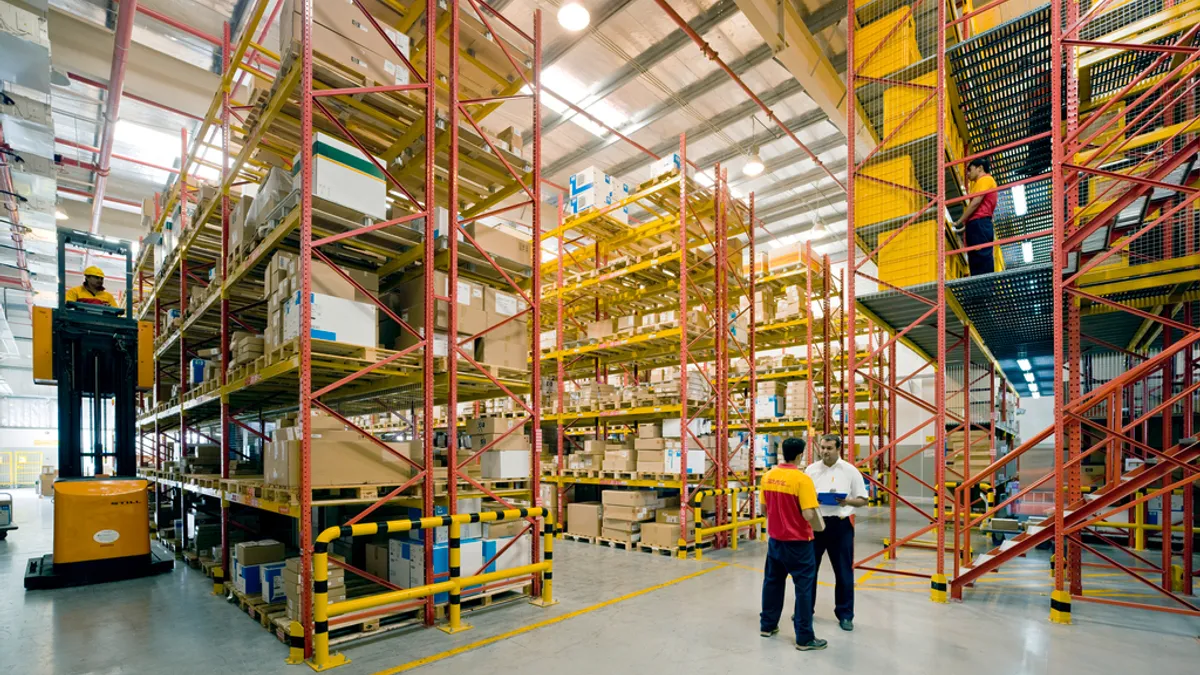
In October, the contract logistics provider unveiled its DHL ReTurn Network in North America, adding a new wrinkle to its returns services. The network offers 11 facilities that process and inspect returns for multiple customers and product types, as opposed to the dedicated single-client buildings DHL Supply Chain typically operates.
The acquisitions of logistics companies Inmar Supply Chain Solutions and IDS Fulfillment last year helped enable the network's launch, Thomas Borders, VP of operations for the network, said in a November interview with Supply Chain Dive. Through the deals, DHL Supply Chain gained new reverse logistics assets and grew its base of small and medium-sized customers better suited for multi-client spaces.
"Those were two different business models built on a network of multi-client facilities and an important way for us to be able to extend our service offerings outside of needing large, dedicated warehousing space for individual customers," Borders said.
Handling volume for a diverse customer base in one building can limit drastic demand swings, as different sectors have different peak returns periods, according to Borders. For example, a home improvement retailer may see returns jump in late spring, while a seasonal decor seller will likely encounter more returns after the holidays. Multi-client operations within one building will help the ReTurn Network keep warehouse, labor and transportation costs in check amid such fluctuations throughout the year.
"It's great for our labor planning, it's great for our space utilization, and we can really optimize and provide better services and more competitive services for the customers, because we don't have to staff to peaks and because we were able to utilize the space more efficiently," Borders said.
The diverse client base means the holiday returns rush "doesn't hit as hard as in a traditional logistics environment," according to Borders. Some customers in the network may see returns quadruple during the holiday stretch, while others encounter minimal returns volume, which he said makes staffing for and executing during the rush more manageable.
The ReTurn Network also makes use of proprietary software called ReSKU, which helps standardize and speed up the decision making process in returns processing. The software helps train employees in the same fashion so they can consistently determine the quality of a return for a particular brand, Borders said.
"We're training them to make the decisions based on the guidance that's provided through the software platform, as opposed to sitting up in a classroom and saying, 'This is what a grade A looks like, and this is what a grade B looks like,'" Borders said, adding that the latter method would lead to inconsistent decision making.
DHL Supply Chain's reverse logistics investments come as companies beef up their returns offerings to help retailers better manage customers' post-purchase experiences. Seventy-one percent of consumers surveyed for an October report from the National Retail Federation and Happy Returns said they would be less likely to shop with a retailer again after a poor returns experience, up from 67% in 2024.
Although a product return is something retailers like to avoid, the event is an opportunity to build brand loyalty, Borders said.
"Many of us are loyal to certain brands because we're not perfect shoppers, and we're going to get something that just doesn't fit right, doesn't look right, we don't love once it arrives, and studies have shown that people who have a really great returns experience build a lot of loyalty with those brands where that great returns experience is provided," he said.