
Knowing that a shipment was delayed, rerouted or expedited is important. Understanding the financial consequences and using them to improve the next decision is where transportation intelligence becomes valuable.
Global companies have invested heavily in supply chain visibility. But visibility answers only part of the question. A shipment is rerouted. An expedited service is approved. A spot rate replaces a contracted rate. Operations may know what happened.
The harder question is: What did it actually cost the business?
Every disruption creates a financial outcome, yet the information needed to understand it is often spread across transportation systems, invoices, rate agreements, Freight Audit and Payment platforms, claims systems, ERPs and analytics tools. The next stage of visibility is connecting transportation decisions to their financial consequences.
Disruption creates a financial trail
When a shipment encounters a disruption, the original provider, service level or expected cost may change. Each decision creates information. The TMS records planning and execution. Pricing systems capture contracted and spot rates. Freight audit determines whether charges are correct. Claims, payment and ERP systems record what happens next.
The challenge is connecting the information well enough to explain the financial result.
A freight invoice tells you what you were charged, not necessarily why
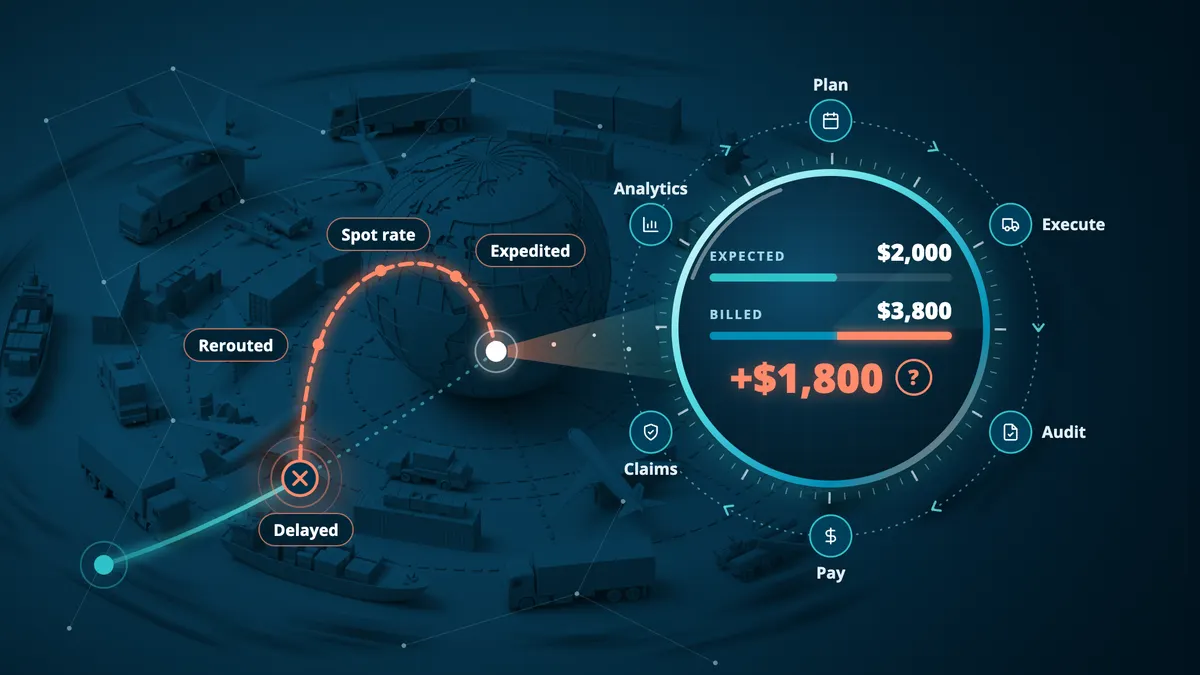
Suppose a shipment expected to cost $2,000 ultimately costs $3,800. The invoice may be correct. The more valuable question is why the additional $1,800 was necessary.
Was the contracted provider unavailable? Did the shipment miss pickup? Was a facility late releasing freight? Was spot capacity required? Was a more expensive service selected to protect a customer delivery?
Finding the difference between expected and billed cost is useful. Understanding why it occurred is far more valuable.
Transportation information should follow the shipment
Transportation information begins long before an invoice arrives.
That information should remain connected. Planning should inform execution. Execution should inform audit. Audit should inform payment. Payment, claims and financial outcomes should feed analytics. Analytics should influence future planning, pricing and provider decisions.
That creates a closed loop.
From visibility to Transportation Financial Intelligence™
Traditional visibility may tell an organization that a shipment was delayed two days. Transportation Financial Intelligence™ should help explain what those two days cost, whether the delay triggered expedited freight or detention, whether a claim resulted, whether another provider was selected and whether the additional cost was justified.
These are business questions, not simply freight audit questions.
For multinational organizations, the challenge is greater. Payment requirements, currencies, taxes, documentation and regulations vary by country and region. Technology provides scale, but local expertise provides context.
The goal is better decisions next time
There will always be another disruption. Weather changes. Ports become congested. Capacity tightens. Rates move. Transportation providers reject tenders. Regulations and geopolitical conditions shift.
The organizations that perform best will learn from those events.
If disruption increases transportation spending, leaders should be able to determine where it happened, why it happened, which providers and facilities were involved, what alternatives were available and whether the premium produced the desired outcome.
If the same problem happens again, that intelligence should influence the next decision.
Turning transportation information into Transportation Financial Intelligence™
This is what nVision Global helps organizations accomplish. Transportation Financial Intelligence™ comes from connecting information across the transportation lifecycle and applying the technology, governance and expertise needed to make it decision ready.
nVision Global brings those capabilities together through IMPACT TMS™, nGauge™, nSure AI™, Freight Audit and Payment, Freight Claims and nSight™ Business Intelligence. Together, these solutions connect planning and execution with data capture, validation, audit, payment, claims and analytics.
The value is having a connected eco-system where information created at one stage strengthens what happens next.
nVision Global helps organizations move from knowing what happened to understanding why it happened, what it cost and what should happen next.
That is the foundation of Transportation Financial Intelligence™.
About nVision Global
nVision Global provides integrated transportation technology and financial services, combining Transportation Management, Freight Audit and Payment, Freight Claims, AI-powered transportation data intelligence, dynamic pricing, benchmarking and business intelligence. With global operations and regional expertise across the Americas, Europe and Asia, nVision Global helps organizations turn fragmented transportation information into governed, validated and decision-ready intelligence.
Global by Design. Governed by Intelligence. Measured by Results.