Dive Brief:
- Walmart's capital investments in its supply chain will "probably peak this year and next year," with the company's increasing use of automation being a component of that spending, President and CEO John Furner said on an earnings call Thursday.
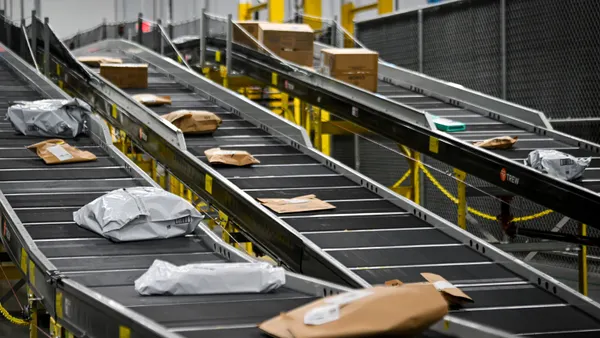
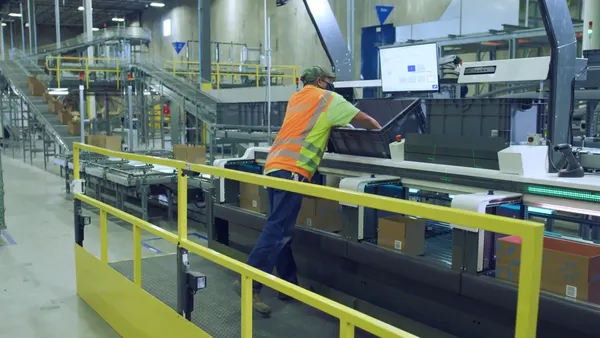
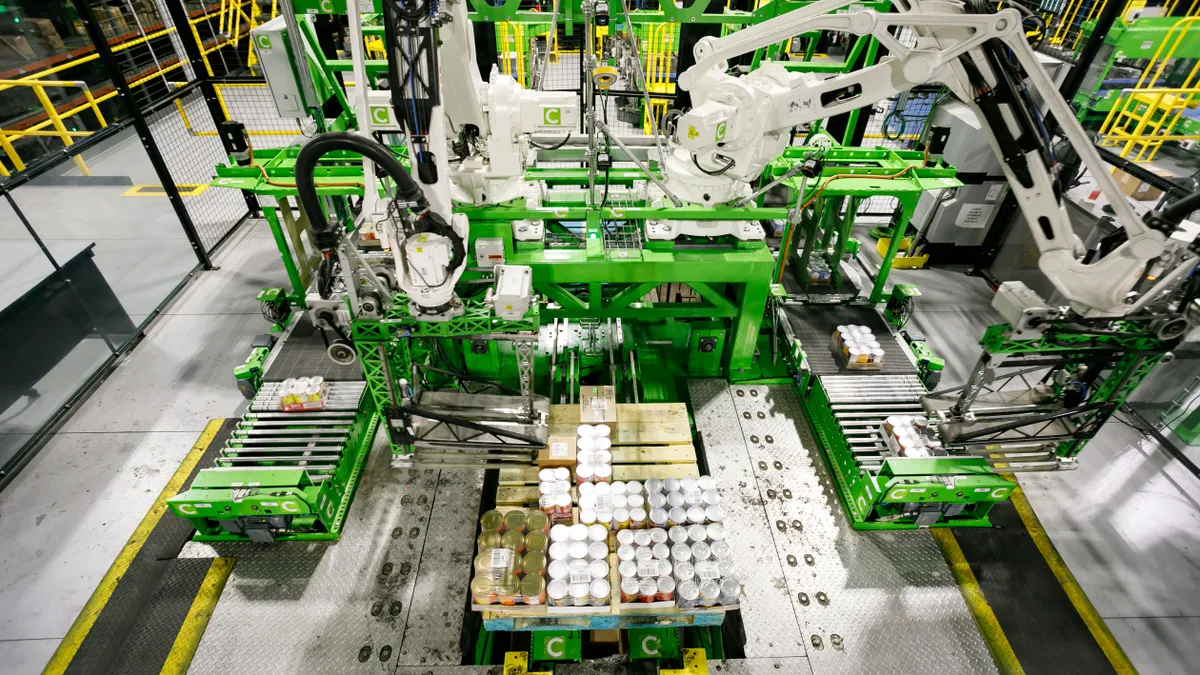
- In the U.S., 23 of Walmart's 42 regional distribution centers are in the process of being retrofitted with automation, per an earnings presentation, with the company's eventual goal being to upgrade all locations. Walmart is also in the early stages of deploying supply chain automation in select international markets, EVP and CFO John David Rainey said on the call.
- About 60% of Walmart's U.S. stores currently receive a portion of their freight from automated distribution centers, and roughly half of Walmart's e-commerce fulfillment center volume is automated, which the retailer says helps limit shipping costs. "Technology-enabled productivity benefits are critical to our ability to grow our core omni business at lower marginal cost," Rainey said.
Dive Insight:
Supply chain automation has been a priority for Walmart in recent years as the retail giant looks to better manage two of its largest expenses: inventory and labor. For example, Walmart has deployed inventory-tracking sensors providing automated alerts and equipped distribution centers with robotics to boost shipping capacity and speeds.
Walmart's inventory globally increased by 2.6% year over year in Q4, about half the rate of its sales growth, "an impressive number" aided by automation, Furner said. Visibility for in-store inventory has also improved through the use of technology, he added.
"Over 1 million associates just in the U.S. alone have handheld devices, and they're using computer vision to map our inventory to know what we have, to know exactly where it is and know how it's deployable," Furner said.
Stores are playing a growing role as fulfillment nodes in Walmart's supply chain, as their proximity to customers enables faster delivery speeds on online orders. In Q4, Walmart delivered 35% of store-fulfilled orders in under three hours.
"Stepping back, when I look at the enterprise today, it's a portfolio of businesses anchored in growth, especially our digital channels with an emphasis on having inventory close to the customer to maximize our delivery speed," Furner said.