Dive Brief:
- The military conflict between Iran, the U.S. and Israel is shaking up the air cargo market outlook established earlier this year, according to a March 5 Xeneta report.
- In February, a 6% year-over-year rise in air cargo market demand signaled ongoing resilience despite economic and trade volatility. Now, the market is dependent on the duration of the conflict.
- “If we only had February’s data to focus on, we would say the start of the year has been encouraging for the air cargo market,” Chief Airfreight Officer Niall van de Wouw said in the report. “Now, the stakes are raised.”
Dive Insight:
Global logistics is yet again facing turbulence after the U.S. and Israel launched military strikes on Iran on Feb. 28, disrupting both air freight and ocean networks.
Van de Wouw believed that the U.S. Supreme Court’s ruling against Trump administration tariffs would be the main talking point of February, but that has clearly since changed.
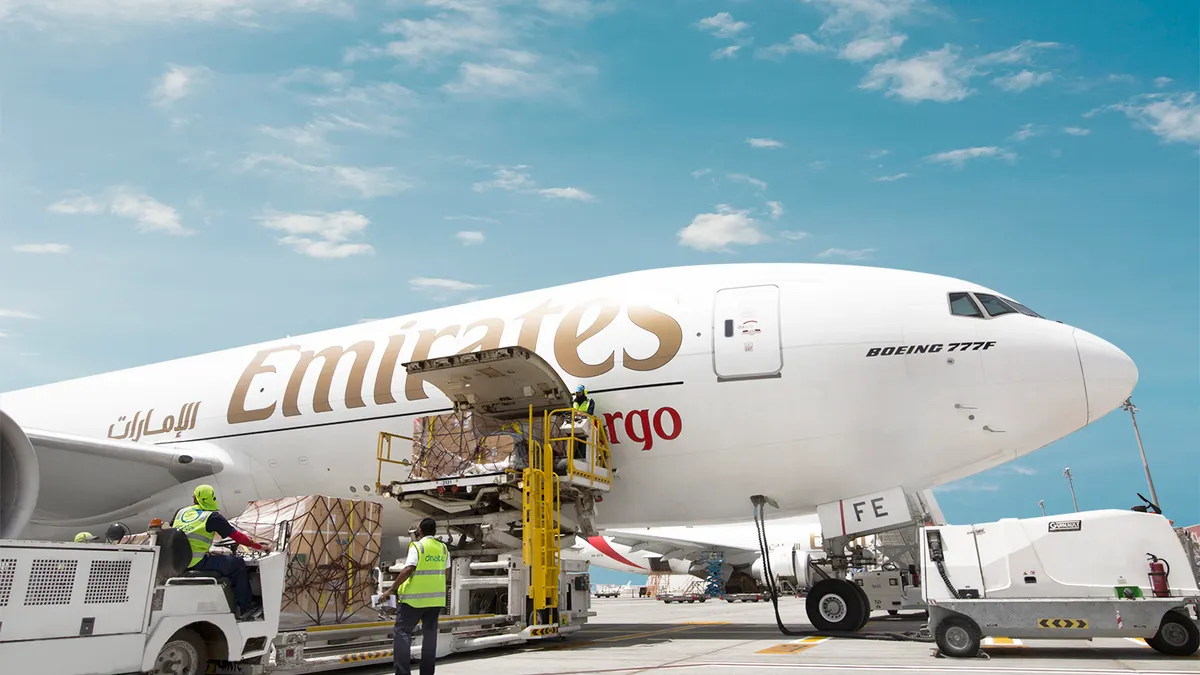
The conflict primarily disrupts logistics activity in the Middle East, impacting major regional hubs including Doha, Qatar, and Dubai and Abu Dhabi in the United Arab Emirates, per Xeneta. However, broader market impacts stretch beyond the region.
The Strait of Hormuz is currently closed as a result of the Iran conflict, which accounts for about 20% of global oil shipments and 30% of global seaborne oil trade, per Xeneta. In turn, jet fuel, for instance — a major cost component of air freight — may spike if crude prices continue to climb. Brent crude oil prices have already surpassed $100 per barrel as of Monday morning, and are still on the rise.
On the other hand, if the conflict is brief and the Middle East logistics market can recover quickly, concerns of long-term spikes in cost for oil could lessen, per Xeneta.
However, a protracted disruption could cause short term air freight rates to double or triple on the air corridors directly impacted by transit hub closures in the Middle East, van de Wouw told Supply Chain Dive. And while the disruption may be felt acutely on corridors to Europe, the U.S. still faces vulnerability. India to the U.S. East Coast, for instance, is a key tradelane for pharmaceuticals and retail that would typically transit through the Middle East.
Prior to the military strike, February air cargo spot rates were boosted by a “mini peak” rush ahead of the Lunar New Year holiday, up 5% year over year to $2.58 per kilogram. This was the first recorded monthly increase since May 2025. However, freight activity from China to the U.S. was weaker due to tariff impacts.
Demand growth during the month, meanwhile, continued to surpass available capacity growth by 4% YoY, pushing the dynamic load factor — which is Xeneta’s measurement of capacity utilisation — up two percentage points to 62%.
Semiconductor demand continued to drive freight rates from Northeast Asia to North America, up 10% YoY to $4.29 per kilogram, Xeneta reported. Rates from Southeast Asia to North America, on the other hand, were down 6% YoY to $4.75 per kilogram.
Rates from Europe to North America stood at $2.96 per kilogram in February, up 21%, which was the largest YoY increase in air cargo spot rates during the month.
As the air cargo industry faces yet another crisis, it is “highly skilled” at finding and creating solutions, van de Wouw said.
“But it will come at the price of higher logistical costs for the owner of the goods,” he added. “But I am sure they will temporarily have no issue with paying such additional fees as long as they can serve their customers on time.”