
Dive Brief:
- The Federal Reserve on Wednesday, in a decision with two dissents, held the main interest rate steady at a range between 3.5% and 3.75%, noting robust economic growth and signs of stability in the unemployment rate.
- Policymakers cautioned that inflation persists above their 2% goal while not expressing the same degree of concern about weak hiring that prompted them to trim the benchmark interest rate at three consecutive meetings during the final months of last year.
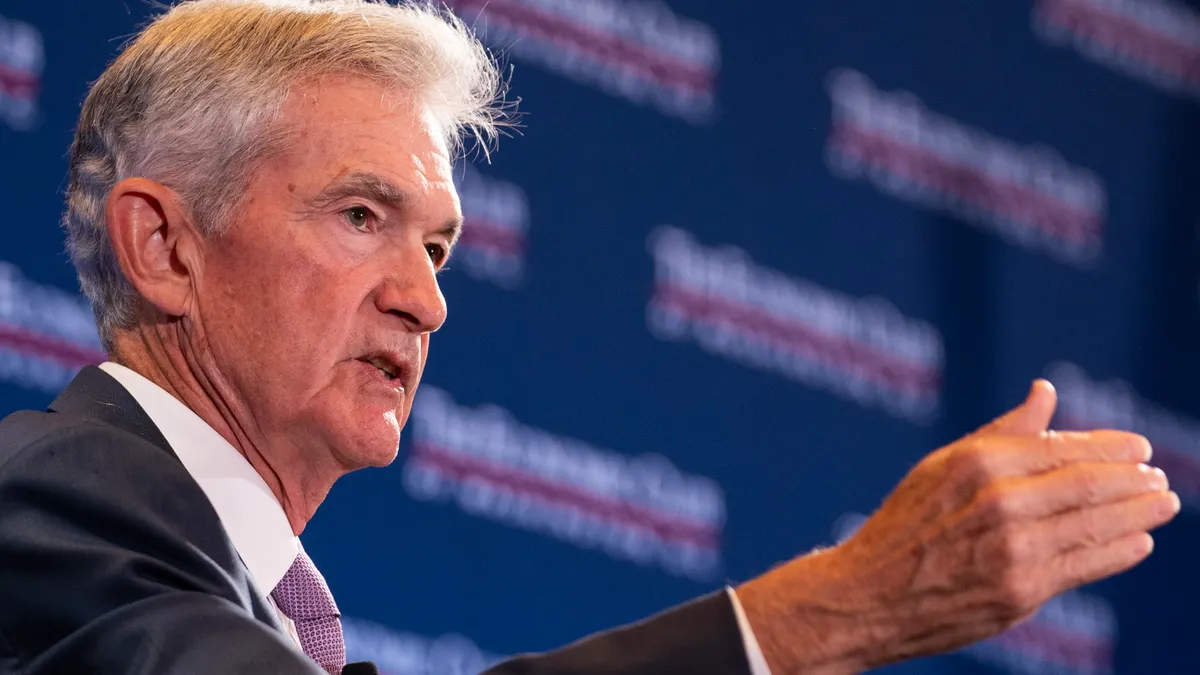
- “The economy is growing at a solid pace, the unemployment rate has been broadly stable and inflation remains somewhat elevated,” Fed Chair Jerome Powell said in a post-meeting press conference. “The upside risk to inflation and the downside risks to employment have diminished but they still exist, so there’s still some tension between the mandates” of the Fed to achieve price stability and full employment, he said.
Dive Insight:
Powell for several months has faced pressure from President Donald Trump to cut the main interest rate to as low as 1%. He declined to say on Wednesday when he expects the central bank will resume reductions in borrowing costs.
Powell and his policy-making colleagues, aiming to balance their dual congressional mandate, have sought through monetary easing to shore up a shaky job market while not fueling inflation.
Price pressures have changed little in recent months. The Fed’s preferred inflation measure — the personal consumption expenditures price index minus volatile food and energy prices — rose 2.8% in November and will likely fall to 2.5% by the end of this year, according to a median estimate by Fed officials last month.
“Inflation has eased significantly from its highs in mid-2022 but remains somewhat elevated relative to our 2% longer run goal,” Powell said.
Meanwhile, the unemployment rate in December edged lower to 4.4% from 4.5% in November but still exceeds the 4% level in January 2025.
Also, hiring by U.S. employers last month fell below expectations, with payrolls expanding by just 50,000.
Fed Governors Stephen Miran and Christopher Waller dissented against the policy decision, favoring a quarter-point reduction in the benchmark interest rate to a range between 3.25% and 3.5%. Appointed by Trump, they have voiced concern in recent months about signs of weakness in the job market.
Recent data “suggest some signs of stabilization” in the labor market, Powell said. “There are also signs of continued cooling.”
The inflationary impact on goods from tariffs enacted by the Trump administration will likely begin to recede around the middle of 2026, Powell said.
“If we see that, that would be something that tells us that we can loosen policy,” he said.
Powell highlighted the unexpected vigor of the U.S. economy.
“The economy has once again surprised us with its strength, not for the first time,” he said, noting a fillip from the construction of data centers for artificial intelligence.
“Consumer spending overall numbers are good” even though some surveys indicate that households harbor a gloomy view of the economy, jobs and prices, he said.
Consumer confidence, deflated by low hiring and high prices, sagged this month to the lowest level in more than a decade, the Conference Board said Tuesday.
An index based on a survey of household confidence fell to 84.5 this month from 94.2 in December, the Conference Board said.
“Confidence collapsed in January as consumer concerns about both the present situation and expectations for the future deepened,” Conference Board Chief Economist Dana Peterson said Tuesday in a statement.
“References to prices and inflation, oil and gas prices, and food and grocery prices remained elevated,” she said. “Mentions of tariffs and trade, politics and the labor market also rose in January, and references to health insurance and war edged higher.”