Dive Brief:
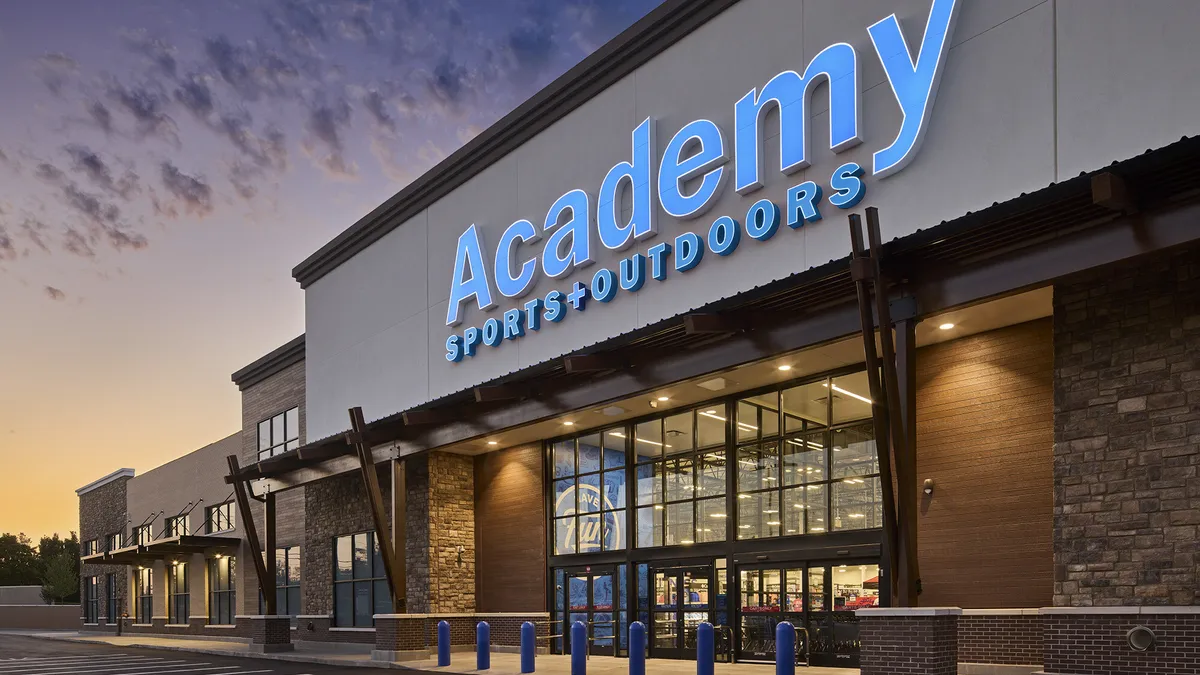
- Academy Sports and Outdoors has “no regrets” associated with its move to frontload inventory in the first two quarters of the year, EVP and CFO Earl Ford told analysts during a Dec. 9 earnings call.
- Because inventory was pulled into the retailer’s warehouses and distribution centers prior to President Donald Trump’s new tariffs, Academy Sports and Outdoors was able to price a lot of those items at last year’s level, Ford said.
- “We feel really good about our ability to hold that inventory to lower cost and offer that to our consumers, and that's resonating from a value perspective,” Ford said.
Dive Insight:
Ford said it was “sweaty knuckles” in the first part of the year as Academy Sports and Outdoors tackled elevated inventory levels. However, inventory balance has improved throughout the year.
“In the first two quarters, we pulled forward inventory to minimize duties and those payables came due in Q3,” Ford told analysts.
Units per store were up 6.5% year over year in the first quarter before dropping to 4.6% YoY in Q2, per Ford. As of Nov. 1, per-store units are down 0.3% compared to last year.
Ford added that the retailer saw good sell-through of the frontloaded product and has an upbeat inventory outlook for the holidays and the end of the fourth quarter. He further noted that the company chose to allocate capital to manage inventory instead of repurchasing shares during the quarter.
“These decisions have allowed us to appropriately manage our inventory position and risk during this period of heightened uncertainty,” Ford said.
However, price hikes are still coming, CEO Steven Lawrence told analysts, but it will vary depending on the category.
“We've got some categories in [the] front end where I would say that it's been fairly inelastic,” the CEO said. “We've taken prices up, and there's been no resistance to that.”
Ford further noted that changing prices on the store floor and in a distribution center is “very disruptive” and costly.
“We feel that if there's no significant changes to the tariff structure, we've reset the floor, reset the inventory in the distribution center so we can run a little bit more efficiently next year,” Ford said.
Shippers and retailers have been advancing cargo shipments in an attempt to skirt tariffs throughout the year, causing a wave of activity at ports. In July, for instance, the Port of Los Angeles recorded its highest single-month of handled cargo volumes as shippers hurried to stockpile inventory ahead of tariffs that were set to go into effect in the summer.
Academy Sports and Outdoors’ decision to pull forward $85 million worth of evergreen receipts — like weights or bicycles — in Q1 was just one lever in the retailer’s multipronged tariff strategy. The company also shifted its sourcing network and paused cargo out of China before selectively resuming shipments.
Another sports and activity retailer, Sportsman’s Warehouse, also decided to pull receipts forward to battle tariffs. During an earnings call in June, CEO Paul Stone told analysts that the retailer frontloaded $20 million worth of goods in categories such as hunting, fishing and camping.