Artificial intelligence is proliferating across supply chains, and even as companies recalibrate their strategies after years of hype, the trend is nowhere near slowing down.
Retailers, manufacturers and logistics providers alike see the potential benefits of AI applications for improving visibility, resiliency, planning, compliance and inventory management — and that’s just the tip of the iceberg.
Here’s a look at several ways companies are embedding AI technology into their operations and how the trend is altering supply chain management.
Hormel modernizes supply chain with AI planning platform
The branded food company is using o9’s forecasting tools to model demand drivers, reduce manual overrides and sharpen seasonal forecast accuracy.
By: Antone Gonsalves• Published April 6, 2026
Hormel Foods has implemented artificial intelligence to sharpen demand forecasts and strengthen supply chain operations.
The branded food company deployed AI by installing o9 software between March and December 2025, according to a press release from the technology vendor. The deployment spans more than 70 sites across dry and refrigerated networks.
"By connecting demand, supply, and inventory decisions in one streamlined platform, we are shifting from reactive problem-solving to more proactive, data-driven planning," Hormel Chief Supply Chain Officer Will Bonifant said in the release. "We believe this will strengthen our ability to operate consistently, serve customers more reliably, and ultimately, drive additional growth across our brand portfolio.”
Bonifant joined Hormel in March 2026, having previously served as VP of manufacturing, engineering and supply chain strategy at Hershey.
Hormel manages thousands of distinct items across a portfolio that includes brands such as Spam, Applegate and Planters, the release said. The portfolio spans refrigerated foods, shelf-stable grocery products, deli meats and ethnic cuisines.
Taken together, those product lines create complex planning variables, including perishability, seasonal demand spikes, capacity constraints and multi-tier distribution flows, o9 said.
Hormel declined to comment for this story, but in a Dec. 4 earnings call, President and Director John Ghingo said the company was implementing AI-enabled tools like o9 and streamlining processes including integrated business planning.
"Enhanced data access, cutting-edge technology and modernized workflows are reinventing nearly every aspect of our business, across all aspects of our supply chain, cross-functional collaboration and all the way to the physical and digital shelf," Ghingo said.
Hormel is leveraging o9's forecasting intelligence to model key demand drivers, cut back on manual overrides and improve forecast accuracy for seasonal demand, the technology vendor said.
Hormel uses other features in the o9 platform, such as system-recommended inventory transfers and truckload optimization based on weight, volume and stackability constraints, according to the software maker.
Beyond logistics, Hormel planners can evaluate the software’s demand signals to synchronize supply, inventory and deployment decisions and evaluate trade-offs earlier in the planning cycle, o9 said. This improves visibility and alignment across Hormel’s retail, foodservice and international segments.
o9 deployed the software at Hormel's sites with consulting firm Accenture. The latter is helping the foodmaker execute a "growth-oriented pivot from a supply-led value chain to a demand-driven value chain," Adheer Bahulkar, global supply chain lead for consumer industries, said in the release.
Hormel is among a growing number of large enterprises using AI‑driven forecasting to anticipate demand. Gartner, a technology research and advisory firm, projects 70% of similar organizations will adopt such tools by 2030.
Article top image credit: Justin Sullivan via Getty Images
Nestlé upgrades ERP system to set stage for AI, automation
The food and beverage giant will embed SAP’s AI-powered assistant into its business systems.
By: Antone Gonsalves• Published Nov. 4, 2025
Nestlé has completed the first phase of a cloud-based SAP S/4HANA deployment, rolling out the enterprise resource planning software upgrade across 112 countries and 50,000 employees, according to a press release from October 2025.
The installation, which will take two more years to complete, will embed SAP's AI-powered assistant into Nestlé's core business systems, per the release. The company expects the added intelligence to improve procurement, supply chain management and order fulfillment efficiency.
"With the upgrade, we gain more flexibility, capabilities and insights that will help us roll out new products globally faster to meet the needs of our customers and consumers," Chris Wright, CIO and head of Nestlé IT, said in the release.
With the deployment of a more AI-focused ERP system, Nestlé expects more advanced order fulfillment that matches supply and demand in real time for in-store and online retailers. Other upgrade advantages include consistency across reporting and planning processes, along with automated and standardized procurement procedures, according to the release.
“Nestlé has not been the most efficient company in the past," CEO Philipp Navratil told investors in October 2025l, adding that the organization wants to speed decision-making through more digitization and automation.
Nestlé’s upgrade comes as the company aims to reduce costs by cutting 16,000 jobs, or 6% of the global workforce, over the next two years. Three-quarters of the cuts will include corporate workers, with the remainder coming from manufacturing and supply chain staffing reductions.
The food and beverage maker is currently upgrading from SAP S/4HANA Finance, the legacy Enterprise Central Component ERP system on SAP HANA, an SAP spokesperson said in an email. SAP introduced ECC in 2004 and the finance component on the in-memory database management system in 2014. SAP plans to end mainstream support for ECC in 2027.
Nestlé migrated its entire SAP ERP from its data centers to the SAP Private Cloud in 2022, the spokesperson said.
Article top image credit: Courtesy of Nestlé
How AI is changing food supply chains
As consumer shopping habits evolve, experts say accurate and on-time deliveries have become more important than ever.
By: Laurel Deppen• Published April 15, 2026
After the pandemic spurred drastic changes to supply chains, resilience in logistics has emerged as a primary way food companies can win in today’s competitive environment.
Since the COVID-19 outbreak upended supply chains, disruption has become the new normal as companies continue to combat inflation, geopolitical uncertainty and other challenges. But food manufacturers face more challenges than other industries — most notably that food is perishable, so ensuring on-time deliveries is paramount.
Accurate and quick deliveries have become more important as the pandemic has shifted more shopping online. Consumers now receive their groceries through delivery platforms or set up subscription services where fresh food is sent directly to their home.
“[There] used to be very well-defined flow paths for companies – moving full truck loads and predictable numbers of goods across what used to be predictable lanes and transportation networks,"said Shri Hariharan, senior vice president of solutions for Blue Yonder, an AI-powered supply chain management platform. “Now, everything is subject to change, starting with the consumer and their expectations.”
For CookUnity, a chef-to-consumer meal delivery subscription service that delivers fresh, restaurant-quality meals, timeliness is paramount. The company taps chefs to prepare curated meals that are then delivered to consumers' doors. This requires precise delivery times and a focused logistics plan.
Aalok Kapoor, chief operating officer of CookUnity, said deliveries can "not be late," but they "can't be early either."
The food isn't frozen and doesn't contain preservatives to extend shelf life, so the company needs to take great pains to ensure a package isn't left at a consumer's doorstep and goes bad before they return.
CookUnity also needs to ensure products are temperature-controlled throughout the shipment process. This can require different packaging depending on the route, with heavier ice bags depending on the distance of the shipment.
The temperature-controlled aspect of CookUnity's supply chain also makes it more important for the company to quickly react when there's a disruption in deliveries, whether it be a changed route or a delay.
"Things happen on the route, which, if you're delivering toilet paper is fine," Kapoor said. "If you're delivering food, it's a problem."
Artificial intelligence has become a key tool to navigate supply chain disruptions. Technology can forecast a wide range of scenarios that companies can use to inform their logistics. Hariharan is seeing more companies use AI as a "copilot" to help humans do their jobs.
Among other things, AI can alert logistics teams when there are disruptions on a route or identify new shipping opportunities, Hariharan said. More companies are teaming with non-competing firms to share space and avoid deadheading, or when a truck drives with an empty trailer, often after delivering product.
CookUnity has been utilizing AI to predict sales and potential stockouts, according to Kapoor, which allows the company to work backward and set up its logistics plan. Prior to AI, the company could predict 50% to 60% of sales. Now, its forecast is 80% to 90% accurate.
“The fidelity of that forecast has never been higher in our history,” Kapoor said.
But AI also allows CookUnity to better respond to consumer feedback. An AI agent can scan reviews and inform the supply chain team that a certain product isn't performing well, which the company can use to inform discussions with its suppliers and make changes if needed.
"There's just less guesswork now," Kapoor said.
Article top image credit: Laurel Deppen/Supply Chain Dive
WD-40 deploys AI in supply chain, business processes
The household chemicals company is implementing Microsoft Dynamics 365, Salesforce and Atlas.
By: Antone Gonsalves• Published April 22, 2026
WD-40 is leveraging artificial intelligence across parts of its business to improve efficiency and augment decision-making, CEO and President Steven Brass said on an earnings call on April 9, 2026.
As part of that push, the household chemicals company is deploying AI-enabled platforms such as Microsoft Dynamics 365, Salesforce and Atlas, Brass told investors.
"Our goal isn't just personal efficiency; it's rethinking processes across the business," Brass said.
WD-40's Dynamics 365 enterprise resource planning system currently operates in the U.S., Latin America and Asia distributor markets and parts of Canada, Brass said. Collectively, the areas represent about half of the company's global revenue.
The Atlas system, which is a supply chain planning platform by John Galt Solutions, has yet to be rolled out globally, a company spokesperson told Supply Chain Divein an email.
In line with these technology efforts, WD-40 lists productivity-driving enhanced systems as critical elements within the company's strategic framework, according to a 2025 securities filing. Also, WD-40's future success may increasingly depend on having enough skilled workers in AI, machine learning and other emerging technologies, the document said.
AI is playing an increasingly important role in improving the effectiveness of business processes within CPG companies. For example, Hormel Foods implemented the technology to sharpen demand forecasts and bolster its supply chain, and PepsiCo is using AI in a multi-year remake of its plant and supply chain operations. Unilever is also using it to strengthen inventory management and forecasting capabilities.
Article top image credit: Scott Olson via Getty Images
Walmart deploys sensors to boost inventory tracking, AI efforts
The retail giant is growing its collaboration with Wiliot to strengthen pallet-level monitoring from distribution centers to stores.
By: Max Garland• Published Nov. 4, 2025
Walmart has deployed inventory-tracking sensors across its supply chain through a collaboration with Wiliot, providing more data for the retailer's artificial intelligence push.
Data from Wiliot's ambient Internet of Things sensors aim to help Walmart improve its supply chain efficiency, inventory accuracy and cold chain compliance via real-time insights into stock levels and locations, according to a news release from October 2025.
The sensors provide automated alerts and reduce manual tasks for employees, per the release. They are currently deployed across 500 Walmart stores, with a national expansion covering 4,600 retail locations and 40-plus distribution centers planned for 2026.
Millions of Wiliot sensors, called Pixels, are already deployed on pallets moving from distribution centers to stores throughout Walmart's supply chain, said Julien Bellanger, Wiliot's president, in an interview with Supply Chain Dive. The company eventually aims to enable tagging at the case level for Walmart, rather than the pallet level, so the retailer can track inventory in an even more granular fashion, he added.
An image of Wiliot's ambient Internet of Things sensor.
Courtesy of Wiliot
The sensors are particularly helpful in cold chain applications, such as making sure produce is quickly moved to a cooler once it reaches a store, according to Bellanger. They also provide automatic signals that make it easier to know where a pallet is in real time.
"Positive confirmation of receipts in supply chain, as you know, is very important," he said. "No manual scanning, no paper trail, just a signal that is automatically created based on real data, and that both the supplier and Walmart will capture eventually."
Wiliot's sensors feed inventory data into Walmart's AI systems. The collaboration comes as Walmart scales up its use of AI in its supply chain, with inventory management being a key focus area for the technology.
"With Wiliot's ambient IoT technology, coupled with our AI systems, we're not only optimizing our supply chain to make faster, smarter inventory decisions, but we're also tackling one of the hardest problems in retail—knowing exactly what we own and where it is at any given moment," Greg Cathey, Walmart SVP of transformation and innovation, said in the release.
Article top image credit: Courtesy of Wiliot
Mango taps AI for sourcing quality, compliance
Using Inspectorio’s software, the retailer can digitize and standardize lab-testing analytics to drive supply chain improvements.
By: Kelly Stroh• Published Dec. 8, 2025
Retail brand Mango is now using Inspectorio’s Lab Test Management tool to gain supplier, material and product insights to optimize sourcing decision-making, according to a press release from Nov. 12, 2025.
The artificial intelligence-powered platform streamlines lab testing protocols across Mango’s product categories and digitizes the information into a standardized format, Antonio Leon de la Barra Rocha, VP of strategy, growth and innovation at Inspectorio, told Supply Chain Dive. Mango can now access the Lab Testing analytics, allowing it to drive supply chain improvements and support its long-term strategic sustainability plan.
“The platform helps Mango have a centralized view of ALL of their different testing operations,” he said in an email. “The platform serves to centralize different types of lab tests, sometimes executed by different labs, into a single system so that Mango can have greater control over one of the most important parts of their overall Quality and Compliance program.”
Implementation began in 2025, and thousands of Lab Tests have already been done, Leon de la Barra Rocha said. He further noted that while the first part of the rollout is complete, there is still “more work to be done” on exploring and expanding use-cases.
Previously, Mango had limited visibility over its end-to-end lab testing operations, essentially just receiving a completed report, Leon de la Barra Rocha said. The report would then be manually processed while Mango closed out any non-conformities with its suppliers.
“Now, they have visibility into the end-to-end process – from the test request creation through execution, report generation, and corrective action plan collaboration with suppliers,” he said.
Mango has been leveraging Inspectorio’s inspection capabilities — consolidating lab test requests, results and audit-ready compliance documents — for six years across hundreds of suppliers, per Leon de la Barra Rocha. Currently, Mango manages 100% of its inspection programs with the software company, including third-party inspections and factory self-inspections. Mango also uses Inspectorio’s performance analytics to reduce supplier quality defects and costs.
“We see this latest announcement as just the beginning of our expanded collaboration with Mango,” Leon de la Barra Rocha said. “Now that key product compliance information is on the platform, we're looking into seeing how we can further support Mango across other areas like supplier and factory onboarding and management, WIP monitoring, strategic sourcing and beyond.”
Article top image credit: Courtesy of Mango
AI’s influence on shoppers ups importance of inventory positioning
Consumers’ desire for speed and convenience in online shopping lends an edge to regional distribution models, experts said.
By: Antone Gonsalves• Published Feb. 6, 2026
Consumer proximity to a company's distribution network will offer an edge for retailers in an online shopping environment more heavily influenced by artificial intelligence, experts said during a Supply Chain Dive and Retail Dive virtual event on Jan. 28, 2026.
Convenience and speed remain important factors in delivery for online shoppers, Rupal Deshmukh, a partner in the strategic operations practice at global management consulting firm Kearney, said.
Also, AI service providers like OpenAI, the developer of ChatGPT, are changing shopper behavior by making last-minute purchases more likely, Deshmukh said. For example, ChatGPT could suggest ways to solve a user problem, such as getting rid of gnats on house plants, leading to an immediate purchase.
"From a supply chain perspective, what it means is ensuring any changes you're making on the supply chain side are as close to the customer as possible," Deshmukh said, advising companies to have AI-driven shopping as a factor in demand forecasting, so inventory can be in the most effective locations.
Except for last-mile delivery, transportation costs have been fairly depressed over the last two years, enabling cost-effective positioning at the regional level, Rick Jordon, senior managing director at FTI Consulting, said at the event.
"We've definitely seen that strategy change a little bit, but you know, all you need is a couple of ticks in transportation cost, and that inventory push will go back to more forward deployment versus perhaps regional deployment," Jordon said.
As inventory placement strategies evolve, companies have focused on reducing the total supply chain cost per case through distribution center automation, Deshmukh said, citing Walmart as an example. More than 60% of Walmart's U.S. stores receive a portion of their freight from automated fulfillment centers, the retailer reported.
Overall, supply chain strategies must take into account consumers' preference for speed and convenience, Deshmukh said.
"Supply chains can't afford to be way behind what's changing with the consumer, more in this day and age than before," Deshmukh said.
Article top image credit:
Antone Gonsalves/Supply Chain Dive
How UPS is using AI, from shipper pricing to customs clearance
As the carrier embraces AI and data analytics across its operations, it’s training employees on how to better wield new technologies, a UPS executive said.
By: Max Garland• Published April 6, 2026
UPS' network isn't just powered by employees, trucks and planes. The company has spent years investing in its artificial intelligence and data analytics capabilities, helping the carrier anticipate and limit disruptions like customs and weather-related hangups.
"As we curate better data, AI can actually help us turn faster decision-making into better experiences for all those customers on the receiving and shipping end of the movements," Mallory Freeman, UPS president of global enterprise data analytics and generative AI, said in an interview with Supply Chain Dive.
UPS prioritizes collecting data that's "clean and accessible for our AI systems to remember," and uses that data to inform possible network adjustments during challenging periods like peak season or inclement weather, according to Freeman. UPS tests the impact of its planned routing adjustments via digital twin technology, simulating how the decision will affect package flows before the carrier implements it in the real world.
"So it's the right data, the right processes, and then the right ability to make decisions, simulate those decisions and make adjustments, especially as conditions change," Freeman said.
AI helped UPS adapt to post-de minimis era
AI has played a hand in how UPS navigates changes in global trade policies like new tariffs, helping the carrier move shipments across borders faster. For example, UPS uses AI and machine learning to ensure imports abide by the correct Harmonized System product classification codes, tariff rules and policies, Freeman said.
"It's extremely challenging to embark on these historic changes without compromising service. But that's really just what we do. We roll up sleeves and get after it."
Mallory Freeman
UPS president of global enterprise data analytics and generative AI
The company's capabilities came in handy particularly when the U.S. de minimis exemption was eliminated in August 2025, which resulted in more formal customs clearance processes for low-cost packages. In March 2025, UPS cleared about 21% of 13,000 U.S.-bound packages without manual intervention on a daily basis, CEO Carol Tomé said on a Q3 earnings call in 2025. In September 2025, the carrier cleared 90% of 112,000 daily packages with no manual intervention.
"To manage the increased volume and complexity, we enhanced our customs brokerage capabilities by integrating Agentic AI," Tomé said. "This advanced technology streamlined formal entry processes."
Tapping AI to maintain reliable shipping flows will be critical for UPS as it navigates global trade upheaval and a U.S. network overhaul driven by reduced package volume from major customer Amazon. The carrier remains focused on how it can creatively leverage and synchronize its range of tools to ensure delivery reliability isn't compromised for its 10 million-plus customers, according to Freeman.
"It's extremely challenging to embark on these historic changes without compromising service," Freeman said. "But that's really just what we do. We roll up sleeves and get after it."
UPS leverages AI for pricing edge
One area UPS has leveraged AI and data analytics in for years is pricing, said Freeman, who described it as "both a science and art" involving the company's technology and sales team. For example, UPS salespeople use tools like Deal Manager, which provides real-time pricing guidance, to boost customer win rates and draw in more revenue.
"Today, the deal is scored through generative AI," Tomé said. "And the salesperson can watch the score as they're negotiating the terms and conditions. And get this, our win rate is higher and our discounting is lower than it was."
Employee upskilling a UPS priority
UPS continues to explore ways technologies like AI can speed up processes or handle currently manual tasks for employees, Freeman said. At the same time, UPS is investing in upskilling its workforce globally through learning development programs, with the goal being for employees across the company to confidently use data analytics and AI as their role evolves, Freeman said.
"The right technology and the right people involved in that technology means that we can actually get to better customer service, better experiences for our customers, better outcomes," Freeman said.
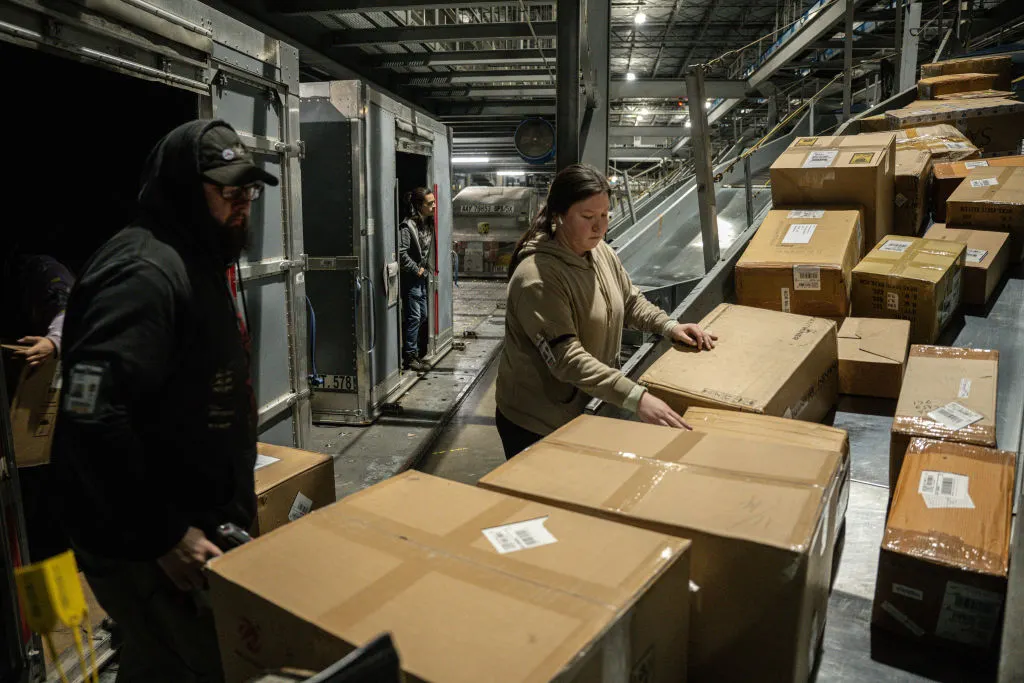
UPS employees load boxes at UPS Worldport on Jan. 3, 2022, in Louisville, Kentucky. The carrier has leaned more on automation in its network as it pursues cost savings.
Jon Cherry/Getty Images via Getty Images
Upskilling has been on UPS' mind as the company overhauls its network and leans more on automated sortation processes. During the Digital Supply Chain Institute conversation, Tomé said UPS' vision is to have some of its sortation centers powered by robots and featuring automated sorting, bagging and label application capabilities.
"Coupled with that is the opportunity to upskill our people and create opportunities for them to do different kind of work," Tomé said. "And I'm excited about that, too, because someone's going to have to oversee the robots."
The carrier isn't alone in upskilling employees for the AI era. Rival FedEx has invested in an AI fluency program for 300,000 employees, including advanced training for all of its technology specialists, Vishal Talwar, FedEx EVP and chief digital and information officer, said at the company's 2026 Investor Day.
UPS and FedEx's push to improve workers' skillsets could help both carriers succeed in implementing AI at a wider scale. Investing in employee upskilling is critical for companies looking to drive operational improvements with AI, said Alan Amling, an assistant professor of practice at the University of Tennessee, Knoxville, in an interview. However, many organizations are focusing their investments on the AI systems themselves, rather than distributing money more evenly between the technology and training for employees to wield AI effectively.
"They're spending money on AI systems but not spending the money on change management, on upskilling employees, and that's probably where I see the biggest issue," said Amling, who formerly served as UPS' VP of corporate strategy.
Article top image credit: Courtesy of UPS
FedEx’s next AI leap to feature RFID, robotics
The carrier is scaling its use of physical assets powered by AI to strengthen network reliability and improve connectivity with shippers, a FedEx executive said.
By: Max Garland• Published April 1, 2026
FedEx plans to further scale its use of AI over the next several years to power physical assets like RFID sensors and robotic systems, an undertaking that aims to boost network reliability and shipper connectivity.
AI and data analytics are already embedded in various FedEx operations, including forecasting, routing and capacity management. Every day, FedEx plans and optimizes 100,000 first-mile and last-mile transportation routes via AI, according to Bala Vaidyanathan, VP and lead for data and AI at FedEx. The company also uses AI to balance its middle-mile network to ensure airplanes and trucks travel as full as possible, Vaidyanathan said in an interview with Supply Chain Dive.
But the carrier's AI journey is far from over. By 2028, FedEx plans to have AI integrated into more than 50% of its core operational workflows, Vishal Talwar, EVP and chief digital and information officer at FedEx, said during the company's 2026 Investor Day. Through its continued expansion of AI use, FedEx aims to improve service, trim costs and boost its competitive standing, Talwar said.
FedEx is advancing toward its integration goal by ensuring AI is embedded in the process of how it executes wide-ranging initiatives like Network 2.0, Vaidyanathan said.
"It's not like a side project," Vaidyanathan said of AI. "It's the main show, right? It becomes a part of how you deliver on these programs, because that's the right way to do it."
Through Network 2.0, the carrier is bringing day-definite volume from FedEx Ground and time-definite volume from FedEx Express into the same network. Amid this overhaul, which is combining FedEx's historically separate Ground and Express operations, the carrier still needs to ensure packages get delivered on time, a task AI is helping with.
"As you put the end of day volume together with the time commit volume, you need AI systems that can help people plan and execute the network, and that's something that we have deployed at scale," Vaidyanathan said.
FedEx eyes expanded use of sensors
As part of its increased AI focus, FedEx aims to make the technology more prevalent in its physical operations. Vaidyanathan said that “physical AI” capabilities such as RFID sensors and robotics will be key in sharpening reliability and efficiency.
For example, FedEx is testing RFID sensors on select customers' packages and plans to scale deployment over time, Vaidyanathan said, a move that aims to expand the scope of the carrier's visibility.
Rival UPS has also been expanding its RFID capabilities in order to drive increased shipment visibility. For FedEx, the goal with RFID sensors is to improve the flow of information between shippers' supply chains and the carrier’s operations while aiding its data platform, Vaidyanathan said. The platform allows FedEx to organize information generated in its processes, such as scans of package labels, to help employees solve operational issues or gain a better understanding of the company's network.
“So think of a platform as an investment that keeps giving, and the way it keeps giving is by generating a flywheel of use cases,” Vaidyanathan said.
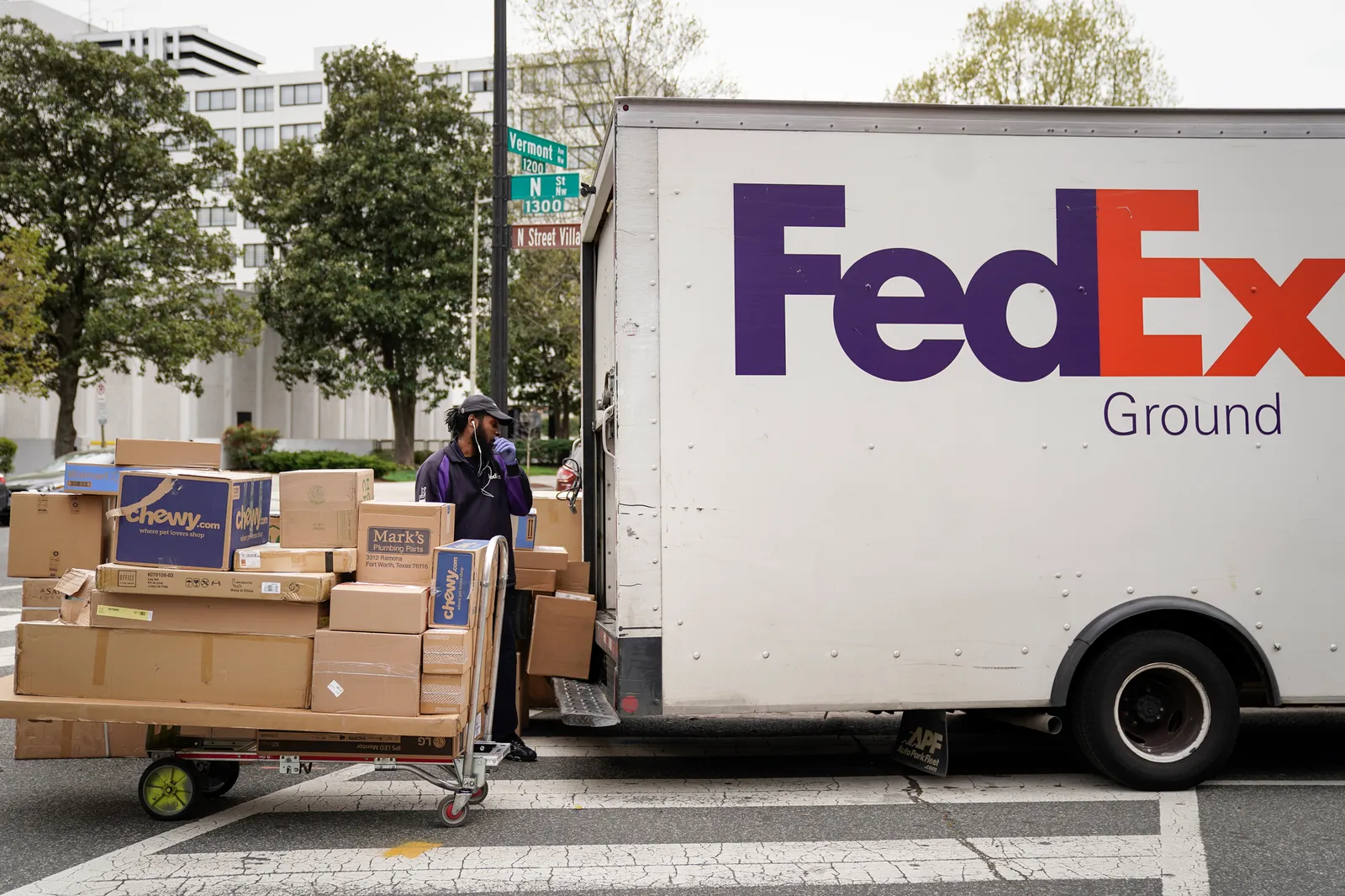
A FedEx worker unloads packages from a delivery truck on March 31, 2020, in Washington, D.C. FedEx leans on AI and data analytics throughout its operations, including for optimizing delivery routes.
Drew Angerer via Getty Images
Additionally, separate sensors used in FedEx's sortation operations combined with AI models help enable predictive maintenance, identifying issues in package sortation systems that need to be fixed before a failure occurs and slows down the network, Vaidyanathan said.
FedEx's predictive maintenance platform, MOBIUS, has prevented 17,000 hours of potential downtime in its deployment across 41 surface operations facilities, per a press release from March 30. The platform is designed with a roadmap for a full rollout across FedEx's industrial network.
"By combining rich sensory data with proprietary AI models, we can anticipate equipment failures in our sorting systems before they occur," Talwar said. "This shift is already saving us $10 million annually, and our goal is to scale it significantly across our network and set a new standard of service."
FedEx taps AI-powered trailer unloading tech
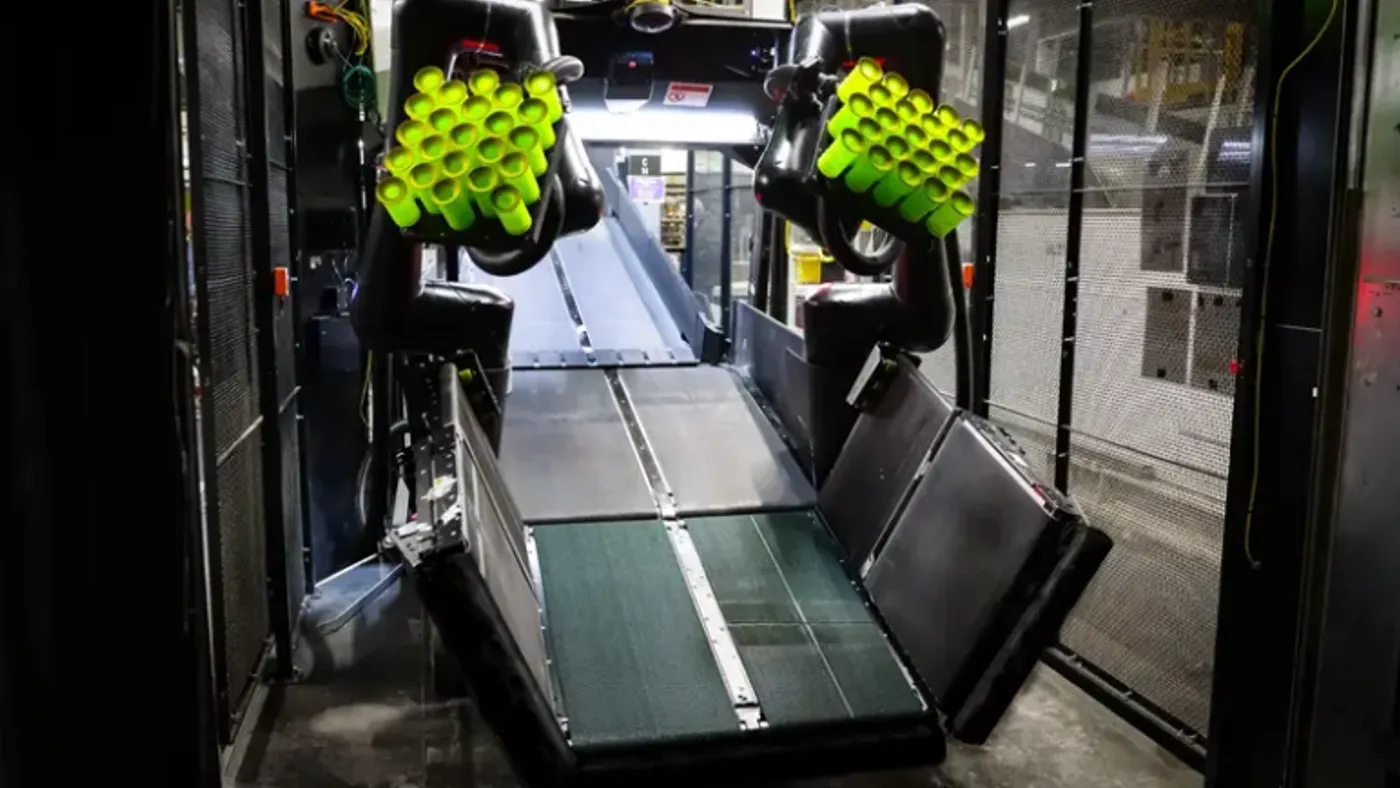
FedEx also plans to scale the use of automated trailer unloading and loading capabilities over the next few years, bringing the AI-powered technology to thousands of dock doors in more than 20 U.S. hubs, Kawal Preet, EVP of planning, engineering and transformation, said during the 2026 Investor Day.
That work has already begun. The company announced in February 2026 that it would use a robotics system from Berkshire Grey to autonomously unload trailers in its operations starting later in the year, enabling a consistent inbound flow of parcels.
"We're also testing autonomous trucking technology in the middle mile linehaul where it is safe and practical," Preet said. "These are the types of solutions that mark a step change in how we move and process volume."
Predictive tools help FedEx avoid delays
Outside the walls of its own facilities, adverse weather is an obstacle FedEx navigates with the help of technology advancements. The company uses predictive analytics to flag potential issues, such as transportation congestion or inclement weather, and generate rerouting suggestions before delays cascade into customer issues, Scott Ray, COO-elect for U.S. and Canada surface operations, said during the 2026 Investor Day.
"For example, when severe weather hits or there's an unplanned disruption, we can increasingly rebalance volume across routes and assets rather than reacting after the fact," Ray said. "We can shift volume between air and surface, between lanes and between facilities to protect service and reduce cost."
Even with FedEx’s improved capabilities, weather-related network adjustments may still require several people working in tandem to plan and implement any changes, Vaidyanathan said. In the future, agentic AI could handle some of that work and present recommendations to employees on what adjustments need to be made at the FedEx Memphis World Hub and beyond.
"We can also scale this horizontally," Vaidyanathan said. "Instead of deploying it just at Memphis, we can apply it at any node in the network. You can deploy it for any kind of weather, not just the worst kind of weather.”
Article top image credit: Courtesy of FedEx
The uses of AI in supply chain management
Shippers and other stakeholders across the supply chain are looking toward AI to position their businesses for success ahead of potential disruption. Whether it’s warehouse automation, predictive analytics or improved delivery times, here are some of the ways supply chains are leveraging AI technology to optimize operations.
included in this trendline
Hormel modernizes supply chain with AI planning platform
How AI is changing food supply chains
WD-40 deploys AI in supply chain, business processes
Our Trendlines go deep on the biggest trends. These special reports, produced by our team of award-winning journalists, help business leaders understand how their industries are changing.